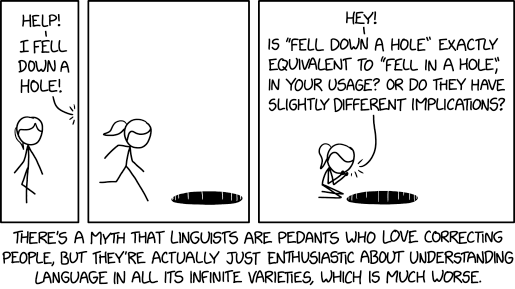

I feel slightly offended. Because it’s true.
(Alt text: “Do you feel like the answer depends on whether you’re currently in the hole, versus when you refer to the events later after you get out? Assuming you get out.”)
I think people who think that know more pedants than linguistics and either confuse the former for the latter, or when they meet a real linguist, the linguist’s questions sound on first glance like the pedant’s ones they are uses to. But I have no empirical data to prove my point
deleted by creator
I feel like I’d use “Fell in a hole” if I took up most of the space of the hole, and could probably get out on my own, while I’d use “Fell down a hole” if I took up very little of the space of the hole, and couldn’t get out on my own.
deleted by creator
I could say “I fell in a hole” to mean either case (I was in or out of the hole beforehand), but for “I fell into a hole” I would only use it when starting outside the hole. (native speaker)
Like on the one hand it could mean “I fell [while I was] in the hole”
But it could also mean “I fell [and then I was] in the hole”
Agreed. I feel like the dimensions of the hole is relevant. Like if it has to be wider than it is deep to fall in. But it be needs to be deeper than is wide to fall down into.
And maybe the hole has to be at least wide enough that you can lie horizontally in to fall in it? Not sure about that though. But when falling down a hole, that definitely doesn’t matter. The hole has to be deeper that I am tall for me to fall down it, horizontal width doesn’t matter, it’s all about the vertical in that case.
Similar for me - I think the depth of the hole matters more? It would sound odd to say “I fell down a pothole”.
Meanwhile in Swedish, leaving out either word would sound super wrong. I fell down in a hole.
As a non-native speaker, wouldn’t falling in the hole be the act of crossing the opening, and falling down the hole be the rest of the way?
As a native speaker, that makes sense, but they still both sound interchangeable.
Edit: In this situation, anyway. Other people are pointing out that “down a hole” wouldn’t work if it was a hole you couldn’t actually be “inside of”, like a pothole in a road. In that case “in a hole” would still be okay, as it’s a partial kind of “in” like water in a dish.
The pragmatics of the sentence in the comic is that the person is in/down the hole, and this is not a normal state of affairs. The exact sort of envelopment isn’t emphasised, and I imagine the choice would come down to exact idiolect. I’d say “down”, I picture someone from another province or old for “in”.
“Down” definitely implies vertical entry, although it could be an abstract downwards, like “he’s further down the tunnel” - an entry is imagined as being at the top by default.
As a native English speaker, I had no idea going into this discussion, but that sounds like a pretty good explanation!
Now, is there a difference between falling down and falling into the hole?..
I would have guessed that into and in are interchangeable for this case, at least in US English. But in other contexts into is a direction, in is a position.
Falling into it includes the travel time (potentially from a great height), whereas in mostly pertains to the end state?
That would mean into and down refer to different parts of the falling timeline.