You must log in or register to comment.
0%
The only winning move is not to choose
This is a conundrum wrapped in a turducken, swaddled in nesting dolls.
lol chill out there buddy it is only self-referential once. maybe twice.
I’m not certain, I think it’s an infinite loop.
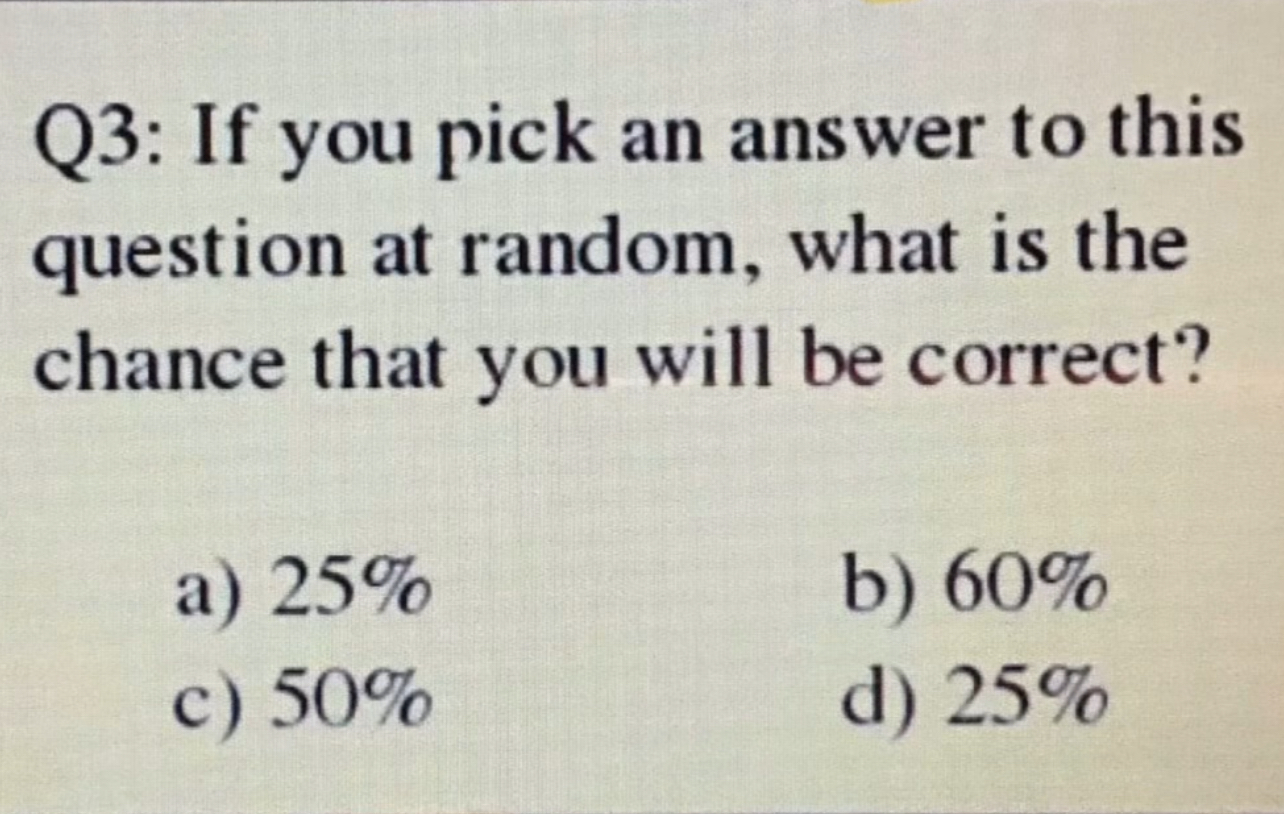
I.E. If the answer is 25%, you have a 50% chance, if the answer is 50%, you have a 25% chance, if the answer is 25%, you have a 50% chance…
The only way out is to choose 60% to accept defeat
Haha, I think they should have made that option 0%, to further the paradox
Yeah, that’s right. https://en.wikipedia.org/wiki/Paradox
B.
This is a multiple choice test. Once you eliminate three answers, you pick the fourth answer and move on to the next question. It can’t be A, C, or D, for reasons that I understand. There’s a non-zero chance that it’s B for a reason that I don’t understand.
If there is no correct answer, then there’s no point hemming and hawing about it.
B. Final answer.
Entertaining response but I disagree.
I’m going to say that unless you’re allowed to select more than one answer, the correct answer is 25%. That’s either a or d.
By doing something other than guessing randomly (seeing that 1 in 4 is 25% and that this answer appears twice), you now have a 50% chance of getting the answer correct. However, that doesn’t change the premise that 1 in 4 answers is correct. It’s still 25%, a or d.
That’s an interesting perspective. The odds of correctly guessing any multiple choice question with four answers should be 25%. But that assumes no duplicate answers, so I still say that’s wrong.
I’m going to double down and say that on a real life test, this would likely represent a typo. In such case, I think you could successfully defend a 25% answer while a 60% answer is just right out the window, straight to jail.
The typo makes the answer incorrect. The whole question would need to be thrown out.
Fair enough
But some tests award bonus points if you get the thrown out question right by answering what it should have been!
Nice logic; poor reading comprehension.
Does better reading comprehension get you a better answer?
No of course not, but the question is more important to the answer than the “correct” answer.
Not in a multiple choice test
This isn’t a test. It’s a logic puzzle.
It’s not a puzzle. It’s just wrong.
“Which of the following is a mammal:
A) rock
B) time
C) verb
D) Enui”Is not a puzzle.
Based on previous guy’s logic: D.
I know A, B, and C are definitely wrong, but I’m not sure I fully understand D. So it’s D and move on.
Reality is I make a note and discuss with the teacher if they don’t notice themselves when tests come back.
You think like I do. Bet you test well.
I love this, it shows how being good at (multiple choice) tests doesn’t mean you’re good at the topic. I’m not good at tests because my country’s education system priorities understanding and problem solving. That’s why we fail at PISA
33% innit
iis
It is 33% if the answer itself is randomly chosen from 25%, 50%, and 60%. Then you have:
If the answer is 25%: A 1/2 chance of guessing right
If the answer is 50%: A 1/4 chance of guessing right
If the answer is 60%: A 1/4 chance of guessing right
And 1/3*1/2 + 1/3*1/4 + 1/3*1/4 = 1/3, or 33.333…% chance
If the answer is randomly chosen from A, B, C, and D (With A or D being picked meaning D or A are also good, so 25% has a 50% chance of being the answer) then your probability of being right changes to 37.5%.
This would hold up if the question were less purposely obtuse, like asking “What would be the probability of answering the following question correctly if guessing from A, B, C and D randomly, if its answer were also chosen from A, B, C and D at random?”, with the choices being something like “A: A or D, B: B, C: C, D: A or D”
This is a paradox, and I don’t think there is a correct answer, at least not as a letter choice. The correct answer is to explain the paradox.
You can rationalize your way to exclude all but a last answer, there by making it the right answer.
Like, seeing as there are two 25% options, so there aren’t four different answers, which means there isn’t a 25% chance. This lead to there only being two options left 50% or 60%. This would seem to make 50% the right answer, but it’s not, because you know the options, so it’s not random, which in turn means you’re not guessing. So you have more that 50% chance of choosing the right answer. So 60% is the closest to a right answer, by bullshitting and gaslighting yourself into thinking you solved question.
Having been to school I know a teacher did not read this question so tge answer is probably A, B, C, or D. Chosen randomly of course. But you will get credit for 3/4 answers as long as you take the time to talk to the teacher during office hours.
Selecting not at random, A xor D must be correct, because the answer key can only have one correct answer so even duplicate right answers must also be wrong.
It asked for whether the answer is correct not whether it lines up with the answer sheet.
The answer is not available. The answer is 0 Percent. Each answer, if chosen, would be incorrect. If 0% was an answer, it would be the correct one despite being a 25% chance. Of course, if one 25% was there, that would be the correct answer.
But if you did randomly choose the 0% option, you’d be correct. So if one of the possible answers was 0% the correct answer would be 25%.
But it wouldn’t be correct, so 0% would remain the answer.
@SculptusPoe @FaceDeer *Schrödinger’s cat enters the box*
The point is that it can’t be the answer if it’s an option.
But the teacher can’t mark it wrong, making it right.
Yes, they can. That’s the problem with it being an option.
If they mark it wrong, and all the others, if chosen, are wrong, then your answer was right and they would have to fix their mistake. That wave collapses to there being 0% chance of being right.
Ahhhhhhhhhhhhhhhhh
There’s a reason I dropped probability at school.
Yes
42
But what’s the question?
how many roads must a man walk down?
What is six times nine
Close, but nah, it’s the meaning of life
nuh uh, it’s the answer. to life, the universe, everything! Um, but what’s the question?
Pick a number. Any number.
Damn hitchhikers.
It’s probably graded by a computer, and a) or d) is a fake answer, since the automated system doesn’t support multiple right answers.
I’m going to go with 25% chance if picking random, and a 50% chance if picking between a) and d).
If it’s graded by a human, the correct answer is f) + u)Many systems do allow multiple correct answers.
Since two of them are the same, you have a 50% chance of picking something that is 33% of the possible answers. The other two, you have 25% chance of picking something that us 33% of the possible answers.
So 50%33% + 2 (33%*25%)= 33%
So your chances of being right is 33% cause there is effectively 3 choices.
But that one answer has a 33% larger possibility of being chosen by random, than the remaining two.
There is absolutely no way it is 60%. Because you can never have 60% chances of picking anything particular when there are only 4 choices. Knowing this, the answer is either 25% or 50%. Two effective choices, so the answer is C, 50%.
If C is the correct choice, then that is only one answer out of four that is correct, meaning you only had a 25% chance to answer correctly. You’ve created a logical paradox.
25% occurs twice, so in reality there are only 3 outcomes from your pick. Since you know 25% is incorrect from this, that is 30% of the total answers, but also 50% of total options. Via this, you can conclude that both b and c are valid answers, depending on whether you view it in relation to outcomes or in relation to options. If you view the 3 outcomes, then you have a 60% chance of being right, but if you view the 4 options, you have a 50% chance of being right. Both 50% and 60% being accepted as anwswers solves the paradoxical nature of the question.
the key word here is at random, you imagine a situation where you’re doing it at random, but you’re not actually answering randomly are you?
It was only the next day that I returned to this post realising that “this question” isn’t even defined.
This can also be used a great example of proof by contradiction: There is no correct answer in the options. Proof: Assume there was a correct answer in the options. Then it must be either 25%, 50% or 60%. Now we make a case distinction.
(A) Assume it was 25. Then there would be two of four correct options yielding in a probability of 50%. Therefore 50 must be the correct answer. -> contradiction.
(B) Assume it was 50. Then there would be one of four correct options yielding in a probability of 25%. Therefore the answer is 25. -> contradiction.
© Assume it was 60%. Since only 0,1,2,3 or 4 of the answers can be correct the probability of choosing the right answer must be one of 0% 25% 50% 75% or 100%. -> contradiction.
Because of (A), (B) and ©, it cannot be 25, 50% or 60%. -> contradiction.
Cheeky answer - the correct answer is a superposition of 25% and 50%, thus you answer it as a multiple choice question
©
because of copyright?