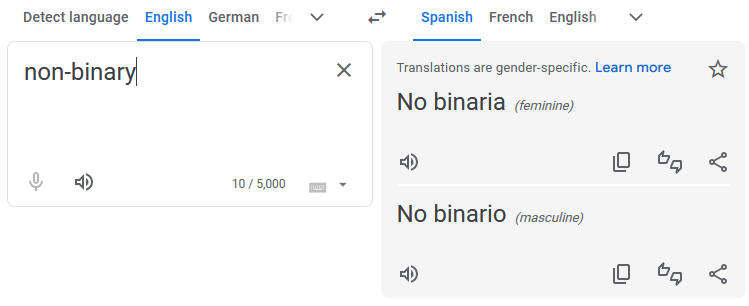

I believe they use “no binarie” if anyone’s interested.
I believe the Filipinos which have a lot of spanish grammar would substitute in English if the Spanish based grammar confused them
Filipinos ignore Spanish grammar entirely and only use Spanish words as roots. Their languages have nothing in common with Spanish and Spanish words only remain because they were occupied for 300+ years by Spain.
For example, “pants” in Tagalog (official dialect of the Philippines) is “pantalon” like Spanish, but the plural is “mga pantalon” due to Tagalog grammar, not “pantalones” as in Spanish (see also “oras,” which doesn’t indicate plural) #. They spell things differently because they don’t have a V sound (so vaca - > baka) and they conjugate with Tagalog rules, not Spanish (e.g. “intindi” meaning “understand” becomes “maintindihan” instead of “entienda/entiendas/entendamos”).
Spanish words are merely loan words in Tagalog, Filipinos don’t generally speak Spanish. Most don’t even know which words came from Spanish and which came from native Tagalog (or other Filipino languages) because they’re treated the same. If a word is not clearly understood, they’ll use the English, not Spanish, because most speak passable English and few speak Spanish.
Also, Filipino has no genders in grammar, the only gendered words are Spanish loan words. For example, uncle/aunt are tito/tiya from Spanish, but son/daughter is “anak,” and pronouns are “siya” (he/she), “niya” (his/her), “sila” (they/them), “nila” (they/them), “sa kanya” (to him/her), and “sa kanila” (to them). You have to go out of your way to specify gender in Tagalog, which awesome.
We do
That’s what the nonbinary Spanish speakers I know use in Latin American Spanish as well.
deleted by creator
I wonder whether linguists and others will gradually adopt calling them noun classes instead of genders.
I have a harder time believing we’d adopt a new term to supplant “gender” for human social roles, but stranger things have happened.
Especially in Spanish where “verb classes” already exist and have distinct, if subtle, rules (-ar, -er and -ir)
deleted by creator
deleted by creator
Spaniard here, you pretty much nailed it. -x makes no sense as it breaks like every rule about the Spanish language so I’ve never heard it outside of Americans trying to be correct. -@ works, but we pronounce @ as [aˈro.βa] so most would just pronounce it like a normal -a instead. -e seems the best to me but I don’t think I’ve ever seen that one before.
Another thing is that most Hispanics don’t think of gender in the same way that Anglos would, as its more ingrained in our language. Of course he have non-binary people here, but its just not as prevalent of an issue. At least that’s my experience in Spain
-x makes no sense as it breaks like every rule about the Spanish language
But every single change does that?
Over here in Germany conservatives keep yelling about similar efforts. As it stands, the most popular gender inclusive variant for referring to a group of people has become “[masuline form]*innen”
Take the word “student” for instance
- Student - singular, male
- Studentin - singular, female
- Studenten - multiple male students OR multiple male and female students
- Studentinnen - multiple female students
Since the generic masculine doesn’t acknowledge non-binary or female people, the following variant has started to spread:
- Student*innen - multiple students of ambiguous gender
When talking, you can differentiate it from the term “Studentinnen” by replacing the * with a short break. You’d basically say “Student…innen”.
Neither the *, nor this break is adhering to any established rules. But the main - or only - reason reactionaries oppose it is because they don’t want to acknowledge non-binary people.
Well that’s pretty much how Spanish works. We have estudiante but that normally ends with -e so we’ll use alumno as an example:
El alumno - single masculine
La alumna - single feminine
Los alumnos - multiple masculine or mixed group. As long as there’s at least one guy its masculine
Las alumnas - multiple feminine
So saying something like Les alumnes (seems like French lol) can sound more neutral than Los alumnos despite not being officially correct because los has an implied masculine connotation
i’m not a spanish speaker but christ -e just seems so obviously the best choice, it looks normal and seems to fit as well into the language as you can expect a new not 100% organic thing to do.
Yeah it just makes sense. Saying something like amigxs instead of amigos completely butchers the pronunciation. It would be pronounced something like ameeg-ek-eese but also the accentuated syllable would move from the i to the a. At least I think so, having that many consonants together is literally impossible in Spanish lol
meanwhile “amiges” looks broadly fine, could pass for being a weird dialect.
deleted by creator
-e is common in LatAm. I’ve never seen the -@ used. X just pisses me off because it only “works” in English, but sounds idiotic as well.
My nonbinary older sibling and I were learning Chinese together at one point, so I called them 哥姊 (gē jiê).
I speak Spanish with my wife and we use “no binari”.
So you speak Italian with your wife?
So I asked my Spanish speaking non-binary partner. They informed me it’s “muxe” in Oaxaca but Catholics pretend that the word doesn’t exist.
It’s apparently a south Mexico thing
You could use the term Latinx unless you mean you’re from Spain
Or just “Latin”. A word Latin Americans actually use. Really don’t need the X.
That only works in English sadly. The Spanish latino comes from the part of the Americas that spoke a Latin-based (romance) language. The Spanish Latín refers only to the language of Rome
Good thing almost nobody speaks Latin today, so it should be pretty clear what the intended meaning is.
Latinx is so stupid. Completely removed from the Spanish language. The real answer is Latine because that actually has some precedent in the language even if it wasn’t initially intended to be gender neutral.
I have only ever seen latinx used by white people being performatively anti-racist. Never seen it from an actual Latin American person.
Latine is also mostly used by the same group in my experience, though I have met one non-binary person from central America that self-described as such (though they also realized that Spanish is an inherently binary language and that doesn’t change overnight, so they just rolled with Latino when others called them that).
Personally, I think we should take a cue from the Pokémon Fandom, who use Lati@s to describe the pair of legendary Pokémon Latios/Latias. Though that has even less chance of catching on and my reasoning for it is even worse than performative anti-racism 😅
I have only ever seen latinx used by white people being performatively anti-racist. Never seen it from an actual Latin American person.
Now you have, I guess? Some people use Latinx in English and latine or latin@ in Spanish. Most don’t use either and just say Latino in English and Spanish. This whole “only white people do it” (who are never also Latino for some reason?? You can be both) thing isn’t something that makes sense to me.
Personally I don’t think its a question of ethnicity, but rather of language. Latinx works in English but makes no sense in Spanish
I mean, why not? There are Spanish words with an x in them that make basically the same sound as in English: extranjero, excelente—and while I’ll give you that those are at the middle of a word rather than the end, there’s even ex (as in ex boyfriend) that can just be used alone.
If you want to say it needs a vowel to make sense in Spanish, sure, throw an e in there for clarity.
It was invented by latinx math nerds on 90s chatrooms. It wasn’t designed to be spoken, it was designed to be a math joke.
Actually the problem is not that hard to solve unless you are trying to be deliberately obnoxious:
You say “no binario\a” depending to the noun it defines. It’s correct to say no binaria because it refers to a person (in spanish persona, female noun).
But it’s also ok to say no binario if you refer to a human being (ser humano in spanish, this one male noun).
Yes but if you’re not deliberately obnoxious how can you possibly signal to the world just how virtuous you are?
why do this instead of “no binarie”? according to others this is what actual spanish non-binary people do
Because not all the words that are gendered refer to a single gender. I understand when we change the last vowel to an e to add a non gendered version of a word that has both male and female forms (e.g. nosotros/as, spanish for “we”, would do great with a nosotres). But when the word itself is already non gendered (as persona, which although is considered female, refers to any person of any kind, because there is no male alternative) I don’t see a reason to do it.
There is no discrimination in referring to someone as a persona, since there is no “persono” word, so saying persona no binaria will offend only who wants to be offended.
No binarix?
No-binarie.
is that a new character in the asterix books?