Say hypothetically a really rich billionaire wants to donate/invest a lot of money to/in you what would be the best non crypto option to get that money since PayPal most bank accounts for that matter would stop and question you on it and probably wouldn’t believe it’s a donation?
You must log in or register to comment.
deleted by creator
It’s a scam. Do not engage. If a billionaire really wanted to send you money, they can pay for the lawyers and accountants to make sure it is all above board. Maybe they make a foundation and give you a cushy job there. That’s how actual billionaires do it. What you do with after is up to you (and your countries’ tax authorities, no doubt.)
Ironically, if it weren’t a scam, then crypto can be the safest way to receive any funds. If you securely generated your own crypto wallet, and sent him an address on a reputable blockchain to send funds to, and he actually sent them, then the money is yours, forever, no backsies.
Of course, that’s not how crypto scams work, either. They always guide you to use a wallet that they control (and can drain funds out of easily), or tell you to send crypto to them first to unlock something.
If they are willing to invest millions in me, they can fly their ass over to me and deliver it themselves.
I’d also be willing to fly out to them if theyd rather just buy me the plane ticket.
Hypothetically: Banks don’t generally scrutinize the source of the money or why it’s being transferred. If the funds exist in the account, they just make the transaction. Also it’s on the gift giver to pay any applicable taxes.
In real life: Scammers posing as a billionaire are infinitely more likely to contact you than a real one. The scammers will depend on you thinking a normal bank transaction won’t work so you can jump through some hoops that will inevitably have you paying them real money instead.
In the USA banks most definitely scrutinize the source of money and why it’s being transferred.
Emphasis on “generally” in my statement. Of course there are exceptions where they would, but if I had a multi-million dollar check from Warren Buffett for replacing a few light bulbs in his house, the bank isn’t going to call him and make sure that’s a reasonable price or anything.
Banks can and do get into hot water if they’re found to have handled – inadvertently or not – funds which ends up with banned entities, like DPRK or terrorist groups, or are the product of fraud AND that they ignored reasonable suspicions.
The classic example is the so-called “703 account” of fraudster Bernie Madoff, held at JP Morgan Chase bank. Although a humble checking account, it saw huge money inflows and outflows, with one reference showing a single withdrawal of $1.3 billion. For their wilful disregard of the obvious red flags, the bank was fined $461 million of their own money, separate from the seizure of the account to pay the victims.
Those are all extreme cases unlikely to be relevant to OP’s question.
The general rule is anything over 10,000 gets flagged and investigated if there’s additional suspicious activity. Same as when there are multiple deposits just under 10,000
if there’s additional suspicious activity
Emphasis on this part. Either way, what you’re describing is generally for tax purposes. Going back to the original question of the thread, if I had billions of dollars and wrote a stranger a check, the bank is highly unlikely to make sure I meant it. At most they may report it to the government to make sure I pay gift taxes (which are paid by the giver, not the recipient, and even they apply far above $10,000 but you still need to report it at that level)
Suspicious Activity Reports (SARs) in the USA are made to track both potential tax evasion and money laundering. This is where the $10k cash “limit” comes from, but SARs can/should be filed for higher amount that create suspicion.
Someone depositing a check for multiple times their lifetime transactions total would absolutely create suspicion on themselves, especially if it was a personal check. But if it were a business check from “ABC Mortgage Escrow”, that’s probably legit but a bank clerk is well within their rights to flag it.
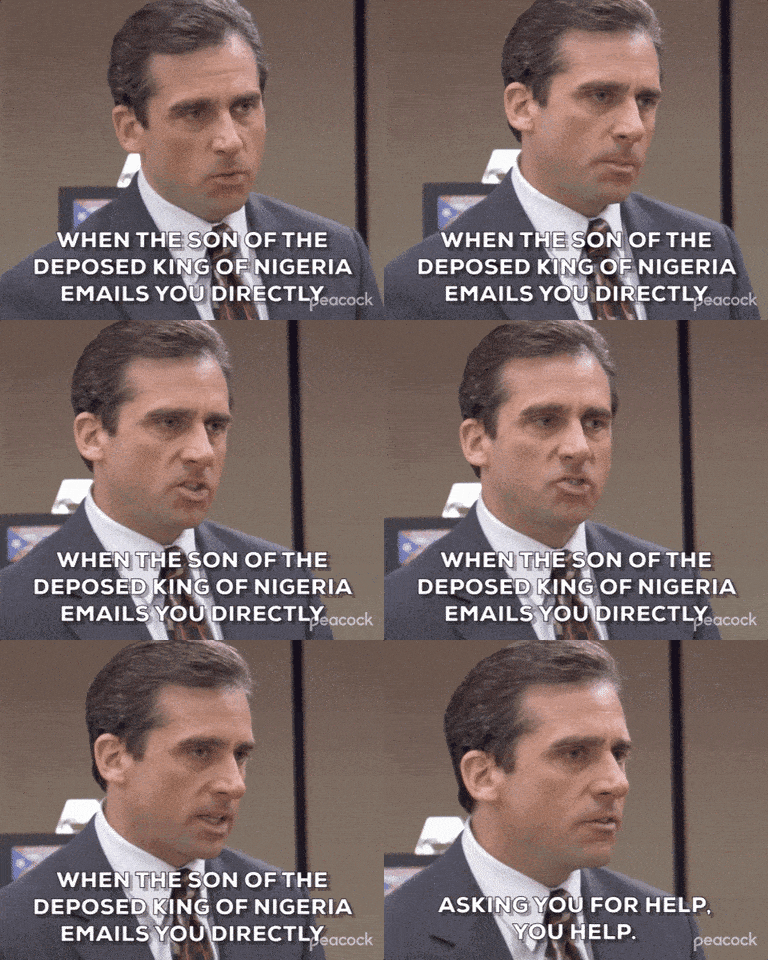
Don’t give the Nigerian prince your account details!
The bank wont do shit. They dont scrutinize shit. This is also already a common scam and the bank won’t protect you.
The funny thing is I genuinely asked this question spontaneously I forgot that is an actual excuse scammers use and some people believe it
They would have their people set up a trust fund for you, or they would have their people transfer the money to you.
This is not a problem you need to consider in this situation
Any billionaire that wants to donate money to a cause won’t be giving it to an individual. Only an organization that can give them a tax receipt.
If billionaires actually wanted to help people, they wouldn’t be billionaires.
They don’t, they want to help themselves, if you happen to benefit as well, it’s basically a rounding error on their part which they’ll be sure to minimize in the future.
They will only do this in context of a company. Get a lawyer to setup a llc. They do sometimes give money this way - see angel investors, but you need a company for legal reasons.
Using legit regular banks would be your best bet to avoid scams or being accused of fiscal crimes.
It depends on where the billionaire’s and your bank account are located (some restrictions may apply), but a normal bank transfer works perfectly for any amount. Of course for large amounts it’s better to contact the banks first because it may reject a large deposit if it comes out of the blue.
For donations there will be taxes and some bureaucracy, the anti money laundering will be triggered, but it’s nothing impossible to handle.
If my nigerian princes have taught me anything is that these kind of things are always best done by western union.
They just make a bank transfer. The real issue is the taxation.
Every country has a threshold for how much someone can receive without paying taxes.
check? EFT? ACH? bank transfer? depends on the amount. When you are dealing with that much money, Step 1: Accountant, Step 2: Attorney. You will be paying taxes, it is their job to minimize it. It is not your job to worry about it. If you are worrying about it, You. Are. Doing. It. Wrong.
deleted by creator