
You must log in or register to comment.
A wireless router consumes single digit watts of power. A tablet or mobile phone consumes 1/10 or less of that. Making a slice of toast and a cup of tea uses more power than both of those devices all day combined. This is another silly attempt to shift blame from corporations and billionaires down to consumers and everyday people. Don’t buy it.
Kind of like how a 1000 LLM prompts equate to a microwave running for a second.
The real consumers of power are corporations.
Like, if millions of homes all had a 55" 4K TV running 24/7, and decided to turn it off at the same time, that still only equates to 300MW/h.
Which is the same as ONE large factory.
We don’t have energy shortages, we have distribution problems.
There is some truth to it, in that the data centers that host a lot of digital content are environmental catastrophes. But like, again, that’s the fault of companies, not the consumers. Companies could choose to optimize their websites better, choose to streamline their systems and minimize the amount of data they’re collecting on users. Choose to use solar power and batteries and eat the upfront capital cost (it would even save them money over the lifetime of the facility.)
But they choose to ignore all that and just boil lakes and chug methane instead.
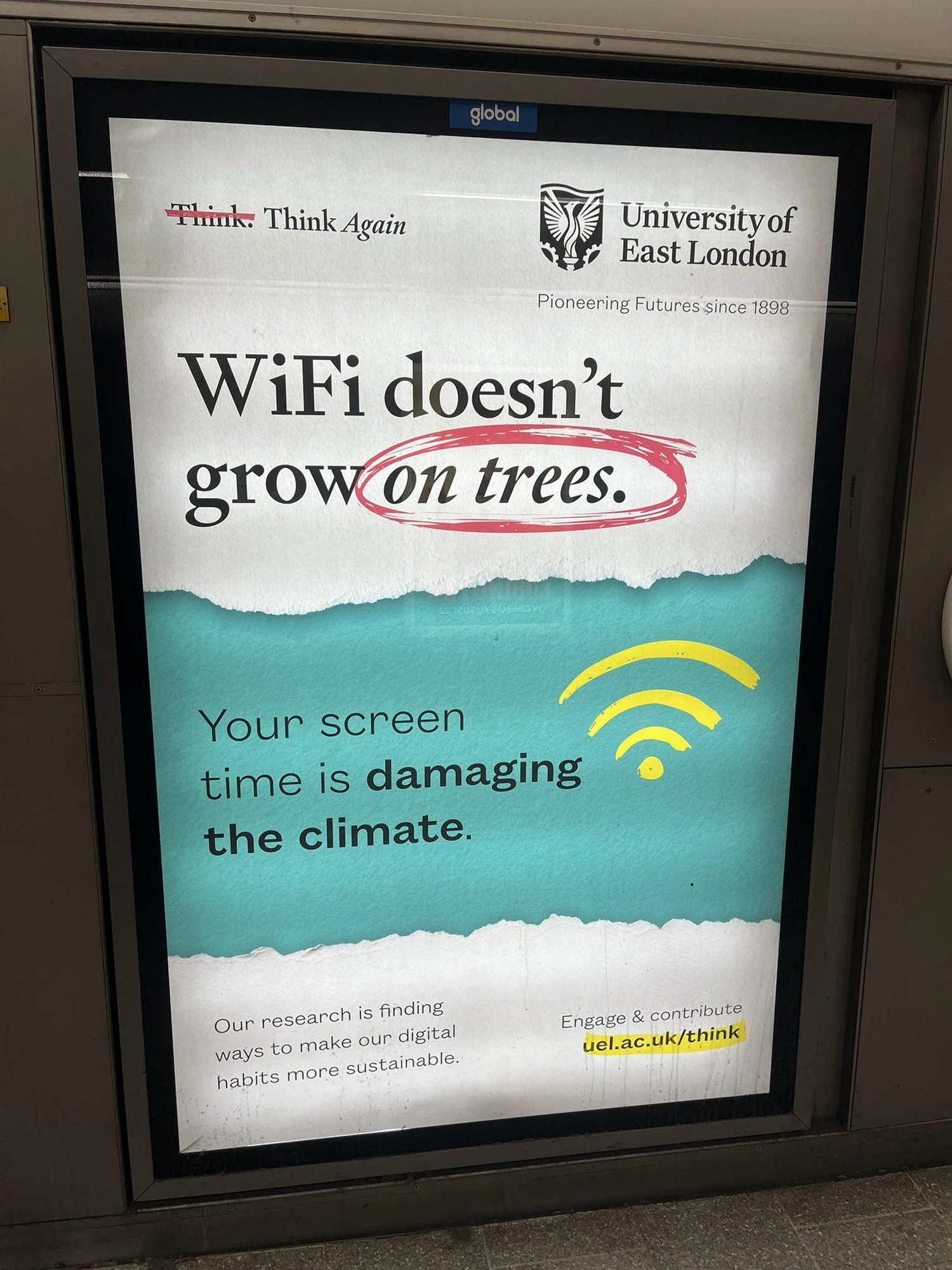
Honestly the amount of energy needed to print and put this ad probably costed more than every amount they save.
Kind of a weird message. The paltry amount of energy my screen time uses pales in comparison to the footprint left by massive careless corporations and the ultra-wealthy, and it would be far more effective at helping the environment to convince them to make even small adjustments.
Putting the onus on the average person just seems cruel. It leads to people like my wife desperate to do every little minor thing she can to adjust her footprint, making almost no difference in the grand scheme, while the real causes continue on unabated.
It also pales in comparison to the carbon cost of printing out the poster and lighting it.
Many small things are important too, like recycling, and voting for parties that enact green policy. “Screen time” is too vague to mean energy intensive.
Not really. Smartphones, tablets use virtually no power compared to other sources. This looks like BS.
It makes me wonder about the environmental cost of printing and lighting those posters.
yeah, definitely blame the individual people using wifi for damaging the climate and not the companies / billionaires whose decisions actually effect things at a substantial level. it’s 100% the homeless guy using wifi at the library who is going to cause the water wars in a few years. /s
Im fairly certain wood-burning generators exist
https://en.wikipedia.org/wiki/Drax_Group
The uk government keeps giving them renewable energy subsidies because trees can regrow but ignore the fact that they cut down trees the other side of the world to burn them here. It releases all the carbon stored in the trees into the atmosphere and then they capture a small percentage of it back and pretend to be the good guys.
This is absolute bs. You want me to feel bad about my screen time when AI data centers are taking up all the water?
Blaming average people for their habits affecting climate change is misplaced. The rich shape and control the systems that overwhelmingly cause the climate disaster. Then again the rich probably funded whatever hand-wringing research this is and the printing of this ad.
I think the University of East London is a low tier educational institution, and so to attract attention it resorts to advertising like this.
It is interesting how much climate research is being done at frankly low quality universities. This is not to say the overall science is wrong, but rather it shows how the research economy works with low quality universities “jumping on the bandwagon” to get research money and try to build up their media reputation.
The University of East Anglia is another example of this. They like to play on how they are one of the “most cited” research centres in the world. But this is a bad metric as it just reflects the nature of the research economy. There is a massive volume of frankly shit “research” in all fields, and only a small percentage in any field is of any value. Also to be clear, this also not to say that all research from the UEA is crap or all the people working for them are poor. Rather, it is just an example of how lots of institutions operate in a bloated and overly commercialised research & university sector, and the newer or lower reputation places are aggressive in marketing themselves.
Background light for ads doesn’t grow on trees.
I object. Look at the CoVID-19 pandemic when most of us were at home staring at screens to talk to each other, receiving money from our governments not to work, gas prices were negative, we actually meaningfully paused the pollution of CO2 into our atmosphere for a very short time.
Not that everything was peachy then but we could use some of the ideas we learned there for the good of us all.
Yeah, my computer would definitely be wasting less energy than running a car for equivalent useful work.
An ad like this uses about 1920W constantly, your phone uses about 10W when active and in use. Lets say your city has 100k inhabitants and all use their phone right now than thats 1MW or about a 1/5 wind turbine. So you break even with 521 of these adverts. While I can only see how they run ~100 of these ads for a city that size, we can also roughly estimate that people “only” have a screen on time that matches this figure. So yeah, they are roughly using the same amount of energy to display the ads compared to the problem they are trying to solve.
In a sane world they would use all the effort to build a single wind turbine and then shut the fuck up.
While were doing maths I can see the eight florescent tube lights behind the sign art, even trying to overestimate the size of the poster and assuming it has 1.16m wide fluorescent tubes in it that are the brightest available that would be 8 * 36W = 288W.
So I think you’re overestimating the power used by the sign by over septuple.
I don’t agree with the campaign though, its just more framing consumers (of relatively modest usage) as a big part of the issue when they really are not. If everyone cut their phone use in half it might impact less than a percentage point of CO2. It distracts from the real problems, thereby assisting the big polluters.
I didnt specify it but this was my source: https://adfreecities.org.uk/2019/11/the-electricity-cost-of-digital-adverts/
That might be on the higher end but I guess they dont use the lowest brightness tubes as they need to shine through the poster and also it accounts for the double sided-ness (at least in my area they are always double sided).
Phones are some of the best forms of entertainment with the lowest carbon footprint, right?
Why do I feel like this sign eats more energy per day than my phone?
Pretty shameful that a university is doing this.