The outside should be a d7 that starts at 0
Where buy!?
Paizo has some:
https://paizo.com/products/btpy879g?19mm-d6-Double-Die-Transparent
And yes, there should be a d10 inside another d10 somewhere around there.
Its perfect for Warmachine, most rolls need 2d6 anyway.
I lesson I have to remind other players of frequently: 2d6 does more damage on average than 1d12
But it is not a d12, it can only roll 2-12, not 1-12.
Easy - if you roll a 2, flip a coin to decide if it’s 1 or 2.
A 1 in 72 chance of getting a 1 sounds good to me
😉
The mythical D11???
It’s a 2d6, but could also be read as a d36.
Distinguished, these dice have been.
Yeah, except too bad prime numbers exist
Let da and db be the results in both d6 dice, the result for the d36 would be 6(da - 1) + db. This gives an equal chance of getting any number between 1 and 36, both included, eg da = 5; db = 5; gives d36 = 29 (which is prime).
Very cool, TIL! Is there a name for this mathematical strategy? Both search and AI are failing me
It’s just using the result of the dice roll as digits to compose a number in a base 6 positional numeral system.
Maybe it’s not obvious because the formula above is already reduced. Digits in base six can only be 0-5, that’s why there’s a ‘-1’ in ‘6(da -1)’. Two digits would give us a result between 0-35, that’s why there’s no ‘-1’ subtracted from db, I already added 1 to make the range 1-36.
You could use two different dice as well, like a d8 and a d6 to make a d48. Or three or more dice with the same number of faces, eg 3 d6 to make a d216 (they have to be distinguishable, in color, size, style…). For more than two different dice the math would get too messy to be practical, I reckon.
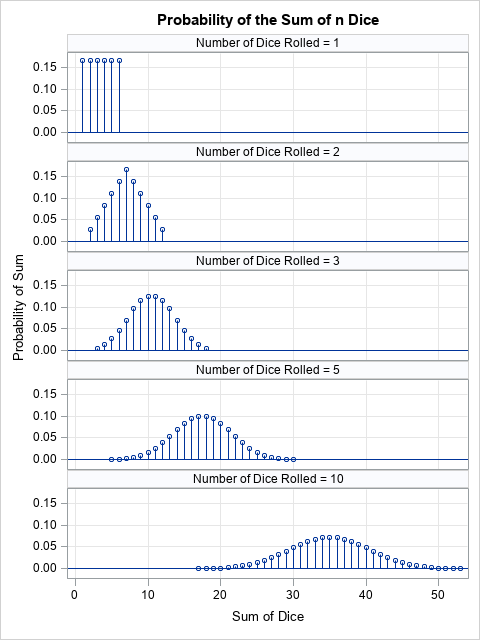
Also the distribution is a bell curve not flat.
Not really, it’s a triangle. It asymptotically approaches the bell curve (aka the Gaussian distribution, which is infinitely long) at higher die counts though.
“what?! ANOTHER seven!” smh… 😂