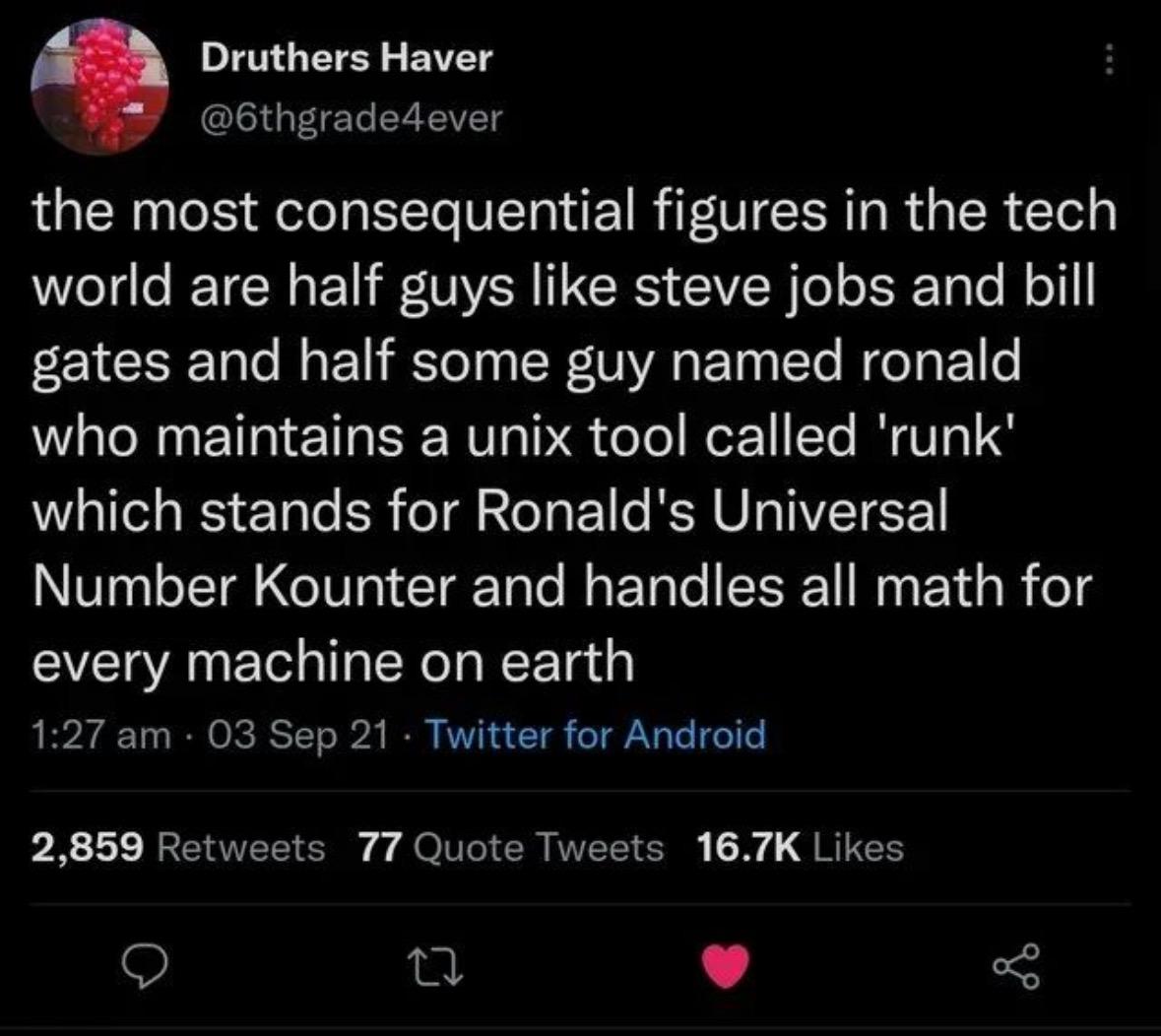
Friend who is not a software person sent me this tweet, which amused me as it did them. They asked if “runk” was real, which I assume not.
But what are some good examples of real ones like this? xz became famous for the hack of course, so i then read a bit about how important this compression algorithm is/was.
I’m surprised that no one seems to have brought up curl, which is maintained by Daniel Stenberg who is Just Some Guy™
It’s okay you can just say FFmpeg
Also Linux
Also CoreJS
Also
Sqlite isn’t quite one person, but it is a very small team and is extremely widely used. https://www.sqlite.org/mostdeployed.html
Damn, I wanted to mention sqlite.
It’s not too late. Mention it!
Curl comes to mind. Libcurl is at the foundation of almost all networking.
And they still get emails from randos when some program that uses curl doesn’t work (the Readme is top notch).
I cannot for the life of me find what you’re referencing. I only remember the
sqlite/etilqsfiasco with McAfee.https://github.com/mackyle/sqlite/blob/a009acaca1fe25d909d8b5180c0120af1abc2b82/src/os.h#L56-L79
https://bagder.github.io/emails/ has the email collection.
Here’s an example from NASA
I feel a bit split about this. Seems it is an actual law, and it kind of makes sense. You probably don’t want random components from unknown people and places in your multi million dollar space equipment. But it feels rather arrogant to just demand such things.
Is NASA actually a customer? Did they pay for a license to use curl (genuine question - I’m not familiar enough with it to know if enterprises and organisations require a paid license)? Are they planning on becoming a paying customer? Do they make donations to the project? If not, it feels kind of rude to send a demand letter to the lead developer of a free piece of software straight up demanding a formal letter stating where the free software is being developed and maintained (for free), or if outside the USA, that the free software has been tested in the USA. Oh, and a bonus demand that such information be returned within 5 business days (naturally with an implied “or else”, just to really make sure those pesky people maintaining open source software for free really get the memo)
In any case, why don’t all their scary 3 letter spy agencies go and figure it out on behalf of NASA themselves? It’s open source, they could just like, read the source, test the source, and audit the source themselves. Or fork it and make any modifications they’d like to ensure its safety
I don’t blame the person sending the emails, obviously, they’re just following orders, but the whole email reads as very entitled and arrogant, assuming NASA don’t provide any compensation to the project and projects maintainers for their use of curl
https://daniel.haxx.se/blog/2020/12/17/curl-supports-nasa/
https://daniel.haxx.se/blog/2023/02/07/closing-the-nasa-loop/
Their process for validating software doesn’t have a box for “open source”, and basically assumes it’s either purchased, or contracted. So someone in risk assessment just gets a list of software libraries and goes down it checking that they have the required forms.
As the referenced talk mentions, the people using the software understand that all the testing and everything is entirely on them, and that sending these messages is bothersome and unfair, and they’re working on it. Unfortunately, NASA is also a massive government bureaucracy and so process changes are slow, at best.
The TLAs don’t generally help NASA, and getting them involved would unfortunately only result in more messages being sent.As for contributions, I think that turns into an even worse can of worms, since generally software developed by or for the US government isn’t just open source, but public domain. I think you’d end up with a big mess of licensing horror if you tried to get money or official relationships involved. It’s why sqlite is public domain, since it was developed at the behest of the US.
Mostly just context for what you said. NASA isn’t being arrogant, they’re being gigantic. Doing their due diligence in-house while another branch goes down a checklist, sees they don’t have a form and pops of an email and embarrassing the hell out of the first group.
The time limit thing is weird, but it’s a common practice in bureaucracies, public or private. You stick a timeline on the request to convey your level of urgency and the establish some manner of timeline for the other person to work with. Read the line again, but extremely literally: “we have a time frame of 5 days for a response”. “Our audit timeline guessed that it would take a business week for you to reply, so if you take longer we’re behind schedule”. The threatening version is “your response is required on or before five business days from the date of this message”.
The presumption is that the person on the other end is also working through a task queue that they don’t have much personal investment in, and is generally good natured, so you’re telling them “I don’t expect you to jump on this immediately, but wherever you can find a moment to reply this week would keep anyone from bothering me, and me from needing to send another email or trying to find a phone number”
curl is most definitely not developed solely by one person though, it has thousands of contributors. in fact, there is so much red tape around curl that you can’t even discuss making a change to it without first writing an RFC and having it approved by a committee.
Based on my cheatsheet, GNU Coreutils, sed, awk, ImageMagick, exiftool, jdupes, rsync, jq, par2, parallel, tar and xz utils are examples of commands that I frequently use but whose developers I don’t believe receive any significant cashflow despite the huge benefit they provide to software developers. The last one was basically taken over in by a nation-state hacking team until the subtle backdoor for OpenSSH was found in 2024-03 by some Microsoft guy not doing his assigned job.
Until very recently the whole Resident Evil modding community relied solely on a Maya 3DS script that a Chinese dude named Maliwei777 created in 2012. The community cherished that script but it got harder and harder to get the correct 3DS version to run it.
The world is built on is-even and is-odd!
left-pad was the first thing that came to mind for me
Yeah that debacle still pisses me off. Especially the fact that someone could possibly trademark and enforce a trademark a name that’s already in use. It’s made even worse that the package that now uses the stolen name is defunct.
I hope all of the bad actors burn in Hell.
What pisses me off is that NPM thought it would be okay to remove something from their repository.
What did NPM remove? My understanding is that NPM restored the deleted package. If you’re referring to giving the author the ability to delete their packages, I’m on the fence about that. On the one hand, if it’s open source, it’s a part of the community. On the other hand, it’s also still the author’s code, and if they are the only author, then it’s their sole decision if they want to host their code under their account.
But at the same time if the code is properly licensed under an open source license (I would assume/hope NPM didn’t allow non FOSS code) then NPM can refuse to take it down. Yes, they put it back up, but I think it’s important for public repositories (as in packaged code repositories, not got repositories) to never remove things (barring legal requirements, sure).
For what it’s worth, the policy they adopted after the fact seemed pretty sensible. I think it was something like you can’t take things down once they have ~100 downloads or x number of dependents.
Is-even and is-odd on npm.
For a while, openssl was maintained by 1 or 2 people.
The guy that runs Rufus.
I remember reading a story here not too long ago about a guy who broke the internet by taking his code away because some big company forced to have his package’s name or something along those lines
That’s leftpad. The package name dispute was over something else, but they pulled all their packages from npm in protest. Turned out leftpad was a transient dependency for a huge swathe of all JavaScript.
I think this probably applies…
So Thief: The Dark Project (1999) and Thief 2: The Metal Age (2000), are a couple of classic stealth FPS games, proto-immersive-sims, and still some of my all time favorite games. They both use the Dark Engine, an in-house engine from the now defunt Looking Glass Studios, which also powered System Shock 2.
In 2010, the source code to a System Shock 2 port (for the dreamcast or ps2 iirc…) leaked online, and on 2012 someone used that code to create NewDark and TFix, patches to make these old games work on modern computers (and some bugfixes, support for HD, etc).
There are still updates regularly released for it too!
I must emphasize that these games are still sold on Steam, GOG, etc and this patch is essentially required for them to work. And these are hardly the only games like this, just the ones most personal to me. Retrogaming is built on the backs of unsung individual heroes who backwards-engineer, hack, patch, and mod their favorite games to keep them running for everyone long after the publishers have died or abandoned their work.
Vampire The Masquerade: Bloodlines had a patch for it that made it way more stable (and also added back in a bunch of cut content).
Way back, my partner played Watchdogs at launch and the stuttering was awful, and it was basically unplayable. Some random person made a patch that fixed most of the problems and made the game look closer to what it did at E3.
Random nerds on the internet are my favourite people
Also the guy who fixed GTA Online’s ridiculous loading times.
Paul Eggart is the primary maintainer for tzdb, and has been for the past 20 years.
Tzdb is the database that maintains all of the information about timezones, timezone changes, leap whatever’s and everything else. It’s present on just about every computer on the planet and plays an important role in making sure all of the things do time correctly.If he gets hit by a bus, ICANN is responsible for finding someone else to maintain the list.
Sqlite is the most widely used database engine, and is primarily developed by a small handful of people.
ImageMagick is probably the most iconic example. Primarily developed by John Cristy since 1987, it’s used in a hilarious number of places for basic image operations. When a security bug was found in it a bit ago, basically every server needed to be patched because they all do something with images.
Runk means masturbation in Icelandic so that adds another layer of hilarity to this
Numpy