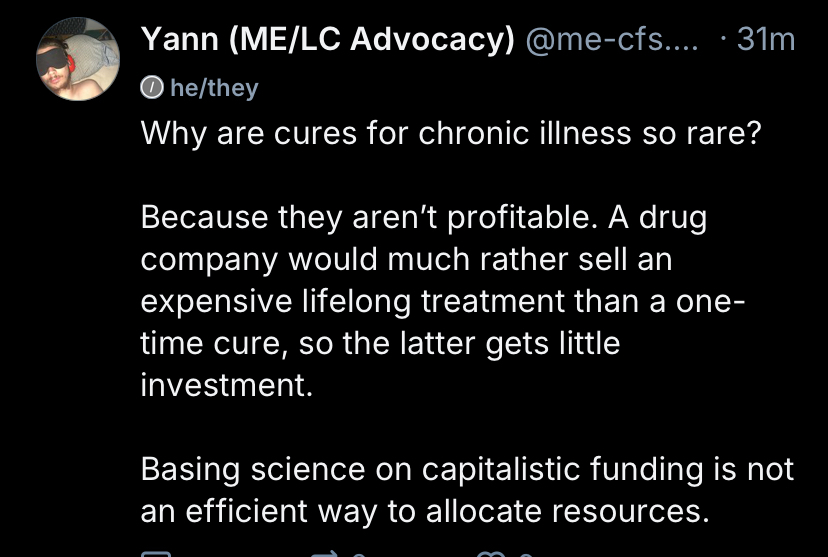
OP in 1939* “Why isn’t there a cure for the consumption?! must be because the travelling physicians wouldn’t make any money!”
This is a moronic take.
Just saying, “it’s capitalism’s fault,” is not entirely incorrect, but it is definitely oversimplifying. Chronic diseases are complex, incredibly challenging to solve, and can vary a great degree by individual.
The government gave the NIH a billion dollars to study long COVID and the result … fuck-all. Literally all they did was loosely define some things that the enormous and growing patient community already knew. No treatments, no diagnostics, nothing.
To be clear, capitalism certainly plays a substantially antagonistic role in solving chronic illness, but just throwing money at a problem doesn’t solve it either.
Not to mention, evolution. You can’t stop it unless you 100% eradicate the things that could evolve.
Time, money, and patience are required to understand novel pathogens, and those three things are in short supply in a “get rich quick” society.
I’m not disagreeing with most of what you said but throwing money at a problem would have significantly higher return on investment if that money wasn’t being slurped up by the capitalist machine.
It also might work a bit better if the country as a whole hadn’t been institutionalising profit driven medical sciences for the last 100 years.
Or to use an analogy.
It’s like pointing out that “just throwing oil” at a car engine that hasn’t been serviced in 150k is a failure of oil to fix the problem.
I mean, yes, technically you have a problem, you put oil in and the problem didn’t go away, but is the problem really the oil ?
In this analogy capitalism is the oil thieves, draining your oil out of the bottom of the engine while you fill it up.
It’s also why so many really good TV shows and series get canceled.
The money is not being invested to create an art project.
It’s being invested in hopes of a gigantic return, and the instant it seems like there will not be a gigantic return the money goes away.
That’s why you do not often see several hundred million dollar productions of original material unless it’s a passion project for a specific director or studio.
That’s why we’ve had, what is it, 10 Spider-Man movies in the last 25 years?
I get you can’t just throw money away but I feel like there should at the very least be some sort of clause and a contract that says that if your show gets canceled then you will be provided the timing and funding to either finish up the season that you are in and provide a finale or two at the very least provide a finale.
There is a film from 1995 which is literally about companies trying to prevent a cure from getting out since it would interfere with their ongoing treatments.
Tap for spoiler (the name of the film)
The film was Johnny Mnemonic .
A cure for a chronic illness could be plenty profitable if we had a free market.
Like, people can make money actually repairing cars. Even though a car that leaks oil could be a constant revenue center for someone selling oil, someone else can actually make a profit fixing oil leaks.
The fact that selling a continuous stream of oil to someone with a leaky engine does not automatically imply that fixing the leak isn’t profitable.
This sort of “X is more profitable so Y doesn’t happen” thing only actually causes Y to not happen when the market isn’t free.
If one company — via government-enforced monopoly — controls motor oil sales and oil leak fixing, then that one company can nix the permanent repair market in order to maximize profits from selling motor oil. But that’s not a free market.
It’s the fact our medical market is so tightly, centrally controlled that makes less-profitable things like preventing diabetes impossible. That kind of niche elimination is a property of a centrally-controlled market, not a property of an actually free market.
We have a free market for clothes. That means: (a) anyone who can sew cloth together can sell clothes, (b) anyone who can acquire clothes for cheap and sell them slightly higher can sell clothes, © anyone with money can buy clothes at any time from anyone. I can buy clothes from my neighbor if I want. I can donate old clothes to Goodwill and others can buy them cheaper than new. I can own 500 pairs of jeans if I feel like it, or wear nothing but sweatpants simply because I feel like it.
Imagine if you needed a prescription from a clothing consultant before you could buy a jacket, or a shirt. That’s not capitalism. That’s not a free market.
Just because money is exchanged for healthcare in the USA does not mean we have a free market for healthcare. We do have a market in healthcare; we do not have a free market in healthcare.
If we had a free market for healthcare, I’d be able to buy chemistry equipment and make whatever anti-cancer drugs people need and undercut other manufacturers. I’d be able to just go pay a hundred bucks to use an MRI machine or an x-ray machine, without needing to pay money to see a doctor first and get their okay for the scan. I’d be able to just go buy wellbutrin for $15 instead of paying my psychiatrist $100 every two weeks to check in and see if it’s still working.
We do not have anything even remotely resembling a free market for healthcare. We really, really need one though.
The original “this doesn’t need to be a subscription”
Still relevant comic.

What is this disinformation on Lemmy? There are so many counterexamples to this:
- If a patient doesn’t find a cure, they’ll go to a different doctor and sometimes leave their country to seek help (like when Americans go down to Mexico for treatment). Wouldn’t it make more sense for them to fix you so you return when something else happens? Who ever goes to the doctor to stay sick?
- People will always be sick of one thing or another because not all illnesses are transmittable diseases so there’s no shortage of customers if you cure them. Delivering babies and cosmetic surgeries don’t even require you to be sick for the doctors to turn a good profit. Sometimes people fall and break a bone. Do you really think your doctor will keep your bone broken for profit? When has that ever happened without repercussions for the doctors?
- Most illnesses are self-limiting, meaning you will cure yourself over time and your doctor knows this and will be frank with you if you ask and they’ll say “Yeah, but you can take this to alleviate your pain” and you can simply refuse. But thank god you went in anyway because now you know your stomach pain was food poisoning and not appendicitis which may need surgery because the symptoms overlap as is the case with many diseases.
- You can sue your doctor for malpractice and win because they’re accountable to a board of ethics. They can lose their license and face jail time for making you suffer by knowing the cure and withholding it from you.
- Evolution will always find something to break, like new mutations to ancient viruses that led to covid/aids and inherited diseases like sickle cell disease. New diseases will always emerge because our world is always changing.
- There is no shortage of new people being born. It’s a numbers game: Your case won’t be any more profitable when they have 10 other people coming in that same day with whatever illness you have. They need to get people out the door to accommodate more people.
- Not all diseases can be cured, like cancer. And even if cancer is cured, you can’t stop it from happening at the molecular level so you always have more customers needing treatment. (And no, sharks aren’t immune to cancer, and yes research has made many cancers curable when detected early, and experimental cures are actively offered to the moribund.)
- There are plenty of examples of cures and total eradication, like smallpox and polio. Are doctors making less money because they’re gone? Absolutely not.
- Most people who go into medicine are thoughtful, smart, compassionate individuals who want to help people and gladly take the Hippocratic Oath voluntarily. Don’t confuse business practices by big corporations with your poor doctor who’s just trying to get through the day.
And the list goes on. The image makes no sense.
It’s a comic from 2006, that was taught in medical school’s business class as a “joke”, on which they then spent the semester learning how to skirt. Source: medical school. Is it all of the doctors? Obviously not.
Ah, sorry, I didn’t know the context. I’ve seen people argue this seriously and it drives me up the wall because it sounds convincing at face value.
No worries, mate. I figured it was a misunderstanding. The internet is full of it haha Yeah, PART of the problem is capitalism. But most doctors are fine to great (with a minority few that are truly bad), with much of the blame lying on the insurance companies.
In terms of the research and researchers: well, science takes time.
Or they’re illnesses and conditions primarily affecting women.
Chronic fatigue has only since covid (when men started reporting constant excessive tiredness) been started to be treated like a real thing by doctors. And it’s still barely considered by most doctors.
Endometriosis is another ‘chronic’ womens condition that has only very recently started being researched properly and taken seriously. And again, it’s still incredibly hard to get taken seriously and helped if you suffer from it.
See also the massive discrepancy between autism and adhd diagnosis in men and women, and with bpd diagnosis between women and men.
On a somewhat less severe side of things, lack of libido in women is still considered a jokey non-issue by most doctors but viagra has been on the market for decades for men.
There’s a lot more but I’m too tired to keep writing this.
On a somewhat less severe side of things, lack of libido in women is still considered a jokey non-issue by most doctors but viagra has been on the market for decades for men.
Viagra doesn’t treat a lack of libido, it treats a lack of blood flow to the relevant anatomy. And it was discovered by accident - a drug meant to treat high blood pressure and angina that was more effective at doing something else to blood flow. In other words it’s not that men use viagra to have the desire, but rather to get the equipment to play along. Lack of libido in men is often a symptom of low testosterone, so they check for that and prescribe testosterone if that’s the issue but that’s really the entire toolbox on that front.
Lack of libido in women is a much harder problem to solve, and the first attempt at it that ever made it to market barely worked, had to be taken daily, and went horribly wrong if you consume any alcohol at all. There’s a second that hit market a few years later that’s supposedly more effective and isn’t a daily regimen but is also an injection, has significant potential side effects and can’t be mixed with naltrexone (a drug used to treat opioid addiction) because it will cause naltrexone not to work.
Compare to contraception, where there are tons of options available to women and basically all insurance is legally required to cover at least one brand of each type, including barrier methods, with a prescription. The options available to men are condoms or being surgically sterilized, and there’s no requirement to cover either at all.
It’s harder to get contraceptives for men approved because it doesn’t prevent a medical condition for the user and so the bar for what is acceptable as a side effect is really low. You may have seen news stories about a male pill and men chickening out over the side effects (what wimps!) but the problem wasn’t men backing out of the study, but that the acceptable side effects for a treatment that prevents a different person from developing a condition are so restrictive that they killed the study because it was already never going to be approved.
There is another male contraceptive that’s been in development in India since the 80s, and as of 2022 has still not been approved - RISUG. Phase 3 clinical trials for RISUG were published more than twenty years ago. There’s a variation of RISUG that’s in development in the US called Vasalgel, and it’s been in development here for over a decade. RISUG and Vasalgel are long term reversible contraceptives - think like an IUD - that consist of an injection in each of the vas deferens and lasts up to a decade, but can be removed earlier if needed by another set of injections in the vas deferens. Should it get approved in the US, there’s no legal requirement that any insurance cover it, let alone without copay because the ACA specifically only requires coverage for contraceptive options for women.
There’s a lot of work/investment into curative cell and gene therapies that are very promising! Some have already received FDA approval with high success rates of curing some childhood cancers and sickle cell disease
Now let me preface this by saying “I hate Trump”
One of the few things that I have hope for with the proposed cuts to the FDA is that is wont cost as much money to research possible treatments/drugs/cures so the lower profitability drugs and treatments might actually get a look in. Not saying the drugs companies arent predatory AF but spending hundreds of millions to make tens of millions is just bad business.
So, it’s like if you lose the ability to walk, a wheelchair is the treatment, while spinal reconstruction would be the cure?
That just shows we’re nowhere near the technological advancement needed to develop actual cures—we’re still at the wheelchair stage for most illnesses.
Most of the answers to why a specific drug works are “we dunno but we tried it, compared it to people who didn’t get the drug and these guys got better”. Medicine is crawling right now and I would love to see it run.
Even going so far to use male mice for experimenting exclusively due to fluctuations of female hormones during cycle (which fuck up statistics)… In some cases leading to less effective medication for women than men.
Guesswork at best…
It’s an entirely efficient way to allocate resources if the goal is “shareholder enrichment”.
How’s this a meme?
deleted by creator
It’ a meme in the same way that anti-vax is a meme.
To your downvoter: https://en.wikipedia.org/wiki/Meme
Making cure when everyone else makes a treatment means that you can undercut everyone and eat their lunch so incentives are there
part of the problem is that developing treatments is easier and can rely on more conservative, safer assumptions while cures require more early stage risky research
besides chronic diseases that do have cures aren’t considered chronic anymore. the rest are problems with insurance that doesn’t want to cover single expensive cure over cheaper but recurrent treatment that might add up to more
Capitalism or not the claim would be true, chronic diseases are defined by their lack of effective cure.
Completely true. But there would be fewer of them.
It’s crazy that when my research team comes up with a therapeutic target we believe might lead to curing a disease, we get crickets from drug companies. But when we present therapeutic targets for long term treatment, we get lots of interest.
Could that be (at least partially) explained by those companies looking at a long-term treatment as the more realistic goal after being burned by proposed cures in the past? Lots of quacks out there offer a quick cure, not as many say up front that their product will need a prolonged period of use. Not saying you and yours fit that label but their bullshit tips the signal-to-noise ratio in an unfavorable direction for both relief-seekers and providers.
I don’t know your field, team’s reputation or the companies you’ve been in contact with though so of course it could be the simple greed motivation too.
“In the case of infectious diseases such as hepatitis C, curing existing patients also decreases the number of carriers able to transmit the virus to new patients,” the memo argued.
Jesus. Fucking. Christ. They’re not just arguing against curing chronic illnesses, they’re arguing against curing infectious chronic illnesses because it creates less patients to extort in the long run. That is one of the most heinous things I’ve seen put to paper.
That’s the lenient interpretation I’d hope.
But we’re not an alternative medicine group or anything. If you look into their shareholder meetings the public info seems to be that they judge whether investments are worth it by potential return on investment, and well a lifelong treatment is always going to be more profitable for them than a cure.
To be fair, and it’s still bullshit, we also look at number of patients per week per cost. Crispr for example, could be used for a huge variety of issues, but curing 100 people globally for $100M in clinical development is just not going to work.