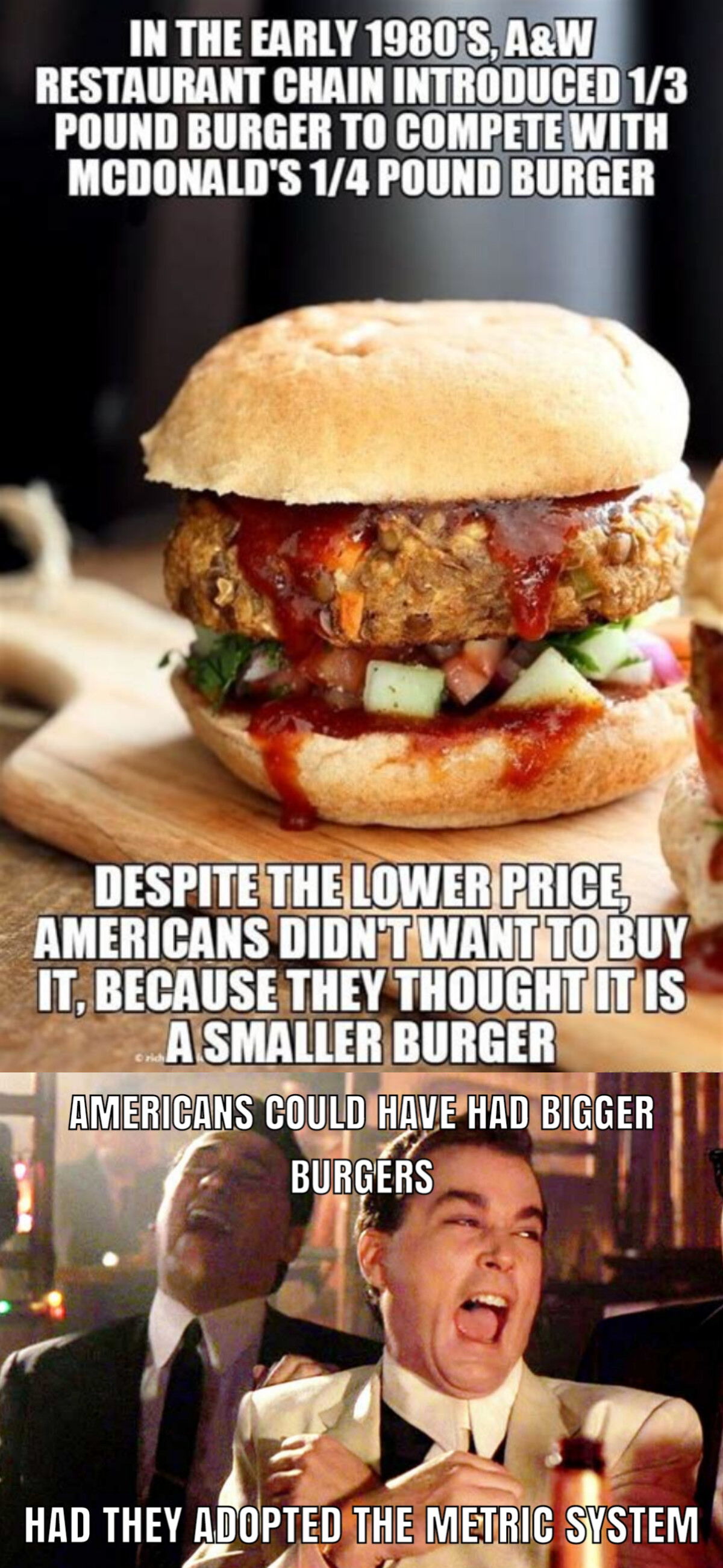
I see this repeated all the time and I’m sure there’s some truth to it, but A&W burgers are also disgusting and more expensive than their competitors. So there’s that.
Americans if they adopted the metric system: “.25kg > .5kg”
But that’s easy to solve by just adding a zero to .5
.25kg < .50kg
Though I could see some profit seeking companies selling a .250 burger for 25% more than their .25 burger.
Classic.
“.25kg > .5kg”
Which one of those is a third?
Deoends on whether you’re asking for a third of 0.75kg or a third of 1.5 kg
0.25 > 0.3
0.03333333333333333~
Missed a bit
Americans are every bit as capable of assuming a 1/8 kg burger is bigger than a 1/6 kg burger.
It’s not like Americans need bigger food.
I thought this was kind of a myth? I recall it being something like the quarter pounder was just well marketed so beat out even bigger burgers.
Wikipedia confirmed though:
The A&W research firm organized focus groups. The results revealed that many participants mistakenly believed that one-third of a pound was smaller than one-fourth (quarter) of a pound. Focus group participants expressed confusion over the price, asking why they should pay the same amount for a “smaller” third-pound burger.
This misunderstanding stemmed from consumers focusing on the numbers “3” and “4,” leading them to conclude that one-third (1/3) was smaller than one-fourth (1/4), even though the opposite is true.[2]
A similar explanation appeared in The New York Times in 2014, citing the third-pound burger as one of the most vivid examples of consumer arithmetic failure.[3] In taste tests, customers actually preferred A&W’s burger to McDonald’s, and it was less expensive.
According to a CBC report, more than half of the people surveyed about the burger said they didn’t buy it because they thought they were getting less meat.[4]
In taste tests, customers actually preferred A&W’s burger to McDonald’s,
If those taste tests are accurate, I’m guessing that individual stores could select their own suppliers, and didn’t choose the suppliers used for the taste tests. Because every A&W burger I’ve had has been terrible. Completely inedible.
I would rather buy a quarter pounder from anywhere else than accept a free 1/3, 1/2, or 1lb A&W burger.
This is even more interesting if you notice that Americans use fractions a lot, maybe even more than countries with metric system. It’s 1/2 pound, 5/8 inch, 3/4 mile and so on. Countries with metric system just change the units. Typically we don’t say 1/2 km, we say 500m.
We use power-of-two denominators. 1/2, 1/4, 1/8, 1/16, 1/32. We don’t use 1/3, 1/6, 1/9, 1/12, 1/5, 1/7.
We intrinsically know that 1/2 and 16/32 are equivalent; we would have to think about 3/6 or 6/12.
That’s interesting. I never really noticed it but I’m not a fan of changing units. Whatever the “base unit” is for something is what I’ll use, even if it crosses the order of magnitude threshold.
Metric always gets decimal though, and sae units get fractions.I’ve gotten myself switched to metric for kitchen weights and volume, and for small distances in projects I’m working on.
I’ll buy a 1/2 pound of meat, and then measure out 200 grams, with 100 ml of stock and 0.5 grams of something-small-i-cant-think-of-for-an-example-recipie.
Saying 500 milligrams feels wrong. So does asking for 1000 ml of pop though, since that’s the “wrong unit”.I think there’s something baked into the American brain that says unit conversion is a source of error and should be avoided. Converting from 1 mile to 2640 feet is obviously gonna cause issues.
As for the fractions, I think that’s because sae units developed in a context where division by whole numbers was helpful, and metric was designed so that division by 10 was consistent and predictable.
Nothing intrinsically wrong with fractional units, other than 1/3 meter being a less reasonable number of centimeters than the inches in 1/3 yard.There’s no change of “unit” when going from km to m or ml to L, etc. It’s just the next “size” up or down, we immediately know 500m is half a km.
Why does this meme have a veggie burger?
Is it a vegan meme?
How do you spot a meat eater? They’ll tell you.
Just pointing out the odd choice of pictures.
It’s obviously not a A&W burger or from McDonald’s.
In fact I don’t think either chain had a vegetarian option in the ‘80’s but I could be wrong.
I just found the picture with the caption during a web search for such an infographic. Only the Goodfellas-part is from me. But does it matter what kind of burger it is?
Only for the quality of the meme. And seeing as this is the comment section of the “memes” comm, it seems like the perfect place to discuss just that topic. If this was in shitposts then yeah, who cares. But since it is this comm, people are going to critique things more minutely.
I almost commented that I’d never seen the burger attached to this story before and if that’s what it was, it may not have been the fractions!
If you’re happy with it that’s all that matters.
The meme is literally about two fast food restaurants and the quantity of ground beef they sell. It’s not like he was stretching to point out that’s a plant based burger…
I just used the opportunity to flip some of what vegans come across daily.
Sounds to me like they missed the opportunity to sell a 1/5 burger for more instead.
Fifthy pounder on the way
The filthy pounder with cheese. Sounds like a good movie.
A regular McDonald’s hamburger is 1/10, I think people would have figured it out at that point.
If we’re talking about a focus group specifically comprised of regular fast food consumers, you’re already kinda pre-selecting for the lowest common denominator.
No surprise that this segment would have lower education overall
Carl’s Jr. did the same thing. The 1/3 pound was perfect. Two 1/4 patties are too much, one 1/4 patty is too little.
I miss the Carl’s Jr. 1/3 pound burger.
Pretty sure fractions are pure math & not metric or imperial.
Americans do be dumb AF, though.
Yes and no. Imperial measurements that are not integers are displayed in fractions. Hence quarterpounders and thirpounders. In metrics, fractions are rarely used. Because the scales are more granular and because non-integers are usually displayed in decimals.
People thinking a third-pound-burger being smaller than a quarterpounder could not have happened with metrics, because, well, look at the title.
Fractions are more accurate. You can’t display 1/3 as a decimal. Americans are dumb, but this isn’t an imperial versus metric thing.
Your accuracy goes out of the window when you are actually measuring things though. The error is as significant as rounding 1/3 to 0.33
Not rounding. Mathematically, 0.(3) (repeating) is the exact same as 1/3
I know that. But practically, if you are trying to measure 1/3 of an arbitrary distance, or 1/3 of an arbitrary weight, you are not going to be able to hit the exact, precise measurement using normal household or kitchen tools. Therefore your origin assertion that 1/3 as a fraction is more accurate than decimal is meaningless, as you can’t actually utilise that extra precision.
1/3 = 0.(3) (repeating)
2/3 = 0.(6)
3/3 = 0.(9) which is equal to 1 btw
https://en.wikipedia.org/wiki/0.999…
Despite common misconceptions, 0.999… is not “almost exactly 1” or “very, very nearly but not quite 1”; rather, “0.999…” and “1” represent exactly the same number.
I’m from a country where we use metric and can’t think of anything that would normally be displayed as a fraction. Sure we know what half and third are, but they’re not used officially for anything
You’ve never had to halve a recipe before? Which is easier to do in your head, half of 78.862 milliliters or half of 1/3 cup?
I would round it to 40ml. I have no idea how much 1/6th of a cup would be. Most of my cups are different sizes too so I wouldn’t know which on to trust. Also they are oddly shaped and not transparent making it a real challenge all and all.
No recipe lists 78.862 mm of anything.
A recipe with metric units will default to gram amounts that are divisible by ten and thus infinitely easier to halve than “5/8 of your grandmother’s good cake spoon” or any such folksy nonsense.
Imperial measurements that are not integers are displayed in fractions.
Often, they’re not: look at packaging labels especially in grocery stores. Engineers use decimals regardless of unit.
Weight scales in the US don’t mark 1⁄3.
Quarter & third likely show up for verbal ease/brevity of naming: saying 250 grams is a bit of mouthful & unlikely for naming anything. I suspect if Americans used metric, they might still use fractions to refer to burgers by weight/mass in kg (like drugs!).
In metrics, fractions are rarely used.
Also convention. Nothing prevents 1⁄3 kg, 1⁄4 kg, and I’d expect to see 1⁄3 kg more often than 0.3̅ kg if rounding were avoided.
In metric, Americans still would get this wrong, because they don’t understand fractions despite using them. Or are you suggesting everyone would get the order of 1⁄3 kg & 1⁄4 kg wrong?
Obviously 1/3 vs 1/4 is the same distinction regardless of unit. But part of the whole idea of metric is avoiding dealing with fractions in lieu of decimals. It’s inherently less fraction-heavy.
Americans rarely see 1/3. We typically only use binary fractions: halves, quarters, eighths, sixteenths. Occasionally, 32nds. Smaller than that, we use decimal.
I find it funny how people are very confidently incorrect here. Best example I can think of is to compare an imperial and metric drill bit set
Are Europeans afraid of fractions or something? It’s way quicker to mentally add 9/16 and 3/8 compared to 0.5625 and 0.3750…
Like I get that metric is better but “metric is when no fractions” make 0/1 sense.
xD
I’m a lifelong American and neither of these are easy, but the decimals are much more like real numbers to me.
I encounter decimal points in my day to day interactions with numbers. Not so with fractions.
I will start learning fractions when restaurants put them in their prices.
“That will be $4 and 3/4,” said no one ever, thank gob.
I will make a 1/100 pound burger, instant money machine
No one went to A&W for burgers back then, footlong chili dog and root beer.
But that can’t be right! I have it on good authority that A&W stands for Amburgers and Woot beer!
This, exactly.
Anyone repeating this 1/4 vs 1/3 bullshit never had one of their 1/3lb burgers. They were fucking terrible. Sysco prison-grade burger patties, drowned in store-brand ketchup with a thin slice of “American”-flavored yellow #5.
Absolute worst burger I’ve ever had.
Growing up, A&W was for chili dogs and a big glass mug of rootbeer. Never order anything else; its always a fat sack of disappointment.
That must have been a US thing. A&W in Canada has had excellent Teen burgers for decades.
The hell is a “teen burger”? Canadians are eating the underaged!!
I miss it. We’d get footlongs and a gallon of root beer then go to the park across from it. I wonder if it’s still there.
“try our new 113g burger”
Yes, I’ve literally seen baked goods advertised like that. One bakery in my town is proud of its bigger-than-average pretzels and puts the weight right there on the ad posters.
We can’t afford bigger burgers now anyway, the price of beef is insane. And when bigger burgers are desired, they’ll sell “double quarter pounders”. Not that Americans generally need bigger burgers anyway, but that’s a different topic.
the price of beef is insane
Good
TIL fractions don’t exist in the metric system.
We wouldn’t normally say “I’d like a 18/100 kilogram burger”…
Yup for us its 250g vs 333g burgers. Or 0.25 vs 0.33kg
Eh that’s regional still, like in dutch we’ve changed the meaning of old imperial words to be equal to metric quantities, though probably used more common by older people. So 1 ons (ounce) = 100g and a pond (pound) is half a kg. But this is mostly used at a butcher. For other stuff we mostly just use the metric nomenclature.
especially in the context of foodstuffs the decagramm (or just deka in common language) is getting used in Austria, don’t know if it’s the same in germany, so it would be a 25 deka burger
MORE DEKA!!!
And these signs could have used ounces instead. But they didn’t. We had other units available. The units weren’t the issue
well they do, but since it’s metric it’s always 1/10 1/100 … and they have their own name so no math needed
Fractions still work the same way. The thing is Americans would think the 1/100 is bigger than 1/2, because 100>2. Doesn’t matter what unit you start with
Edit: I see what you’re saying with the names. But do you think the average american knows that a quarter pounder is less than a third pounder?
I don’t think they’re significantly stupider than anywhere else. I don’t know if there even are statistics on that, I should probably check. Plenty of people are terrible at math over here in Europe too.
The average American literally works in random-ass fractions all the time and doesn’t rely on everything being base ten.
I really want to believe that, as an American. I really, really do. How would a legitimate way of testing that go? There’s no feasible way to test EVERYBODY, so you’d have to consult the statistics people, who I am not.
I was about to start looking into median ages and education rates and literacy, but I really don’t care that much about this as I lay in bed and am about to go to sleep, so I asked chatgpt, which then gave me a long answer with this at the end:
Yes, the average American probably knows that 1/3 is greater than 1/4, but a noticeable percentage—especially among adults with lower educational attainment or math anxiety—may hesitate or answer incorrectly, especially outside of a clear, direct question.
And my intuition tells me this is likely right on.
one way to test it is if a major corporation active all over the country introduces a product with a fraction in the name, meant as a competitor to another product with a smaller fraction. the sales numbers would roughly reflect the result.
Mmmmm… Doubt.
I grew up with a mcds and an a&w nearby in the 90s and 00s. A&W is kinda like Wendy’s: their food just kinda sucks. I don’t look at value that closely unless all other things are equal. So saying “nobody bought our burger because they all can’t read numbers” is kind’ve a petulant behavior unless it’s proven imo… it’s like making excuses for your failures.
People just LIKE McDonald’s. And and brand loyalty is real.
People just LIKE McDonald’s
…why?
People all over the world like McDonald’s for different reasons. That’s not a serious question.
Can this not be Reddit? Please? Reddit culture sucked and I left there for good reason. It doesn’t have to be funny or clever anymore. It’s just real people having real discussion, intelligently, on a real level, yeah?
Most Americans are educated, but it’s a really diverse country with lots of issues. There are plenty of people in countries that use metric that don’t even understand metric or fractions, too, as most people are the exact goddamn same, especially now with the internet. A&W burgers were a specific type and I don’t remember them being very good. I think that’s why they failed, not because people couldn’t maximize the value. If anything, I think it was a death spiral in a company known for putting soft serve and soda together, not 1/12th of a pound of shitty beef.
They probably weren’t making much money, had to cut back, shitty employees cutting quality because they don’t care and bad leadership, and people stopped going even more, and then leadership blamed literacy instead of their own repeated fuckups and that nobody really liked them anymore.