Imagine a woman in hot pants with thighs like a Robert Crumb dream woman.
I don’t know if it helps with this problem though.
NoU Imagine a cactus eating a deer.
That’s a challenging wank.
(RIP Sean Lock)
The electron is rotating in the sense that it resists a tilting force.
https://www.youtube.com/watch?v=PdN1mweN2ds
Disclaimer: My knowledge of physics ends at the high school level.
Apparently there is an experiment where they get an object suspended in water to rotate when being bombarded by electrons with the same spin.
Although my physics knowledge is probably less than the average highschool level.
I studied (a single course…) at university level and I think you understood at least as much as I did.
Is more like a feeling
electrons be vibin
The trick is to accept it without thinking about it
It’s actually kind of liberating when you manage to do that.
It’s not true, but if you pretend it is, it allows you to do all kinds of math. Follow the rules as if the spin were real and there were real momentum and it allows you to predict things that you can test. It’s almost like looking at a really good magic trick, where you know that what you seem to be seeing isn’t possible, but the magician is manipulating things so that your brain can anticipate what’s coming next.
Shut up and calculate!
I’ve always understood it more like a cake that’s moist, but it’s not a cake and it’s not moist.
Sounds like a class with an attribute called spin.
It does however also have repercussions that are inline with it being a sphere that is spinning.
Didn’t it say it wasn’t spinning?
Also I love your handle.
Thank you!
And yes you are correct, as it exists as a probability wave and has not finite size, it is not spinning. It does however have intrinsic angular momentum as seen in effects like Hydrogen Fine Structure, that behave exactly as though it were a ball spinning, with a set specific angular momentum. But don’t worry, the confusion is alleviated when you learn that it very definitely isn’t a ball spinning as it doesn’t have a singular spin but rather a super position of possible spin states. You can think of it like, for example, three parts spinning clockwise and one part spinning counter-clockwise.
It usually around this point that I am reminded that the universe does not owe my puny monkey brain a lick of sense.
I read an article that was arguing that the universe could be unknowable to our brains. That was real depressing
More like its so small the idea of spin doesn’t really mean anything.
The universe is a digital simulation confirmed
The memory required to track all these particles was insane, so we just made a wave of where they were most likely to be and picked a random spot when the exact location was needed. 🤷
there’s lots of physics that cannot be described in algorithmic terms, and (as best I misunderstand it) quantum is the most that
QM is entirely algorithmic, it just operates on values that are of type “Probability Distribution”
sure, if you say so
Are you implying that’s wrong or you just don’t know
i’m just kinda skeptical of suggesting we live in a computer simulation
tens of thousands of years ago, people looked up into the night sky or a raging tempest and projected human-like traits onto it.
Now instead of seeing an angry father figure in the stars, we’re surrounded by computers so we look up (or down, in quantum cases), and see a desktop environment. It’s… awful convenient.
I think it’s like the magnetic charge of the thing?
imagines a static cube
Ahhh…
Well… Technically they oscillate at a certain frequency.
The way I understood it (probably wrong): imagine if a point like thing, but is actually a wave, hits something else. It will leave a trace on the detector curving in a certain direction. This is interpreted as angular momentum aka spin.
There are also things like Hydrogen Fine Structure , that behaves as though it is a ball that actually spins. 🤷
You must be thinking of the Stern-Gerlach experiment.
Ah yes the spin
And if you’re lucky it doesn’t exist at all.
A ball, however tiny, has 3 dimensions, it has a surface that moves around a mathematical point at the center of the sphere.
A point of zero dimensions has no diameter nor perimeter, no surface with which to spin. Yet when influenced by a magnetic field, a point-like indivisible particle behaves as if it does spin.As Chief Brody might say, we’re gonna need a bigger math!
How about imaginary numbers and the complex plane?
Now add the Uncertainty Principle, just for shits ‘n’ giggles!
Probability space! Probability amplitudes and polarizations!Right-hand rule bitches!
I recall a Richard Feynman video where the interviewer asks him to explain how magnets work.
His answer amounts to “I can’t explain that to you because if I gave you an accurate answer it would be too technical for it to make sense to you, and if I simplified it to the extent that you could understand, it would no longer be a meaningful answer.”

All of the most-impactful minds in science were mocked by their contemporaries.
Think about it.
Uuuh I have to remember that one
His point was that we don’t understand the interaction between fundamental forces enough to say, if we were to try and answer the question accurately enough.
So, in one sense ICP was right that we don’t know how magnets work. But also they were wrong that scientists be lying. They shouldn’t have been pissed.
That interview answer always seemed like a cop-out to me. You could make a comparison to gravity to explain how magnetism “just is”.
To me, there’s two ways you could interpret that, one is what are the effects of magnetism which we learn on high school physics, the other other is why does magnetism have those effects which is more something you’d learn in an undergraduate physics or chemistry degree.
The answer to why they have those effects would grant you a Nobel prize.
A lot of Feynman quotes are ultimately just witty cop-outs IMO.
I guess they are, there’s for sure something to that, but at the same time these quantum or relativistic phenomena really can’t be described accurately in simple words
It’s certainly unintuitive, but that makes sense; our intuition is formed from our experiences, and we have no experience with the domains that relativity and Quantum mechanics apply to.
I expect Feynman’s answer, if he had a whiteboard and unlimited time, would’ve been to dive into Maxwell’s equations.
With that in mind, his answer makes complete sense. Good luck explaining coupled PDEs to people who aren’t mathy in a few sentences without visual aid. The analogy to the gravitational force isn’t on point; there’s a lot more to be said about how magnets tie to into E&M more broadly, compared to gravity.
Though you’re absolutely right that once you get deep enough into any topic in physics that the answer to “why?” inevitably becomes “it just be like that”.
The analogy to the gravitational force isn’t on point; there’s a lot more to be said about how magnets tie to into E&M more broadly, compared to gravity.
Yeah, a proper answer would need to dive into how it relates to electricity for sure
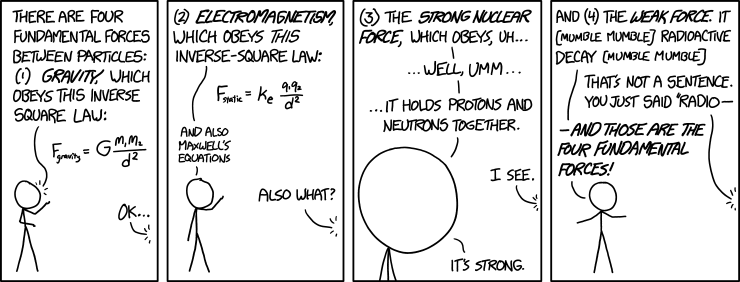
Title-Text: “Of these four forces, there’s one we don’t really understand.” “Is it the weak force or the strong–” “It’s gravity.”
I think OP’s meme illustrates Feynman’s point very well; there comes a stage where if the number of incorrect statements in your explanation outnumber the the correct ones, it’s no longer a meaningful explanation.
It’s been a while since I watched it, so judge for yourself.