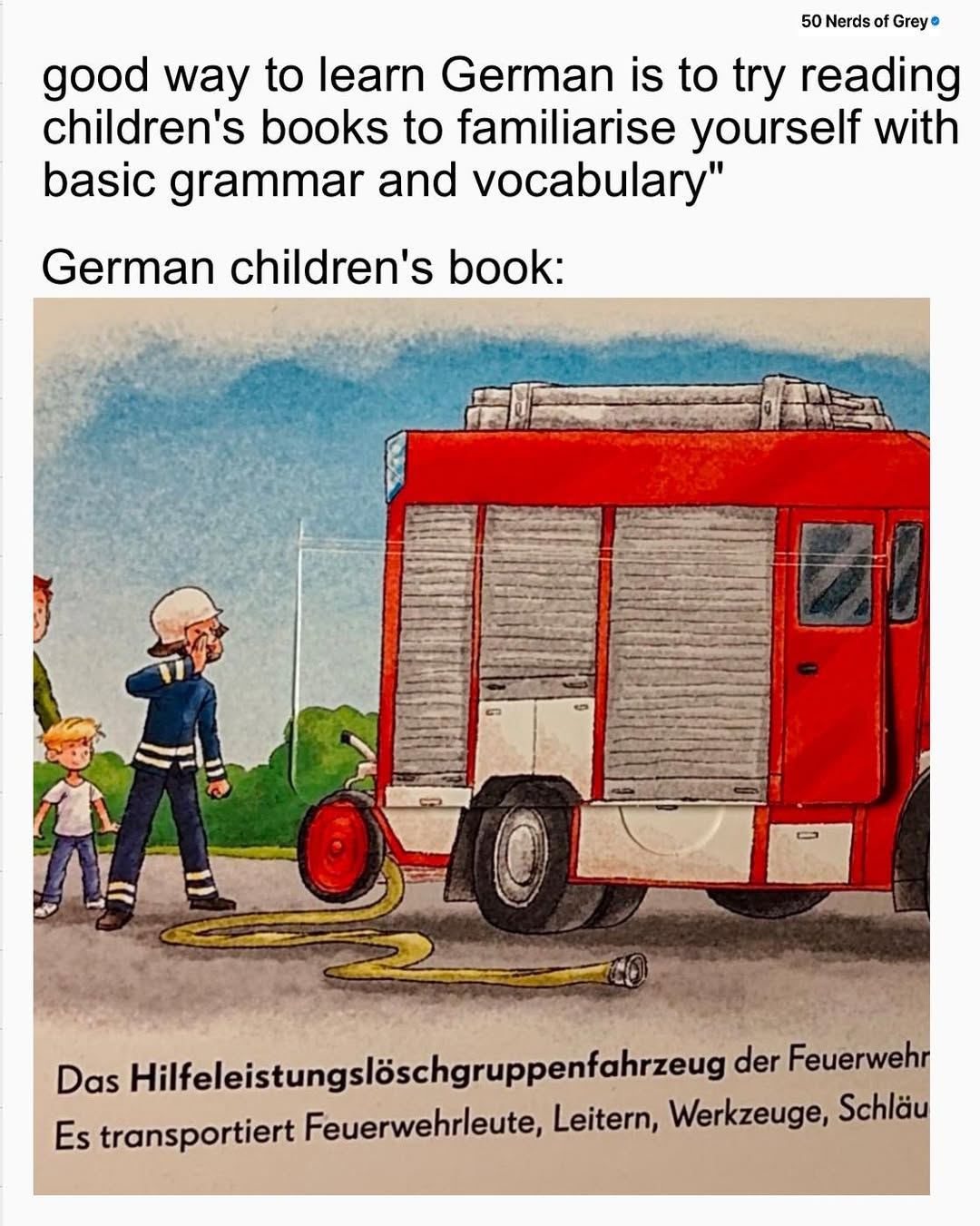

Yes, these compount words might be the reason why we couldn’t get rid of the damn Nazis for good: After the Second World War, we Germans ourselves probably didn’t understand what the purpose of the “Entnazifizierungsbehörde” (authority to combat National Socialist ideology) was and, accordingly, could not really grasp why it was so important. A serious mistake that still has consequences to this day, unfortunately…
/s, obviously
Ah fuck that’s one long mess of several words put together…
Let’s see…
What the fuck does lösch do in that word???
Hilfe (help or assistance)
Leistung (act, performance or service)
Lösch (delete, remove, extinguish)
Fahrzeug (vehicle)
Hilfeleistungloschgruppenfahrze, or Extinguishment help service vehicle
As someone who learnt both German and English as a second language, german was far easier to learn. Atleast the spelling and stuff makes sense.
Removed by mod
How a normal Mexican American misunderstands via conversations with actual Germans…say you got an avocado… Now add salt, its a saltiavocado. Add vinegar, its a saltyvinegaravocado. Now step on it while running and you just “slippedonavinegaravocado” or you had an “avocadoslip”.
I call bullshit. Bullshit doesn’t come.
Say you got a pen … Now add apple, it’s a applepen. Say you got a pen … Now add pineapple, you got pineapplepen.
That’s going to be in my head for a while. Bastard.
I can read “help,” “groups,” and “drive” in the word, but I don’t know the others.
Hilfe – help
Leistung – action (closest translation for this context)
-s- to make it sound less awkward
Lösch – root of the verb “extinguish”
Gruppe – group
-n- to make it sound less awkward (Gruppen being the plural, is incidental)
fahr – root of the verb “drive” or “go” in the context of vehicles Zeug – basically “thing”; hence Fahrzeug = vehicle
I mean, yeah. This is an important part of the German language. They create composite words to describe a thing, and learning to break it down into its constituents is a fundamental part of reading German.
Hilfeleistungslöschgruppenfahrzeug
Hilfe - help
leistung - performance
Hilfeleistung - assistance
lösch - delete, extinguish
gruppen - group (team, department)
löschgruppen - (fire) extinguishing team or department
fahr - drive
zeug - thing
fahrzeug - vehicleAssistance Extinguishing Team Vehicle
Now translate
Donaudampfschifffahrtselektrizitätenhauptbetriebswerkbauunterbeamtengesellschaft
It makes more context to translate “Zeug” as “tool” in most compound words, it is its original meaning like in Feuerzeug, Flugzeug, Fahrzeug, Rüstzeug.
In English, I like to think it would be a “thingie.” Like Germans are constantly trying to remember the word “lighter” and they’re like, “you know, the whatsit, the… fire… thingie.”
No, it’s literally not. It is “tool” or “gadget”. Not just any object or dingsbums.
Zeug used to mean something different back in the day.
Sorry, I wasn’t clear about that being a tongue in cheek remark.
It’s that German humor.
It’s also one of the most difficult parts of learning German as an adult, despite being a relatively simple syntactic rule and something we kinda-sorta emulate in English. The other part, at least for me, were false friends. Also sorry to all the lurking Germans waiting to comment, I forgot all of my German the moment I graduated college.
My biggest issue with Duolingo trying to learn German honestly. Sure I can read a compound word when presented with it, but fucking Duo is like “Cool… now spell it… bitch”
German is phonetic though - once you know how pronunciation maps to the alphabet (and certain compounds), it becomes easier to spell any new word. It’s actually why there’s no Spelling Bee in German.
I learnt to write after hearing in Grundschule. It doesn’t work that well.
As a German I can assure you that false friends are something you scare away all pupils (regardless of age). I have very intense memories of our English teacher correcting us again and again.
Regarding the composita in German: we are moving more towards the English approach by splitting these word monstrousities with hyphens. E.g. Donaudampfschifffahrtsamt may be spelled Donau-Dampfschifffahrts-Amt. Its way easier to read and write. While the hyphenated spelling is not something that is used often officially, it got more popular in the last decades.
My personal favorite is when Pieter cuts off a little girl’s hand:

The words are less impressively compound, but the images speak for themselves. This one is good too:

Great children’s literature!
This is a satirical book right?
It’s German, so probably not.