My goodness. Never realized Europe had such a train problem!
In Europe there is definitely a difference between TGV quality lines and the regional ones which are rarely better than taking the car, sadly (speaking from my years of experience).
I wonder what the map would look like if you at least greyed out the slow lines.
bUt tHe US Is a yOunGEr coUnTrY! wE haVeN’t HaD mUCh TiMe tO caTcHuP.
Looks at China over the last 10 years…
deleted by creator
It both is and it isn’t. An entity know as China has existed for millennia, but the modern government has existed for a little over 100 years.
It’s an interesting thought exercise on how to treat these types of things though. Like how old is the German state? Do you count it from the original unification in 1866, or do you count the government that’s continued since the fall of the Nazi party? What about the Reunification after the fall of the Soviet Union?
The culture and the idea of a country can carry past the fall of its government, but how old does that then make the new state?
Truthfully I don’t know how to answer this, it’s neat though
No, I didn’t say anything like that. I’m saying they’re a large country that only took 10 years to build out a high speed rail network.
US was constituted in 1787. Trains were invented in 1804 and made commercial in 1829. You’ve had the same time as the rest of us.
Railways were being built in the US as early as 1795, and their first purpose-built “main line”, the Baltimore & Ohio, opened in 1830, 5 years after its British counterpart the Stockton & Darlington.
If the train (with a locomotive engine, I assume) wasn’t invented until 1804, as per the comment you’re replying to, were those first railways in 1795 used with animals like horses? Or maybe there’s a disagreement on what counts as the first “real” railway?
Trains have been in use since the mid-18th century, powered by gravity, men, or horses.
They were likely referring to an event in 1804 when, to satisfy a wager, Richard Trevithick’s second rail locomotive hauled ten tons of coal, 5 wagons and 70 men along the full length of the Merthyr Tramroad. It was this run which publicly resolved the question of whether enough tractive force could be generated with only the adhesion of the locomotive itself to the smooth rail.
While this was an experimental design, commercial use of steam locomotives started in 1812 on the Middleton Railway, which had been built in the 1750s and part of which operates as a museum railway today, the oldest route in continuous operation in the world.
Their 1829 date refers to the opening of the Liverpool & Manchester Railway, which was the first purpose-built inter-city main line, but was pre-dated by a lot of other railways.
As there’s a lot of variability of what constitutes a railway (plateway / edgeway? wood / granite / metal tracks? Common carrier or single-user? Passengers? Nags or Kettles Etc) dates are tough. The British rail industry has decided that “modern railways” began in 1825 with the opening of the Stockton and Darlington, and there has been a full year of celebrations for Rail 200. This is a somewhat arbitrary figure and reflects more the desire to rebrand the “newly” re-nationalised rail operators, because the public apparently didn’t sufficiently notice when they were actually nationalised in 2020 as part of the covid emergency. Like I said, dates are tough.
That’s the joke
I always find this one funny as perhaps more than any other nation railways massively shaped how the US grew into what it is today.
the UA
… Ukraine? Normally you’re not supposed to use “the” when referring to it these days.
And while I’m sure rail is an important element of the development of modern Ukraine, I don’t think its the most significant example.
Was a typo. Meant to type US.
It’s much harder to plan around property ownership when you can’t just kill the property owners.
American culture is generally anti-collective so that “independence” coupled with cars becoming status symbols ensured the death of rail in America.
All roads lead to… Chicago?
When in Chicago…
Yes. Please, go on…
Much like in Rome, you eat their signature pizza and then judge. Then you visit the buildings that were left from the time where it was burned to the ground.
Then you go to for their religious sites: for Rome it’s the Vatican, for Chicago it’s the Rat Hole.
… do as Chicagoans do.
Brb getting a deep dish pizza and a shot of Malört
As someone who grew up in Chicago, it has a wonderful rail system. The “US not having public rail” argument always confused me when I was young because I figured everywhere was like Chicago
Fun fact: Cleveland OH was all set to become North America’s hub for continental and transatlantic airship traffic. The problem was that airships fundamentally suck, something that the Hindenburg disaster merely highlighted.
*Tracks
But yes, if you ever need a train you most likely will hit up Chicago.
Chicago has been a major transportation hub for nearly 200 years, it is the furthest inland you can reach from the sea by ship. cattle arrived from Texas ranches to Slaughterhouses on their way to the east coast. Wells Fargo was founded because American Express didn’t want to operate further than Chicago, but they saw there was the opportunity of linking NY to San Francisco by Chicago
it is the furthest inland you can reach from the sea by ship
That’s not actually true. There are several further in than Chicago. Duluth is the furthest inland sea port in the US
I would say that even this is untrue as the US has the largest system of navigable inland waterways in the world You could load a barge with cargo in Albany, NY and get it all the way to Omaha, NE without ever having to portage or unload the barge.
Your wiki link is pointing to the Amazon Sidewalk article.
Thank you. I have been having issues where the Wikipedia app doesn’t properly open up a page and instead puts the text of the new page over the old page.
I didn’t even know there was a Wikipedia app. What’s the point? What does it do better than a web browser?
The UI is much better than the mobile browser and it opens up articles in a new tab that i can come back to without cluttering up my browser tabs
You can reach farther inland than Chicago - Duluth MN. But Duluth is otherwise not a useful destination (unless you need iron ore).
Duluth is to Clevland Cliffs as China is to Long Beach. Empty ships head that way to return with taconite for steel mills
deleted by creator
US also has the advantage of being one big federation with established standards bodies and a federal budget. A train that goes Between Belgium, Netherlands, Germany has to pass through 3 different electrical standards (yes, they are very different), 2 traffic regulations (left or right side), and 3 signalization standards. And they make it work.
Yeah, but excluding entire states is ridiculous.
deleted by creator
We’re already paying to connect rural villages to infrastructure. Do you think connecting a rural village in the middle of nowhere to the street network is profitable? Of course it isn’t. Same for water, wastewater, electricity, and internet.
Besides, a train station doesn’t have to be fancy. If you make it so that people can pay for their ticket on board of the train, all you need is a concrete platform. Relatively cheap, and last approximately forever.
deleted by creator
Tbh do you really need all of that at any train station? Now you could sell the tickets on a website or with a machine. Land yes, that’s true. Don’t actually need really any amenities although would be good of course. Even electricity barely needed if it’s day only. Seriously at the end of the day you dont even need a roof.
deleted by creator
I have a few times but not recently. Why?
Cars and asphalt roads are even more expensive.
Exactly. Every state has a major population hub. Excluding major cities is pretty bad. Except Wyoming. No one fucking lives in Wyoming. Why are they even a state…
South Dakota only has two cities with populations over 50,000.
Another state that shouldn’t exist
In the vague defense of Wyoming and the other great planes states, quite a lot of their population growth was hindered or outright shrank due to the dust bowl which they haven’t recovered from. It’s kinda like how Russia goes through a population dip every 20 years or so due to the sheer number of people who died during WW2.
Is it? There are entire states with populations less than that of major cities.
Yeah where’s my train to Hawaii?!
Apparently the situation with freight is the opposite, where the US networks are efficient compared to Europe (and even China), hence so much stuff is trucked across Europe instead.
As always, take YT videos with grains of salt, but it makes good points:
Meanwhile, other videos suggest that the US’s own passenger rail suppliers (like manufacturers/designers) are basically gone because the situation is so bad, hence companies like Amtrak end up importing EU stuff.
couldn’t they add freight cars to passenger trains to help with this?
Freight and passenger trains optimize for very different things, and those things are largely incompatible.
Passenger trains want speed, quick turnaround on the vehicles, frequent stops etc.
Freight wants efficient transport (= lower speed), few stops, turnaround time is less important.
Based on my experience playing Railway Empire, passenger cars with people and their luggage is significantly lighter than a freight car of the same size loaded with cargo. This means it takes a lot more energy to get the freight moving at a higher speed, and maybe more importantly a lot more to stop (I think it takes 3-4 football fields for a loaded freight train to stop from 30mph). So just having passengers allows the train to travel at much higher speeds. Speed is something more valuable for passengers because they want to get where they are going sooner. Freight is more about total throughput volume so it may be better to have one heavier train carrying twice much at a slower speed than two trains have the size each moving faster. So while you could have a mixed train it’s not going to be as fast as the passengers want due to the heavy freight cars slowing the train down and won’t carry as large a volume as the freight customers want because some cars are being taken up by passengers.
The way I understand it in the states is that all the rail lines are freight lines, and amtrack shares the rails. I’ve taken amtrak before and had to stop for like 15 minutes for a freight train because they have the right of way
AFAIK passenger trains have priority. But they have a lot of single rail infrastructre and freight games the system with trains that are too long for passing sidings, so the passenger trains have to wait.
I had heard that freight usually has priority largely because Amtrak leases the tracks from the freight companies that own the rails and usually a stipulation of those leases is a priority for the company’s trains.
Federal law requires that passenger trains be given priority
Here in Italy most cargo is on trucks, our highways are a nightmare when it comes to traffic. The rest of Europe is usually better.
Kind of? The new locomotives are the Siemens Alc 42, but they are built in California.
Edit: To your point, Seimens makes a way better locomotive, and profits go overseas.
Goes to show how successful the oil and automobile lobbyists. The US passenger railway network is a fucking flop. When will they finally use electric locomotive instead of the pollution belching diesel electrics.

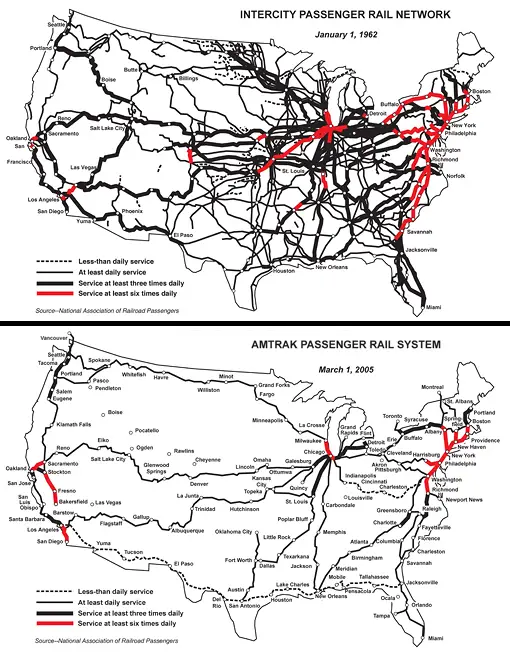
Wasn’t always this way
If you build it, they will come.
I mean yes this does show passenger trains but it doesn’t actually show all of the passenger trains such as the lines that run in Utah nor south well over a hundred miles carrying passengers for commuter purposes. So there’s quite a few lines that are missing on here there’s also lines that run up and down the East Coast I know as well and there’s other passenger trains and other cities such as salt lake as well.
Yup, I can see multiple NJTransit and SEPTA lines missing from this map.
Yeah, you’re right. The train at the end of my street isn’t pictured.
would be good to have a good map …
The european map does not show all minor railsystems, I am not 100% sure but it looks more like interregional rails.
In Holland it seems to show them all but it probably differs by country.
One thing we are really really bad at in Europe is homogenising rail systems. Every country does its own thing, like voltage, signalling systems, sometimes even with their own gauge (e.g. spain). Only the high speed lines are fairly commonised.
There’s some projects going on like the ETCS safety system but they go at a snail’s pace because there’s so much installed base and design by a 25-country committee that are all trying to rope in their own industry ties is a slow process.
That’s basically all of Canada’s lines too. Our East/West line and the Polar Bear Express is that little line at the top of Ontario.
US is grossly wasting fossil fuels on airplane flights. O&G industry is behind this. Their bottom line depends on society being wasteful and inefficient.
It’s even worse if you do a high speed train map. The US only has about 150 miles and even the. A chunk doesn’t exceed 60mph even though they call it “high speed”
Plate glass vs laminated glass
It also doesn’t acknowledge that a lot of that is just empty space. The US is ranked 180 of 242 nations in population density.
https://en.wikipedia.org/wiki/List_of_countries_and_dependencies_by_population_density
The US rail system has been bastardized since its inception, but this map is basically useless. The UK has 7x the population density as the US.
It also doesn’t acknowledge that a lot of that is just empty space.
Yes, we have a lot of empty space, but we have very few N/S passenger trains out west.
For example, a train from Albuquerque to Denver is a 45 hour one way ride because you have to go to Chicago from Albuquerque, then back to Denver. This is a 6 hour drive. There is also nothing from El Paso to Albuquerque. However this does not show the train from Belen to Santa Fe that goes through Albuquerque.
That’s a problem that is easily solved by building less trains in places with no people and more trains in places with lots of people.
To be clear, the U.S has plenty of places that could easily support rail transit, and High-speed rail. That they are not getting built is just good old political failure.
it’s important to stress that rails only work in densely populated areas. it’s very economically stupid to build railways in thinly populated areas. unfortunately, i see way too many idiots advocating that public transport be built everywhere, which smears the reputation of the whole public transport system, because it is then perceived as economically stupid and inefficient. public transport needs to focus on the cities and inter-city rail.
cars are more complicated and took a longer time to develop, which is why trains were the only option before that
More like we decided to invest billions(trillions) into building freeways instead of our rails. And then air travel became cheap.
There’s also a lot of benefit in connecting different densely populated areas by rail, and those rail lines can then serve some of the less populated areas in between. E.g since we’re discussing the US, there’d be value in having high speed rail between NYC and Chicago, because people need to travel between those cities, even if in between there are a lot of sparsely populated areas. Sadly right now it’s not a real option because the train is slow af compared to just taking a plane, but if the system functioned well and they had actual high-speed trains like we do in Europe or Asia, there’d be a LOT of benefit in connecting densely populated areas through sparsely populated areas and adding a few stops in between. Fewer people would be driving cars from small towns to the cities, etc.
The USSR had like half the US’s population density. They ran trains even to remote villages. Sometimes there wasn’t even a platform, just a dude with a locomotive and a car who would stop if anyone looked like they needed a ride or to take their animals to market. Today, Japan maintains unmanned platforms in places with daily ridership <10.
China runs HSR to towns even as small as 120K (probably smaller, but that’s the smallest town I’ve stayed in), the primary way to get between cities in Vietnam is by bus (or motorbike, but those aren’t allowed on highways).
What’s stupid and inefficient is prioritizing cars over public transit.
In principle I agree with you, but I want to nitpick some things because I’m an asshole.
The USSR had like half the US’s population density. They ran trains even to remote villages
Not the greatest example, because a lot of human lives were lost in building the Siberian railroads. I’ve read reports of 300k people, though of course with it being Soviet Russia… Nobody knows for sure.
Today, Japan maintains unmanned platforms in places with daily ridership <10
This sounds stupid inefficient, but it’s actually not. Build a railroad to a destination with daily ridership <10? Very inefficient Build a railroad with actual usage, but also serve stops in between that have nearly no daily ridership? Actually a good idea, because you already build the railroad for the most part and those people also need transport.
China runs HSR to towns even as small as 120K
Lol to me that’s a medium sized city. Second biggest city of my country is fewer than 120k. We don’t have high speed rail, but we will eventually, between the capital/biggest city and the rest of Europe. For now, rail still exists for most towns above 20k.
the primary way to get between cities in Vietnam is by bus (or motorbike, but those aren’t allowed on highways).
Buses actually suck for inter-city transit, trains are way better (and at these speeds and distances, cars are OK too). Are you sure motorbikes aren’t allowed on highways at all? In most countries in the world, they are. Mopeds are not, though - since mopeds can’t go as fast as highway traffic usually does.
I’ve read reports of 300k people, though of course with it being Soviet Russia… Nobody knows for sure.
The records were opened in the 90s, any reports before that were little more than SWAGs. After the 90s, they had the names of the workers involved so you can have very exact estimates.
Lol to me that’s a medium sized city. Second biggest city of my country is fewer than 120k. We don’t have high speed rail, but we will eventually, between the capital/biggest city and the rest of Europe. For now, rail still exists for most towns above 20k.
OK, but there’s 100 cities in America bigger than that. But also it’s simply the smallest Chinese town I’ve spent time in, I’m certain smaller towns have trains. The density was somewhat greater than the average American town, but it meant you could take a public electric scooter or bike across town in 5 minutes instead of 10 minutes.
This sounds stupid inefficient, but it’s actually not. Build a railroad to a destination with daily ridership <10? Very inefficient Build a railroad with actual usage, but also serve stops in between that have nearly no daily ridership?
Yes and no? As far as I am aware the JRs don’t build platforms~~ anymore.~~ in towns with small ridership, but due to japan’s rural population crisis, they simply have platforms in shrinking towns, and if it’s already built it’s cheap to maintain. Low or negative interest loans with regulations to punish companies for providing substandard service could facilitate the construction in theory, but I am not aware of any specific location where that’s occurred.
Buses actually suck for inter-city transit, trains are way better (and at these speeds and distances, cars are OK too). Are you sure motorbikes aren’t allowed on highways at all? In most countries in the world, they are. Mopeds are not, though - since mopeds can’t go as fast as highway traffic usually does.
Vietnam has some political, social, and geographical issues that make building both city and intercity rail very difficult.
Mopeds are not, though - since mopeds can’t go as fast as highway traffic usually does.
Except for CT08 and I think CT10? outside Hanoi, you 100% cannot take a motorbike on a CTXX. There’s other major roads you can take bikes on, and I’ve taken my bike on a highway that was under construction, but don’t take them on the other CTs.
Presumably those countries have a minimum speed limit. VN just bans anything with <4 wheels. I can tell from personal experience and word of mouth, even if you’re doing 100+, you will be stopped and lucky if they let you off without a shakedown. I was lucky enough they believed I got forced on by traffic and was trying to find an exit.
This kinda sucks because it increases the time to get between some places by over 2x
Also I read that in the US Amtrak gives priority to cargo trains even though laws exist expressly forbidding that, so that a 200km trip with no stops ends up taking 4 hours.
That’s true - they do this by making their trains longer than the sidings.
You’d think they’d make that illegal, but no. Political failures are incredibly common in the world of rail
Ah. That’s why the US trains are always stupidly long. It’s not economics. It legal.
Its also so they can use less crews to run trains. A 2 person crew can run a long train that otherwise would require 2 or even 3 crews.
Ok… so why isnt the east coast covered in rails? The western states pulls the average way down.
The East coast is covered in rails. There’s an Amtrak station within walking distance of my house. We have a high speed rail line in the Northeast Corridor and have for decades.
Are we looking at the same image?
Actually, I realize we’re not looking at the same map. Those are the passenger routes. I’m thinking of railways. We’ve got more rail than that, we just don’t run passenger trains on them.
Yes, theres a lot of rails. Though, even that has declined as more freight is being moved by trucks…
I live here. I know where the train tracks are. They’re all over creation.
Only what is vestigally left. This is what it used to look like
Why is no one concerned that europe has taken the place of mexico??? Where is mexico now??? How is this not international news?
It’s an exchange program so that the Scandinavians can learn to cook Mexican food for us
Yeah but now Mexicans are cooking pickled herring tacos.
Hmm. I would try it.
And still here in Europe they are not a meaningful alternative to the plane. Taking for example an Amsterdam to Barcelona is an exhausting 12-14h deal (almost 10x as long) and 5x more expensive.
What we need is express trains that go from A to B without stopping anywhere, avoiding city centres and constantly running max speed. If I’m going to Barcelona I don’t want to stop in Schiphol, Amsterdam, Rotterdam, Antwerp, Brussels, and various cities in France. There should just be a dedicated departure just for that (and judging by how many planes go back & forth daily these trains could certainly be filled). This would cut down on that exhausting travel time a lot. But we lack the high-speed network capacity for that. And won’t have it for at least 15 years even if they decided to build them now :( So planes it is.
The will never be enough capacity to connect capitals with no intermediate stops. And let me tell you, it’s in general a stupid idea.
12h is not a big deal if travelled overnight. Which is currently not possible. So this what we really miss, not constant 300 km/h direct connections.
And of course, we need to stop taxing passenger rail companies. And maybe re-nationalise them, while we are at it. Forcing free market in the railway has been one of the biggest mistakes of the European Union.
The will never be enough capacity to connect capitals with no intermediate stops.
Do you mean demand? Currently there is not enough capacity.
Counter-examples to your negativity are found in Japan, Korea and China.
There are no such examples for what the user I replied to is proposing.
They want one high-speed train per each European capital.
I think 12h is a big deal, for business travelers it makes the whole trip pointless. And for leasure travelers it means paying for a really expensive sleeping cabin or “sleep” in an uncomfortable seat.
I agree the privatisation was a big mistake, also in healthcare, energy etc.
I agree the privatisation was a big mistake, also in healthcare, energy etc.
Privatizing is always a mistake. Profit is waste and theft. Making public services for-profit is inevitably going to turn to shit.
I agree completely. I wish more people did :( In Holland in particular, neoliberalism is like a religion and nobody even questions it anymore.
There was a concept I thought was neat. Imagine around stops you had a parallel set of tracks with cars that would connect to the train and passengers would have X number of minutes to transfer between the parallel trains before they decouple.
So a ‘fast lane’ train wouldn’t actually stop, it would just couple to another train that does pretty much nothing but transfer passengers to and from the stop.
Though the reality is that would require a lot of work when the counter argument can be “fly a plane direct instead”
The Nightjet trains from La Spezia (Italy) goes both to Wien and München, as it splits in Villach.
On the opposite direction, the train from München is coupled with the one from Wien.Why is it not done more often? Because coupling trains is a security operation, and it takes time (1h+).
On top of that, modern trains are a fixed composition that you cannot couple and decouple as you like.Note this concept was about a hypothetical design and infrastructure. That coupling would be horizontal and occurring while moving and using train designs that didn’t yet exist.
I said interesting, not necessarily practical. It’s something we might have tried to do if we didn’t have direct flights as a viable option.
Twelve hours to get across a whole continent is fine.
I think we must stop thinking of the whole world being just a few hours away. Travel has to include some actual travelling again.
Amsterdam to Barcelona isn’t crossing an entire continent, though.
And you still haven’t countered his point about planes being faster and cheaper.
Let’s stop being tribalists and look for real solutions to real problems, eh?
spoiler
Just kidding, I know that’s asking too much of you people.
The LowTech Magazine disagrees
Interesting, well-written and nerdy report from 2013! I wonder if the aspects of the trans-European rail situation (pricing, travel times, frequencies, interconnectivity, train changes etc.) have gotten better or worse since then.
Interconnectivity did not increase at all. Ironically it’s countries like Slovakia which still have a parvence of that.
And Switzerland, of course, is doing fine.
honestly I wouldn’t mind it taking 12 hours, but it also being more expensive just doesn’t make any sense at all. Europe needs to stop subsidizing air travel and needs to up its rail subsidies
Yes. In Italy train travel, and especially bus travel, is still somewhat affordable. In most other places you feel just stupid in paying 100€ to cross 300 kilometres when you can go much farther with 30€ on a plane…