
Want to wade into the snowy surf of the abyss? Have a sneer percolating in your system but not enough time/energy to make a whole post about it? Go forth and be mid.
Welcome to the Stubsack, your first port of call for learning fresh Awful you’ll near-instantly regret.
Any awful.systems sub may be subsneered in this subthread, techtakes or no.
If your sneer seems higher quality than you thought, feel free to cut’n’paste it into its own post — there’s no quota for posting and the bar really isn’t that high.
The post Xitter web has spawned so many “esoteric” right wing freaks, but there’s no appropriate sneer-space for them. I’m talking redscare-ish, reality challenged “culture critics” who write about everything but understand nothing. I’m talking about reply-guys who make the same 6 tweets about the same 3 subjects. They’re inescapable at this point, yet I don’t see them mocked (as much as they should be)
Like, there was one dude a while back who insisted that women couldn’t be surgeons because they didn’t believe in the moon or in stars? I think each and every one of these guys is uniquely fucked up and if I can’t escape them, I would love to sneer at them.
(Credit and/or blame to David Gerard for starting this. A lot of people didn’t survive January, but at least we did. This also ended up going up on my account’s cake day, too, so that’s cool.)
Found another website doing a good job keeping eye on the slop machines and their promoters: The AI Dirty List.
It also lists those who have fought against the bullshit fountains as well.
In other news, Larry Garfield of GarfieldTech has had enough of the bullshit fountains, and put out a fury-filled sneer in response.
Don’t want to use AI because it’s built on copyright infringement and literally destroying the planet? Well, I guess you can’t work in software anymore, sorry. It is what it is.
Every time someone like Jeffrey Way says “it is what it is,” it makes it so. It is not inevitable just because Sam Altman tells his over-leveraged investors it is so. It becomes inevitable when you, you personally, decide that you just don’t want to think about the externalities or put in the work to find better alternatives.
We are making this choice. But really, that means you have already decided for me. And I curse you and the ground you walk on for it. No, I’m not joking or exaggerating. Burn in hell.
10/10 No notes.
Someone has a program to steal people’s entire codebases using malicious ai coding assistant extensions.
(note, it is an ai firm posting this, compete with cutesy slop hero image)
The vscode extensions actually do exactly what they advertise, it’s just that they also take all your code and share it with a third party for whatever purpose.
Emails Show Even Epstein Thought Crypto Pumps are Unethical | Gizmodo
Crossover month for the epstein extended universe continues…
Re datacenters in space:
Multiple hackernews insist that SpaceX must have discovered new physics that solves orbital heat management, because otherwise Musk and the stockholders are dumb.
SpaceX must have discovered new physics that solves orbital heat management, because otherwise Musk and the stockholders are dumb.
Truly a conundrum worthy of the XXI century
Very much “sweaty guy hovering over two buttons”
recently learned about electrofuels. it’s a hypothetical rube goldberg scheme where you put enough energy to propel 5-7 EVs in, and pull out enough gasoline to fuel one car. it’s sold as a green technology, because now gasoline is green somehow. this spin ignores that it would require massive buildout of renewables + nuclear, and just by doing this electrification of many energy end uses just makes sense, including transportation. (what the fuck is train??) it’s also sold as a long term storage for renewables, but i struggle to see how scheme that has less than 30% roundtrip efficiency can be considered “storage”. just build more renewables and don’t use them all if needed
cui bono?
it’s a complicated pr campaign by volkswagen group (and some other usual suspects). this is a nonexistent magic solution to a real problem, so it fits a common pattern (and also makes it stubsack material) that also attempts to shank electric vehicles adoption.
if anything, it’s backwards because EVs are adopted faster than renewables buildout happens (cars last less than powerplants). if realized, this allows volkswagen group to manufacture regular cars for a long, long time even after oil refining stops. originally, it was proposed as a hypothetical luxury product for antique car owners, because it’s physically possible, but doesn’t make sense in energy or cost terms. but then someone spun it into potential regular retail good, and also maybe this pr campaign was a part of reason why internal combustion car ban was axed at eu level recently. now that it happened, they don’t need to push it so hard
it is something ironic in there that last time this process made sense was in nazi germany, just this time source of syngas is different
So, the idea isn’t entirely as stupid as it initially sounds. There are two things that you gain from this approach:
- You can more easily separate your energy generation and consumption. Power lines are lossy, and there are a lot of very sunny and very windy places that are a long way away from where people actually want to live. Massive HVDC infrastructure buildout isn’t cheap or easy.
- Energy density of chemical fuels is higher than batteries. Being able to travel long distances without convenient nearby power sources is useful… long distance high speed rail isn’t always convenient to electrify, but also long haul flights and rocketry are Quite Difficult to run on batteries.
FWIW, I suspect the cost will end up being even higher, because you’ll start losing the economies of scale that modern vehicle infrastructure has, because normal people will just use EVs.
It can only ever be an intermediate technology anyway. Artificial photosynthesis and more sophisticated fuel cells seem like much more plausible longer-term futures.
i think that business logic goes against your first point. spatially: if you have source of cheap energy and want to make money out of it, instead of making little money (by making fuel) why not make more money? (by setting there energy intensive manufacture) this seems to be current meta, with places like iceland and norway making aluminum and nitrogen fertilizers respectively. this can continue in other places and maybe extended to some other industries.
temporally (because there are also sunny and windy days when regular people won’t consume all energy): this scheme requires cheap electricity, which is needed for cheap hydrogen. this requires massive renewables buildout, which means electricity is cheap for regular people, which means that every gas stove/heater and car will get replaced with electric ones, both residential and maybe perhaps faster for industrial users (more available loans). this means you have to reinforce transmission grid anyway. this also means cheap hydrogen, and because main input to its production is electricity, it makes more sense to use electricity when it’s cheap. this means it’s naturally suited to suck up all excess generation (both daily and seasonal), and also if electricity production is seasonal then so should be price of hydrogen. if price of electricity or hydrogen varies, then some industries can suck it up at greater rates when it’s cheap. i’m thinking here of aluminum smelting (electricity input, daily variation, already done), or ammonia synthesis, or direct reduced iron smelting. i bet there’s more. the point is, maybe you get to avoid storing hydrogen to some degree, because you can effectively store energy in finished or semi-finished goods. you can, for example, make some direct reduced iron and just store it when hydrogen is available, and then smelt it into steel in arc furnace when it’s not. fertilizers are already sold in annual cycle and stored long term, and anyway ammonia is much easier to store than hydrogen. how it plays out will depend on energy/hydrogen costs vs storage costs vs capex for overcapacity costs. all together, i think this means that because of large amount of generation needed, you don’t actually need to store energy this way at all, because when generation is low then electrolyzers turn off, and something will work at all times, probably. when you’re able to do that, you won’t need to
in terms of scale, first your lunch is eaten by EVs of various shapes, then by use of hydrogen for transportation (rocketry fits there), then you have to compete with biofuels (jet engine will take anything that burns without ash and can be pumped). then some of methanol will be used for fuel first, because it just works in engines and fuel cells, and it’s a step before hydrocarbon synthesis. only then synthetic petroleum makes sense, this basically leaves some aviation (that won’t use methanol) and military uses
instead of making little money (by making fuel) why not make more money? (by setting there energy intensive manufacture) this seems to be current meta, with places like iceland and norway making aluminum and nitrogen fertilizers respectively. this can continue in other places and maybe extended to some other industries.
Because now you have to establish a complex supply chain and potentially large worker base in a place that’s potentially quite inconvenient for both, instead of a much simpler supply chain and smaller workforce.
this requires massive renewables buildout, which means electricity is cheap for regular people
Well, not necessarily. Because as I said, there are places which are very sunny and/or windy which are also a long way away from the people and industries which would like to consume the power that could be produced there.
Long distance power transmission is an very expensive infrastructure to build, and unless you’re building even more expensive modern HVCD systems you can get significant transmissions losses to the point where your distant renewables aren’t really much good. If you can convert the power to something transportable, either on-site or nearby, then you can avoid the transmission losses and giant infrastructure projects.
Much as I do not like the oil industry, there is a significant amount of equipment and expertise out there for storing, transporting and converting flavours of hydrocarbons into other flavours. Some use could be made of it.
then you have to compete with biofuels
I’m not so sure about that. They’re a whole ecological catastrophe in and of themselves, and another cash crop that rich nations can extract from the poorer ones, ultimately to everyone’s detriment. They’re also going to be feeling the squeeze from climate change which is going to make them harder to grow economically as time goes on.
There might be a breakthrough ethanol-brewing algae which might suddenly change everything, but I don’t anyone has the bioengineering chops for that yet.
hydrogen costs
I strongly feel that hydrogen is even more of a dead-end technology than these e-fuels. It is a right pain to store and transport and has rubbish energy density. There’s no future in the hydrogen economy. I’d bet we’re more likely to jump to artificial photosynthesis and fancy fuel cells than we are to see any substantial hydrogen infrastructure.
Because now you have to establish a complex supply chain and potentially large worker base in a place that’s potentially quite inconvenient for both, instead of a much simpler supply chain and smaller workforce.
i’m not sure why you think that it is the case. if you want to make aluminum, you just need a ship to come in and pile up alumina, then take up piled up aluminum. the process is decently automated these days and you avoid making hydrogen. if you want to make ammonia, then all you need is hydrogen that you use as soon as it’s made and nitrogen which is separated from air on demand. nitrogen fertilizers account for something like 2% of global primary energy use so it’s probably decently scalable. then you can ship out liquid pressurized ammonia, or convert it to ammonium nitrate which again you can pile up*. however with methanol you run into a Problem, because you need carbon dioxide, which means that you have to ship it from somewhere or capture in a massive installation. this immediately makes logistics of this entire enterprise harder. if you want to convert methanol to hydrocarbons then it takes some extra energy for little benefit (2x energy density) and some losses. to some degree, maybe it will make sense, but maybe it’ll be easier to just build up renewables where people already live
in that scenario biofuels get to serve much smaller segment than today in the first place so maybe it’s less of a problem. there are also things like biogas
I strongly feel that hydrogen is even more of a dead-end technology than these e-fuels. It is a right pain to store and transport and has rubbish energy density. There’s no future in the hydrogen economy. I’d bet we’re more likely to jump to artificial photosynthesis and fancy fuel cells than we are to see any substantial hydrogen infrastructure.
and you base that on what exactly other than vibes? there are applications where you need hydrogen directly as a reagent like ammonia synthesis, and these are probably most adaptable to this approach. methane is also proper PITA in terms of storage, yet we store it anyway because it’s cheap as a fuel. if hydrogen is cheaper than that, then it will be used where applicable. it’s easier to transport coal than electricity but not lignite; i don’t know how it will play out with hydrogen, but either way you can imagine a situation where hydrogen is generated onsite, or within pipeline distance, and used immediately or maybe with some storage worth hours to days. this fits iron smelting (DRI) nicely, today the fuel used for it is methane because it’s cheapest (process common in India). if hydrogen is cheaper than that, it will be used instead. other than that, applications where high heat is needed and where no electric heating can be used would be another use of hydrogen, like glassmaking and metal objects manufacture. hydrogen might be not disastrously bad option as fuel for transportation, because every step in manufacturing other fuels introduces losses; there are other tradeoffs
what do you want to fuel these fuel cells with? hydrogen is simplest option and most efficient (60% roundtrip efficiency or so). artificial photosynthesis is not a thing currently and strictly worse than combination of any energy source + conventional electrolyzer, because you have to combine not within single device but within single material something that will work as both. this also is only applicable to solar, not to wind or nuclear. some of these direct light to hydrogen schemes also only use UV only, and hydrogen is mixed with oxygen which is suboptimal, not to mention that main output of that work seems to be grant applications, while both electrolyzers and solar panels or wind turbines are available today, in bulk, straight from factory, and even more efficiently in decarbonization terms, these can replace coal-based electricity generation
regardless, main value of electrofuels today is in propaganda
* regular process starting from gas has carbon dioxide as a byproduct, so urea is another option, but with hydrogen it would have to be provided. it’s more expensive even today. maybe liquefied gas carrier could provide carbon dioxide and load ammonia on return leg, with some other dry cargo ship picking up that urea at some other time
Wait so they figured how to use renewable energy to create something that still generates emissions? Is this a ploy to get Trump on board with renewables?
the point is, as always, to continue doing business as usual (in this case, by inhibiting BEV adoption). that fuel is carbon-neutral but also extraordinarily wasteful. trump’s deal is something called “clean coal”, which isn’t (it suggests carbon capture, but it’s not a thing, they marketed normal emissions control like we have in europe as some unusually green innovation). i think he was also captured by gulf monarchies for the one hour when their representative talked to him
e: wait it still makes smog so checks out
if realized, this allows volkswagen group to manufacture regular cars for a long, long time even after oil refining stops. originally, it was proposed as a hypothetical luxury product for antique car owners, because it’s physically possible, but doesn’t make sense in energy or cost terms.
If VW is trying to mainstream this, that tells me they’re scrambling to keep milking the premium end of their portfolio that relies on extravagant IC engines (Porsche, Lamborghini, Audi etc.). Very bad sign for them, as the ID Buzz van looks to be a complete failure to the point of “pausing” production, and VW Commercial Vehicles is their backbone in Europe, much like Ford relies on truck sales in the US. I watched a video a few weeks ago that discussed how their European van/utility vehicle portfolio is aging and totally fragmented, to the point that they are selling rebadged Ford Transit vans manufactured in Turkey. I thought it was bad when they were badge-engineering Dodge Caravans for the US market for a few years, but totally bungling the EV van rollout in Europe is seriously bad business for them.
It was also hilarious how the rich guys on the Porsche forums were bad-mouthing the rather sexy Mission X EV supercar concept a couple years ago. No matter how cool a 9,000-rpm flat-six is, letting yourself be driven by the guys who just want you to keep making that forever will not stave off everyone else (now including China and Vietnam!).
i don’t know if they started it. what i suspect as their contribution is bold claim that electrofuels might be cheaper than regular petrol in the glorious future, while currently they’re much more expensive. (30x?) strict prerequisite for their competitiveness is cheap electricity, but at this point they’re not needed. there was also Porsche owned wind power to methanol plant, and while methanol works as petrol replacement, all the plastics in contact with it must be resistant which is not a given. i guess the main value of it for them is propaganda, they’re not ready for EV manufacture
Either the stupidity just metastasized or China is going to try and pull a reverse star wars on the US and make them burn up an even more horrendous amount of capital to keep up with nothing.
China plans space‑based AI data centres, challenging Musk’s SpaceX ambitions (reuters)
You know what they say. Never interrupt your enemy when they are making a mistake, as this can allow them to continue their errors and lead to their own downfall
Today in excellent cold opens: “I didn’t talk to ChatGPT, I never have. Instead, I took a load of edibles and laid down in the driveway with the hose on. I produced nothing of value and wasted a ton of water, but at least I ate three protein bars so I’m so healthy.”
Not one, but two utterly out of touch LWs trying to interact with culture.
Earlier today, woke Proust get slammed by some young 'un direct from college: https://awful.systems/post/7140871/10327823 (note that they can take time off to read Recherche, even going to the length of spending time in France, which tells me they don’t really have to worry about getting a job or anything)
And now, someone tries to “explain” the perfectly spherical explosion at the end of the Akira movie with the fact that atom bombs in Japan really looked like that because humidity, utterly forgetting that the explosion in question was psychic/telekinetic and therefore probably follows its own damn rules on visual appearance
I swear to fucking god both LW and HN have the worst takes on culture in general and SF/F in particular.
Axios publishes an ad for Anthropic. tptacek bravely defends a corporation from unimpressed fellow hackers
https://news.ycombinator.com/item?id=46902909
Edit: tptacek implies that Ludic no longer stands behind Contra Ptacek’s Terrible Article On AI, which I don’t believe.
https://news.ycombinator.com/item?id=46906403
tptacek explains that the one armed bandit addiction loop is good actually:
https://news.ycombinator.com/item?id=46905142
Edit2: He took off to his Xafe space. Getting Mozilla Jake vibes. lol at tptacek calling it the orange site:
Here’s a fun exercise: go email the author of that blog (he’s very nice) and ask how much of it he still stands by.
Has someone already done it or should I send the email? Ludic would be delighted I’m sure
I can do it, I have to email a bunch of stuff today anyway. (Edit: sent.)
Hero!
Here’s a screenshot in case it vanishes:

that one in which the person behind/running @FirefoxWebDevs drops the mask so fast it looks like a magic trick: gallery link
thread by @self, toots by myself and others. the poster managed to keep their civility for quite a while until I dared™ to highlight their lack of a reply outside of UK 5pm, at which point they immediately ramped up
(and based on some screenshots I’ve been sent, he’s also been doing the classic tail-darvo moping elsewhere)
I’ll have you know we’re acting like someone who’s rude to “serving staff” right now, where serving staff is defined as a formerly chrome currently mozilla developer relations marketing guy with fucking flatlined vibes
uhm @self can you show me where I wrote this? can you show me where I wrote these exact words? no? that’s so irrational of you.
Thanks for lighting his ass on fire. o7
and it wasn’t even my goal to do that! couple of replies across hours, trying to see if this guy is capable of … irunno, unassing their head(?) and engaging with the criticisms
then the subtlest thing set them off and shit went mask off so fast
but hey, at least this way we now just know and don’t have to guess. so much easier
In Great Depression 2 news…
Goldman Sachs taps Anthropic’s Claude to automate accounting, compliance roles:
https://www.cnbc.com/2026/02/06/anthropic-goldman-sachs-ai-model-accounting.html
Love the idea of having the plagiarism machine do compliance work. The computer takes care of everything!
AAaas: Arthur Anderson as a Service.
It seems that Anthropic has vibe coded a C compiler. This one is really good! The generated code is not very efficient. Even with all optimizations enabled, it outputs less efficient code than GCC with all optimizations disabled.
did you have a point you wanted to make?
There seem to be a few people here now who just dump unrelated links without any explanation. (See also the one who just posted a dozen, which all seem to mention Trump). No idea what they are trying to do.
this, yeah
not everybody heard of gas town within first two weeks
I wonder what actual experts in compilers think of this. There were some similar claims about vibe coding a browser from scratch that turned out to be a little overheated: https://pivot-to-ai.com/2026/01/27/cursor-lies-about-vibe-coding-a-web-browser-with-ai/
I do not believe that this demonstrates anything other than they kept making the AI brute force random shit until it happened to pass all the test cases. The only innovation was that they spent even more money than before. Also, it certainly doesn’t help that GCC is open source, and they have almost certainly trained the model on the GCC source code (which the model can regurgitate poorly into Rust). Hell, even their blog post talks about how half their shit doesn’t work and just calls GCC instead!
It lacks the 16-bit x86 compiler that is necessary to boot Linux out of real mode. For this, it calls out to GCC (the x86_32 and x86_64 compilers are its own).
It does not have its own assembler and linker; these are the very last bits that Claude started automating and are still somewhat buggy. The demo video was produced with a GCC assembler and linker.
I wonder why this blog post was brazen enough to talk about these problems. Perhaps by throwing in a little humility, they can make the hype pill that much easier to swallow.
Sidenote: Rust seems to be the language of choice for a lot of these vibe coded “projects”, perhaps because they don’t want people immediately accusing them of plagiarism. But Rust syntax still reasonably follows languages like C. In most cases, blindly translating C code into Rust kinda works. Now, Rust does have the borrow checker which requires a lot of thinking to deal with, but I think this is not actually a disadvantage for the AI. Borrow checking is enforced by the compiler, so if you screw up in that department, your code won’t even compile. This is great for an AI that is just brute forcing random shit until it “works”.
I wonder what actual experts in compilers think of this.
Anthropic doesn’t pay me and I’m not going to look over their pile of garbage for free, but just looking at the structure and READMEs it looks like a reasonable submission for an advanced student in a compiler’s course: lowering to IR, SSA representation, dominators, phi elimination, some passes like strength reduction. The register allocator is very bad though, I’d expect at least something based on colouring.
The READMEs are also really annoying to read. They are overlong and they don’t really explain what is going on in the module. There’s no high-level overview of the architecture of the compiler. A lot of it is just redundant. Like, what is this:

Ye dude, of course it doesn’t depend on the IR, because this is before IR is constructed. Are you just pretending to know how a compiler works? Wait, right, you are, you’re a bot. The last sentence is also hilarious, my brother in christ, what, why is this in the README.
Now this evaluation only makes sense if the compiler actually works - which it doesn’t. Looking at the filed issues there are glaring disqualifying problems (#177, #172, #171, #167, etc. etc. etc.). Like, those are not “oops, forgot something”, those are “the code responsible for this is broken”. Some of them look truly baffling, like how do you manage to get so many issues of the type “silently does something unexpected on error” when the code is IN RUST, which is explicitly designed to make those errors as hard as possible? Like I’m sorry, but the ones below? These are just “you did not even attempt to fulfill the assignment”.
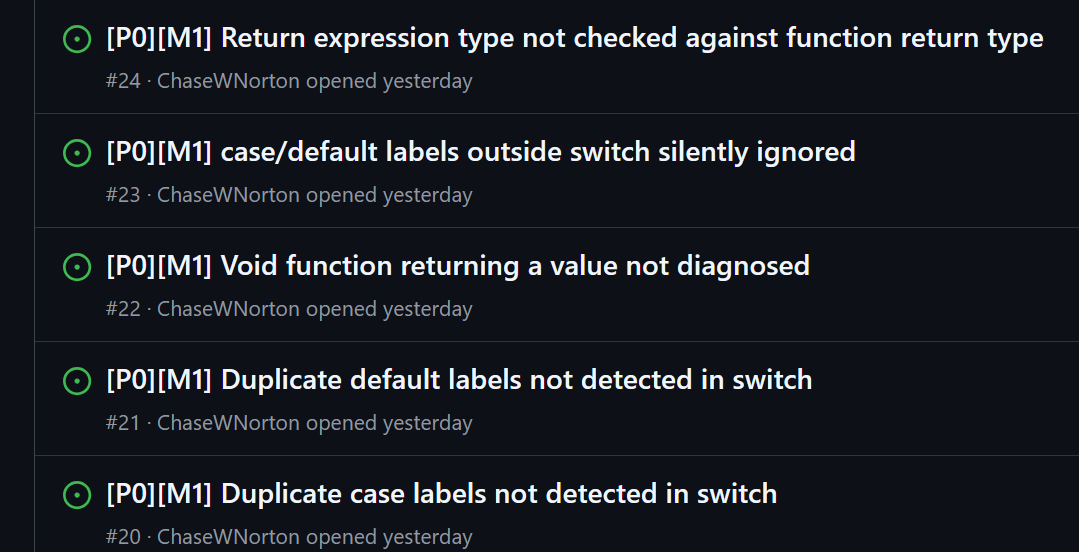
It’s also not tested, it has no integration tests (even though the README says it does), which is plain unacceptable. And the unit tests that are there fail so lol, lmao.
It’s worse than existing industry compilers and it doesn’t offer anything interesting in terms of the implementation. If you’re introducing your own IR and passes you have to have a good enough reason to not just target LLVM. Cranelift is… not great, but they at least have interesting design choices and offer quick unoptimized compilation. This? The only reason you’d write this is you were indeed a student learning compilers, in which case it’d be a very good experience. You’d probably learn why testing is important for the rest of your life at least.
I wonder why this blog post was brazen enough to talk about these problems. Perhaps by throwing in a little humility, they can make the hype pill that much easier to swallow.
I feel this is an artefact of the near complete collapse of mainstream journalism, combined with modern tech business practises that are about securing investment and cashing out, and every other concern is secondary or even entirely absent. It’s all just selling vibes.
People only ever report the hype, the investors see everyone else following the hype and panic that they might be left out and bury you in cash. When it all turns sour and people ask pointed questions about the exact nature of the magic beans you were promising to grow, you can just point at the blog post that no-one read (or at least, only poor people read, and they’re barely people if you think about it) and point out that you never hid anything.
I don’t even think many AI developers realize that we’re in a hype bubble. From what I see, they genuinely believe that the Models Will Improve and that These Issues Will Get Fixed. (I see a lot of faculty in my department who still have these beliefs.)
What these people do see, however, are a lot of haters who just cannot accept this wonderful new technology for some reason. AI is so magical that they don’t need to listen to the criticisms; surely they’re trivial by comparison to magic, and whatever they are, These Issues Will Get Fixed. But lately they have realized that with the constant embarrassing AI failures (AI surely doesn’t have horrible ethics as well), there are a lot of haters who will swarm the announcement of any AI project now. The haters also tend to be people who actually know stuff and check things (tech journalists are incentivized to not do that), but it doesn’t matter because they’re just random internet commenters, not big news outlets.
My theory is that now they add a ton of caveats and disclaimers to their announcements in a vain attempt to reduce the backlash. Also if you criticize them, it’s actually your fault that it doesn’t work. It’s Still Early Days. These Issues Will Get Fixed.
the Models Will Improve
I tell people that this is code for RAM and storage will cost 10x by this time next year when this comes up. Highly recommended.
We’re Still Early never dies
I wonder if this is going to hold out long enough to get some obnoxious AI-first language created that is designed to have as obnoxiously picky of a compiler as it can in order to try and turn runtime errors that the model can’t cope with into compile failures which it can silently retry until they’re ‘fixed’
I only sampled some of the docs and interesting-sounding modules. I did not carefully read anything.
First, the user-facing structure. The compiler is far too configurable; it has lots of options that surely haven’t been tested in combination. The idea of a pipeline is enticing but it’s not actually user-programmable. File headers are guessed using a combination of magic numbers and file extensions. The dog is wagged in the design decisions, which might be fair; anybody writing a new C compiler has to contend with old C code.
Next, I cannot state enough how generated the internals are. Every hunk of code tastes bland; even when it does things correctly and in a way which resembles a healthy style, the intent seems to be lacking. At best, I might say that the intent is cargo-culted from existing code without a deeper theory; more on that in a moment. Consider these two hunks. The first is generated code from my fork of META II:
while i < len(self.s) and self.clsWhitespace(ord(self.s[i])): i += 1And the second is generated code from their C compiler:
while self.pos < self.input.len() && self.input[self.pos].is_ascii_whitespace() {
    self.pos += 1;
}
In general, the lexer looks generated, but in all seriousness, lexers might be too simple to fuck up relative to our collective understanding of what they do. There’s also a lot of code which is block-copied from one place to another within a single file, in lists of options or lists of identifiers or lists of operators, and Transformers are known to be good at that sort of copying.
The backend’s layering is really bad. There’s too much optimization during lowering and assembly. Additionally, there’s not enough optimization in the high-level IR. The result is enormous amounts of spaghetti. There’s a standard algorithm for new backends, NOLTIS, which is based on building mosaics from a collection of low-level tiles; there’s no indication that the assembler uses it.
The biggest issue is that the codebase is big. The second-biggest issue is that it doesn’t have a Naur-style theory underlying it. A Naur theory is how humans conceptualize the codebase. We care about not only what it does but why it does. The docs are reasonably-accurate descriptions of what’s in each Rust module, as if they were documents to summarize, but struggle to show why certain algorithms were chosen.
Choice sneer, credit to the late Jessica Walter for the intended reading: It’s one topological sort, implemented here. What could it cost? Ten lines?
I do not believe that this demonstrates anything other than they kept making the AI brute force random shit until it happened to pass all the test cases.
That’s the secret: any generative tool which adapts to feedback can do that. Previously, on Lobsters, I linked to a 2006/2007 paper which I’ve used for generating code; it directly uses a random number generator to make programs and also disassembles programs into gene-like snippets which can be recombined with a genetic algorithm. The LLM is a distraction and people only prefer it for the ELIZA Effect; they want that explanation and Naur-style theorizing.
It’s one topological sort, implemented here. What could it cost? Ten lines?
This one idk, some of it could be more concise but it also has to build the graph first using that weird seemingly custom hashmap as the source. This function, however, is immensely funny
There’s a standard algorithm for new backends, NOLTIS
I think this makes it sound more cutting-edge and thus less scathing than it should, it’s an algorithm from 2008 and is used by LLVM. Claude not only trained on the paper but on all of LLVM as well.
This could be its own post. Very nice!
The first issue filed is called “Hello world does not compile” so you can tell it’s off to a good start. Then the rest of the six pages of issues appear to be mostly spam filed by some AI guy’s rogue chatbot.
@sailor_sega_saturn @dovel the nice thing about rogue chatbots is that there’s no difference between that and a non-rogue chatbot
I knew the Anthropic blog post was bullshit but every single time the reality is 10x worse that I anticipated.
@lagrangeinterpolator
That’s beginning to look like a metric…
The first issue filed is called “Hello world does not compile” so you can tell it’s off to a good start.
The comments are a hoot, at least.
Waiting for some promptfondler to complain that this kind of assignment is not really fair for an AI because it has actual requirements.
This could be regarded as a neat fun hack, if it wasn’t built by appropriating the entire world of open source software while also destroying the planet with obscene energy and resource consumption.
And not only do they do all that… it’s also presented by those who wish this to be the future of all software. But for that, a “neat fun hack” just isn’t enough.
Can LLMs produce software that kinda works? Sure, that’s not new. Just like LLMs can generate books with correct grammar inside, and vaguely about a given theme. But is such a book worth reading? No. And is this compiler worth using? Also no.
(And btw, this approach only works with an existing good compiler as “oracle”. So forget about doing that to create a new compiler for a new language. In addition, there’s certainly no other language with as many compilers as C, providing plenty of material for the training set.)
This could be regarded as a neat fun hack, if it wasn’t built by appropriating the entire world of open source software
This shouldn’t be left merely implied, the autoplag trained on GCC, clang, and every single poor undergrad who had to slap together a working C compiler for their compilers course and uploaded it to github, and “learnt” fuckall
The fact it doesn’t have an assembler or linker, and I am doubting it implemented its own lexical analyzer, I almost struggle to call this a compiler.
The claim it is from scratch is misleading since it has all prior training from open source.
Building a small compiler for a simple language (C is pretty simple, especially older versions) is a common learning exercise and not difficult. This is very much another situation where “AI” created an over simplified version of something with hidden details on how it got there as a way to further push the propaganda that it is so capable.