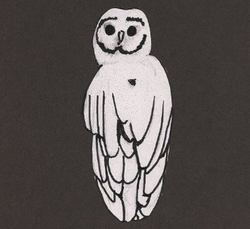

write all of the numbers on top of each other then scribble on them. does that look anything like zero? i don’t know kanji, i’m just understanding my own bad handwriting and trying to understand how they’d get there
nope, doesn’t come from that
 here’s the kanji breakdown according to kakimashou.com (note that kanji is stolen from Chinese)
Japanese enters the chat:
Left: numeral; middle: regular writing; final: certain formal and non-forgery usecases.
または in point 7 means either variant is OK
The last line says one can use the modern yen sign as well (though some would argue that it’s bad manners in at least some situations, but I have no dog in that fight).
万 = 10k. Several countries use both 1k and 10k units (Japan traditionally was on the 10k side but had a lot of influence so now we see both a lot. A used car price might be 130万円 or something ( = 1,300,000 yen)
数字	通常の漢字	金額で使う旧字体(大字)
0	零	零
1	一	壱
2	二	弐
3	三	参
4	四	肆
5	五	伍
6	六	陸
7	七	柒(または 漆)
8	八	捌
9	九	玖
10	十	拾
100	百	佰
1k	千	仟
万	万	萬
円	円	圓(もしくは「円」のまま)
Chart from here that looks better: https://saiseich.com/business/kanji_kingaku/
We have a way of writing numbers in certain situations. Think of it like checks in the US where we write things in a certain way so that the numbers can’t be easily changed to increase the value or something.
I see, the right column is used because they share their Chinese reading 音読み with the numbers, that makes sense. I don’t know all of the Kanji, but the ones I know fit.
Fun fact, for a long time in history minus (-1) did not exist
Zero is also a relatively new invention
Mathematics for much of human history was discrete - it had to be connected to something tangible which you can see, touch or feel. Negative numbers first arose in China, subsequently the use numerical operations on negative numbers and the conceptualization and use of zero arose in India. Spiritual concepts within dharmic philosophies such as Buddhism helped lead to these ideas.
In the history of mathematics, -1 was understood waaaay before 0.
For the Greeks, doing 1-1 would be invalid, something close to dividing by zero for us.
Fun fact, for the greeks, 1 is not a number either - they said the natural numbers started at 2 and unity is something else. This is because, they said, all numbers represent pluralities.
Dividing by zero is well understood and sometimes even well defined.
That’s a stretch.
We know the limit of it and on a Riemann sphere it is defined as infinity.
We know the limit of a/x as x --> 0 if a ≠ 0.
The limit is different if a = 0.
The limit of the division function under certain conditions is not the same as division - division has a discontinuity at 0 which is expressing the same thing.
Defining division by zero only works if you don’t care to preserve the field axioms, which is often inconvenient and so not done. The Riemann sphere is not a field, and fairly niche in the context of mere division, so I stand by my accusation of this being misleading.
The policy of not defining division by zero to preserve the cancellation law is the most sensible default.
I saw a video years ago where somebody was talking (with a translator) to a tribe, I forget where. He asked how do they count. They would point with one hand to the other hand. Once they’ve got to five they start pointing to other parts of the arm moving upwards. He then asked what if you need to count higher. They looked confused, why would they need to count higher.
For them they could exist without needing to count beyond teens.
I’m not sure how accurate that is, calenders are pretty important for being able to survive, and surely they need to figure “do we have enough food to last the rest of this season”.
Maybe they have different math for that or there was an issue with translation.
How about -2?
What about this one?

How many gears is that?
Just enough to make the Kessel Run in less than twelve parsecs.
All of them.
11? Including reverse
-1
That’s the map of the forth level of the dungeon in “Vampires for Hire”.
<s>:.|:;</s>
~~strikethrough~~-->strikethroughWasn’t working on my client which is why I did it the way I did ¯\_(ツ)_/¯
Oh, really? That’s odd. What client?
It was Boost, but I just got an update the other day and now it’s working so nevermind lol
Is this Garfield Breast Reduction?
I’m at a loss
e:f;b
Listen here you little shit
Listen here you little dope /*6 yo me confused face
I’m at a loss for words
Yeah líng 零 is pretty annoying as a learner of the language.
The top character is yŭ 雨 which means rain.
The bottom character líng 令 means order/command as a noun and verb. This doesn’t add meaning, it is the phonetic component: basically a pronunciation cue.
It originally meant “light rain”/“falling in drops, like rain”, actually. It began being used to mean “fragments” or “leftover part”, then as “remainder” in the mathematical sense. Then, eventually, to mean 0. Another form of this character is 霝 which means raindrops. It has 3 kŏu 口 (“mouth”) characters on the bottom to visually represent drops.
So, like a lot of Chinese characters, it really only makes sense when you understand the etymology - and even then it’s kind of a stretch
In OPs post, I see a stick figure guy pooping. Jack shit. Zero
Yeah it’s a visual metaphor - the emptiness of his bowels = the concept of zero shit in bowels

The fact that such intricate characters can even be displayed in such tiny fonts is nothing short of obscene lol, I wonder if chinese phones all have that Assistive / Readability Mode where the text is enlarged and high contrast by default, because I can’t imagine reading texts like that haha
As someone who’s learned Japanese a bunch: once you’re very familiar with the symbols, you don’t look at every little line to determine what character it is, just the general shape. The characters are built by combining a discrete and smaller set of “drawings” (called radicals). So the space of possible characters is limited to those combinations. On top of that, not every legal combination actually exists. You won’t suddenly run into 鬱, but with a different radical in the bottom left, unless you’re playing a trivia game of “spot the mistake” (which can even be difficult for native speakers, just in the same way it can be difficult for native English speakers to spell some words they’d have no trouble reading.)
I would wager some misplaced lines wouldn’t hurt readabiliity much in the same way we, in English aren’t usually struggling to read a sentence even if some of the letters are swapped/missing or a “the” is duplicated, etc. I’m sure you’ve seen examples of that before in English (or your own native language if it isn’t English).
Of course in some instances, even a tiny difference can change the meaning of a sentence entirely. This is also true both in English and logographic languages. Luckily our brains do a lot of subconscious work here too and figure out where special attention is and isn’t needed by using context and knowledge about the writing system.
(Small caveat: of course, especially in languages, there are always exceptions to every rule. And also the brain can be tricked, intentionally or not, in a variety of ways.)
https://bookshop.org/p/books/zero-the-biography-of-a-dangerous-idea-charles-seife/9b102f8407965163
Really good read.
Zero The Biography of a Dangerous Idea.
Japanese isn’t much better:
一、二、三… 四。
In Spanish it’s 1,2,3 and 0.
The fourth character he wrote means 4, not 0, though.
Why would he do that?
And then the other person doesn’t even tell us what 0 would be. So much disappointment in this thread.
Technically, I think that’s Arabic
No, I’ve studied Arabic and it’s actually ١,٢,٣ and ٠.
الله أبهى
Gracias.
De rien
WHY JAPANESE PEOPLE?!
Congrats on being the smart one in this thread. 😞
I want the whole version of that
Not why, memorize.
Memorize Japanese people?
In Korean it’s not so bad: 한, 둘, 셋, 넷. Or 일, 이, 삼, 사. Yes there are two different types of numbers…
the latter set is just the same chinese characters spelled out phonetically
i feel like most people nowadays are getting lazy and just using the chinese numbers more and more instead of learning a new word for each new ten (twenty thirty forty etc)
Thats good to hear, I made a lot of mistakes of using the wrong numbers for times or dates.
unfortunately hours (not minutes) ages and number of days/months (not years) are still korean numbers not chinese
but i guess you can always just say the year of birth and spell out the date instead both of which would be chinese… haha languages are weird
It’s the same as in Chinese, so I wouldn’t expect it to be 😅
Wait. I’ve played a lot of Fatal Frame, and they only signify the Zero Lens by its kanji, and it’s not that square shape. So now I’m confused…
Maybe its ghost folklore origins put it more on the Chinese side?
That’s because 四 is 4
In Japanese they also use 零 (rei) for zero. Or 〇 (maru) or ゼロ (zero)
Chinese characters are seen in Japanese media as stylistic choice, yes.
The ones I typed are proper Japanese Kanji, which are derived and very simplified forms of Chinese characters. Even more so than Simplified Chinese.
A) Kanji are Chinese characters.
B) Both languages simplified their characters, but Chinese was actually more aggressive in simplifying than Japanese, not the other way around.
For example, look at the character for turtle:
Traditional Chinese: 龜
Simplified Chinese: 龟
Japanese: 亀kanji are not a stylistic choice, but an integral part of the writing system
also I think you mean the syllabaries (hiragana, katakana) are ultimately derived from chinese characters, japanese kanji are largely the same as chinese hanzi
You misunderstood me because that’s not what I was saying.
If there are Chinese characters in a Japanese game, they’re there for the visual appeal of them… unless they’re trying to actually teach Chinese, which I doubt the Fatal Frame series (horror) is doing.
when you say “Chinese characters” do you mean kyuujitai? all kanji are chinese characters, that’s what 漢字 literally means
I think they mean Ateji/当て字, when they’re used phonetically just to represent something as foreign or for style. Like how sushi is 寿司, but the characters have nothing to do with sushi other the the pronunciation.
I wonder when kanji stop being Chinese characters in the same way that souvenir used by someone speaking English isn’t using a French word. Like characters with different variations in Japanese technically aren’t used (and weren’t ever used) in China, like 誤 vs 誤 (prob won’t show up right with the font on here but the Japanese component on the bottom right uses 六 without the top dot and Chinese uses 大). The kana were all derived from kanji as well, so could those be “chinese” characters? The etymology is obviously Chinese in the same way souvenir is French, but what does that really mean?
Dunno, maybe it’s mostly semantics, especially when trying to talk about it in English
to me, “Chinese characters” means a certain writing system that is used by several languages (and not just Japanese and Mandarin, but also Cantonese, Korean, Vietnamese etc.), but doesn’t inherently belong to any one of them. So, in my opinion, Japanese variants or 国字 are totally valid Chinese characters.
whether kana are also Chinese characters is a very interesting question. I think the main thing that makes them distinct is the purpose they serve, as they no longer convey any meaning by themselves but are instead used to write language phonetically. but I wouldn’t be so sure when it comes to 万葉がな. although manyogana was used the same way as modern kana it retained the shape of chinese characters. so maybe it’s the combination of both the evolved shape + different purpose that makes kana distinct from kanji?
Zero seems to be someone very upset… Is it mad at me ? Or, maybe, am I the 0 ?
- 壹
- 貳
- 參
- 肆
- 伍
These exist as well.
They’re used in places where numbers should NOT be forged(i.e. bank documents…)

This is how they got their numeric meanings btw.
Their math homework must take forever
Oh, cool af! I got adviced to always write years with all 4 numbers not to allow forgeries
I don’t get 4. At least the kanji 4 looks very different
A very Christmassy number, that 4. A Chrismas tree and the scaffolding to decorate it.
Yeaaaah, I don’t know Chinese, but I’ve never seen a kanji of four horizontal lines, just 四 for 4
I never learned it as four lines. 四 was the way to do it. Maybe locally or something the hip kids are doing? Source: Mandarin professor ETA: I was a person of simplified Chinese though
I guess the image is a lie and the Kanji are chosen by the reading and not because they contain the number kanji. It’s just that due to phonetic radicals, containing the number may give it the same reading.
Does 0 have a shorthand character as well?
It’s pretty complicated as-is so no.
This reply makes no sense lol
Sorry, I misunderstood what shorthand meant. I thought the question was whether there’s a complex variant, like 一 → 臺 for 零.
I’m an ESL speaker, so please forgive me.
零 is the only character, as far as I know. 一, 二, … are not shorthands; they’re the original characters, while 臺 and other more complex forms are used only in certain situations where necessary.
Hope this is what the questions was about.
Can be written as 〇
I’m not sure about China but in Japan there’s 〇 which can be used like so: ハ〇〇円 to mean 800 yen, in a restaurant menu for example
So 伍 is not 5, but five.
correct
or 〇, if you prefer
Binary calculations must be a nightmare for some
Sure, when you mean “zero” it may look a bit excessive. But it’s quite adequate if you want to express “Void, the Dark Realm of Nothingness and End of All Things”.
ps: Glory to ZA̡͊͠͝LGΌ.
So basically = 0 and the long = Null?
No
= is 2
well atleast this post + Comments teached me some Chinese.
And now an English lesson:
The past tense of teach is taught. Teached is not a word.
It’s not an officially recognized word, but you understood what they were saying, so it still functions the same as the “correct” word.
I understand my 3yo as well but that doesn’t mean they should continue to speak that way just because they can technically be understood.
Yes, but your 3yo isn’t a stranger on the internet that you’re condescending to, so the situation is a bit different, no?
I wasn’t condescending to anyone. I presume, based on the incorrect tense form of a very common English word, and the fact that they appreciated learning a bit of Chinese, they might appreciate some polite correction. Not everything has to carry a negative tone
Not entirely, because if I never corrected them they would be a stranger on the internet to SOMEONE talking that way eventually.
Ultimately the ability to understand something doesn’t make it correct and I get tired of the “language evolves” and “you understood it, right?” arguments because even if true we can also understand “me want job” and “John hungry” but it doesn’t mean you shouldn’t both attempt to speak correctly and continue to learn.
I’m learning a second language and I would prefer to be corrected and speak naturally in it as much as possible rather than the bar simply being understood.
Thus nit haw english werks
Sure it is. I understood what you just said, therefore you successfully used the language. That is how English (and languages in general) works.
Yes, Language is a form of Communication and you and I have a Difference of opinion.¯\_(ツ)_/¯
零 isn’t too bad as far as chinese characters are concerned. you should see the character for depression. or the biang biang noodles character, although that one is kind of a meme
I’m partial to the Japanese-invented 𱁬
Here’s in image in case it doesn’t show up

Though it’s pretty simple once you see it’s just 2 kanji repeated 3 times. There’s also a good one that is 4 龍 in a 2 by 2 grid, meaning “verbose” (haha)