
- cross-posted to:
- programmer_humor@programming.dev
- cross-posted to:
- programmer_humor@programming.dev
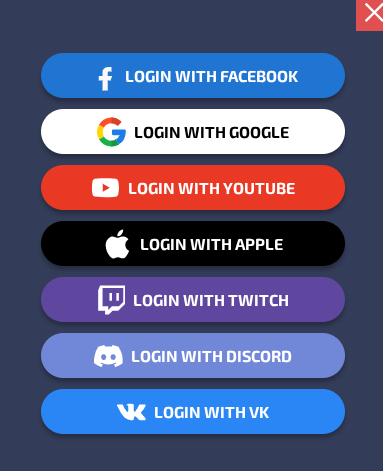
How hard is it to implement email verification?
You must log in or register to comment.
I’ve always hated that shit. Why would I want to add dependencies to my fucking logins?
Yes, I prefer an Email/password, too, so to depend less on third-parties, and keep it more transparent.
Yet, OAuth/OpenID is significantly easier legally and financially than Email processing (even via outsourced services as MailChimp) and store someone’s personal information as Email address if compared to a social account ID, in long term.
Not only that, but OAuth providers have APIs to get sufficient User information, and regularly actualize, including: Name, Email (yet, by requested/allowed scope only), activity on that social network as posts/channels/followers count etc.
Technically, using an email and password is being dependent on more 3rd parties to keep your information safe.
Third parties that are getting one of maybe 6 emails and a unique password?
I’ll take my chances.
This right here. I’d rather my email stay the source of truth for auth, but totally sympathize with website owners that don’t want to store and protect any sensitive user data (like an email address and password).
I do wish some sites would offer the magic link option if they don’t want to keep password hashes. It has problems too, but can be a simple way sometimes.
On some level I know the OAuth flow should be pretty safe. The idea that I have one identity that gets me into multiple sites makes a lot of sense. And I’m already using the same email in most places, so it’s not like I’m anonymous anyway.
And yet… I can’t convince my paranoia that ‘sign in with Google’ isn’t oversharing. I always worry that authorizing with other sites will give too many permissions yo see/alter Google/whatever data, or that clicking it will take me to a fake Google/whatever page where I give away my creds.
If you log in with social media, they get more than your email address. Data mining.
They do not, normally, unless you specifically allow that. Yet, indeed, many services enable/require quite permissive scopes by default.
Regardless of your privacy choices, if you are using a shared login, that activity is connected with your broader profile.
so they mostly do…
per oauth spec you get told what is shared. usually it’s just your user id (which often is email or username), i haven’t seen crazy scopes in the wild in a while
Some services even have an option to only share a dummy email and not your real. Apple for example does this, so all the site gets is “36382618161@apple.com” (don’t know the exact format). And it is only tied to your real email address on apple’s side
Collecting as much data they possibly can to increase the value of the data. Bottom line: more info=more money
They get less info… oauth is used do you can handle less customer data and so you don’t have to worry about leaking a bunch of usernames and passwords…

That’s like every freaking store offering me a “points” plan. All this shit is getting out of hand already.
Guess I’m not logging in
I dislike sites like this, I usually click away or just don’t sign up
I want to login with my butthole print. Did you know that no butthole is the same?
Problem is with general cleanliness. Like the Japanese with their bidet’s, they wouldn’t have a problem signing in because the print is always a clean print.
There’s also hemorrhoids and other temporary deformations of the butthole that take some time to repair. I mean with hemorrhoids you’ll be waiting there for a week. But what if you just had a big poop. Well, it might help deter criminals trying to ping the machine too quickly.
American high-school athletes in conservative states: Log in with genital verification.
A SAML token verification can be implemented correctly in under 50 lines of code. (Without needing anything beyond a basic crypto library for decryption and signature checks ) then you just have a SAML identity to user account mapping table (so that they can have multiple SAML providers and retain access or switch between different accounts).
But yeah, some shady sites use it to get your name and other information. (Which SAML providers should properly inform you about, as they are the ones packing that data based on what the receiving has registered)
A SAML token verification can be implemented correctly in under 50 lines of code
I have seen multiple implementations of SAML logins, and I have never seen one with less than 500 LoC, and mutliple layers of complexity.
On the other hand I have migrated some (1 i did myself, 2 i just witnessed) of these SAML logins to oauth, and then it became actually 50 LoC.
Were they generated by chatGPT?
How hard is it to implement email verification?
Harder, actually.
That’s the point of OAuth, which is what you’re seeing there.
The idea is that you’re you and you have a… google account. This shitty little website doesn’t want to be responsible for you login details, because those can get stolen. Maybe they contain an email address, which is a problem. Software needs to be updated, it’s all a big. They don’t want to touch anything in terms of security that identifies you as you.
Maybe all the website does is save your favorite pepe memes. They don’t need anything else from you, but they still need to have something to get a user id and make sure nobody messes with your pepe meme collection. That’s where this system comes in, because the rest of website becomes significantly easier. They don’t need to store anything personally identifying, all they get is an ID and they can connect it with your pepes.
The only downside to OAuth is, as you can also see, that it’s corpos you don’t want to trust that are offering it.
But most oauth implementations use the user email as identifier so they get the email anyway
All the smarter ones don’t because an email can change, your google account unique id will not, that’s the purpose of account IDs.
I won’t deny that many people/websites probably do use email though. Which is bad. But I can’t deny that that probably is what is happening.
Yeah, some of the same reason everyone uses stripe or PayPal for payment systems. If the site itself handles the cc info it holds all the liability, and has to pass rigorous POC testing and compliance.
Shitty little website…
I don’t know, man, I don’t want anyone that doesn’t understand or doesn’t give a shit about security trying to implement it.
That’s just a recipe for bad things.
Was just about to say getting Auth right is super hard. Getting someone else to do it for you is a godsend.
Most users outside of Lemmy dgaf about corpos if it saves them having to type in an email address on their phone and get it right and then go to their email and then hit refresh a few times before going back and hitting send again and then checking their spam folder
I have no account with the above. I wouldn’t make one for being able to use another service.
No idea what the product is here, but I guess I’m not their target audience. Which is fine.
Just have a spam account?
spamspamspamspam2026@gmail.com for e.g.
That’s the OP’s point - logging in by email is not an option.
A gmail account is a Google account.
I said email, not gmail.
There are thousands and thousands of email providers. Gmail is only one of them.
And even if your email is a gmail account, you may not want to associate your google account with the service, just the email address.
They’re saying get a spam Gmail account then you can use it for oauth.
While I get that, it is still unfortunate that no open-source, trusted variant can be part of the usual ways.
They can? They are in some cases!
Just usually indie stuff. There’s Login With Mastodon on plenty of websites.
There’s really no reason something like that couldn’t exist. A foundation would just have to decide to dedicate the resources to it.
The issue is it would have to gain significant adoption in order for web admins to think to include it. This list here is actually a lot larger than you usually see. It’s often just the big 2 or 3.
I might trust Mozilla and I already have an account…
Actually, there are some open-source self-hosted alternatives like Hydra but no one implements it :( I have seen only 1 site that support it
That’s… mostly because of popularity and it depends on whether some service is offering OAuth and if the website in question is using THAT identity provider.
For example, mastodon is technically offering it.
https://github.com/mastodon/mastodon/pull/16221
but this is the docs page:
https://docs.joinmastodon.org/admin/optional/sso/
So the answer in this case is to just grow, promote and support what we’re already doing: fediverse stuff.
Even something like bitwarden would be nice
Exactly!
Okay, but where is the link to this Pepe memes page?
Yeah show us deh memes
Unfortunately that was just an example.
Whatever site that is, I dont need to be there.

Money.
Also it kinda depend on how much you trust the website security and how much precaution you have. For general public who don’t really know how to protect themselves against hacking and databreach(those who might not know the existence of password manager), the option of letting a giant corpos handle the login is much better than to just blindly trust the website.
Also money.
Also the website might not want to build and maintain their own database for this(which cost money), so they outsource the login to other company.
And also money.
#feudalism