


Direct link to the LLM Policy Discussion: https://invent.kde.org/plasma/plasma-workspace/-/work_items/187
Example of KDE dev rejecting environmental consideration:
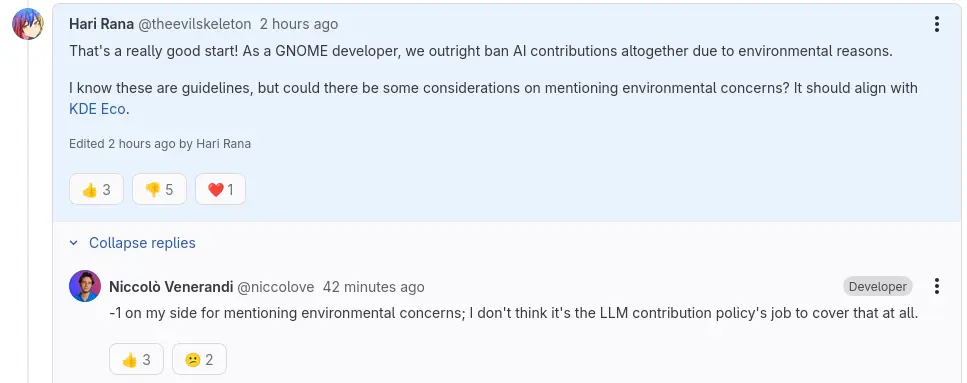
Example of KDE devs not wanting to require LLM use be disclosed.
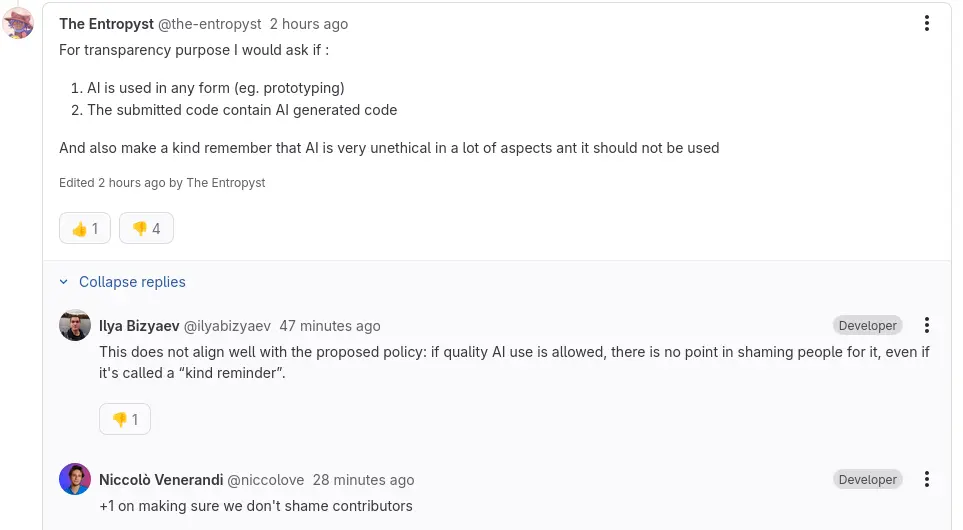
And all of this is coming right after the debacle with an AI slop project being allowed to give a presentation at Akademy, and the person asking how this was allowed being blocked by KDE:
https://lemmy.nz/post/42029517
as well as the discussion thread bringing up legitimate concerns about AI usage being closed:
https://discuss.kde.org/t/sorry-to-bring-up-a-contentious-topic-kde-ai-llm-policy/46333/164
As someone who genuinely loves KDE, and has even donated to the project multiple times, I sadly have to accept that the majority of KDE have hopped onto the Pro-AI train, and they will not be dissuaded otherwise.
I am locking the thread because I consider this cherry picking comments from KDE maintainers misinformation. Let’s wait and see where they go… The discussion as to include gen AI code, in which ways, how much, etc. is something that many projects (if not all) are undergoing. Let’s be respectful to their open decision processes! This respectfulness needs to be regardless of whether we agree or not with what they do. Once they make a decision, sure, go ahead with flaming commentaries and endorsing alternatives or forks (if they appeared)
World sees AI doing awful things like nudifying children, making nearly every software we use worse, and stealing the world’s knowledge to sell back to us, and generally dislikes AI.
Moronic software devs with massive egos: "WE SHOULD USE AI SEE HOW EASY THIS MAKES MY LIFE NOW I DONT HAVE TO LEARN. "
Also them: “I swear I just use it to augment my work! I’d never take a shortcut and eventually keep taking shortcuts and outsource my thinking! Humans notoriously NEVER take shortcuts!”
Guys wtf are we even doing anymore.
And it wrecks the environment, and it stunts the user’s intelligence without actually being able to do anything truly original or novel, and it makes worse, buggier, less secure, less maintainable software. The list goes on and on
AI is not a thing, it doesn’t act, it doesn’t think. Humans do. Humans nudify children, humans enshitify software, humans steal content
You sound like “Guns don’t kill people! Robbers do!”
So I’m going to ask you, would you give a gun to a child? Would you? Just answer that
Except AI won’t kill you
What in the bullshit bad faith non sequitor is this.
it doesn’t act,
I don’t disagree with anything else you are saying or the sentiment, but with the rise of “AI Agents” it is becoming more common that the AI actually does something. It seems like there is a new story every few days about an agent deleting an entire database or buying plane tickets or sending an e-mail to the FBI. Unfortunately, we have people giving it more and more permissions and ability to “just act” and it is only getting worse.
Most of those ‘news’ stories are sensationalized to the point of fiction.
Exactly.
All of the Anti-AI people are actually anti-capitalists, they’re just not finished diagnosing the problem.
AI isn’t building data centers, capitalists are. They’re doing it in such a destructive and rapid manner because they’re trying to leverage their infinite amount of cash into a future monopoly. If it wasn’t AI it would have been some other product.
Fighting the product and ignoring the actual human beings who are making these destructive decisions is only adding to the smoke screen that shifts blame away from names like Huang, Altman, and Musk.
I think you can be anticapitalist and also anti-AI. I’m certainly both
Same here! I don’t care who is responsible for it, no matter where on the political spectrum the creators are, I’m still not supporting it.
I think you can be anticapitalist and also anti-AI. I’m certainly both
Yes, the venn is basically a circle.
All of the ‘bad things AI is doing’ are bad things that capitalists are doing.
Nobody is actually angry at AI for solving age old mathematical problems, folding proteins or locating cancers. It’s not the technology that people care about.
People are angry at rapacious capitalism and are misdirecting it at the technology and not the rapacious capitalists. Anti-AI is just Anti-Capitalism for new leftists.
Actual proposed policy:
Generally, don’t. What you are willing to write is generally the upper limit of what others are willing to read. LLMs, on the other hand, often produce long, rambling, soulless, corporate-sounding nonsense that nobody wants to read; don’t do it. This includes:
Don’t use an LLM to “organize your thoughts” and copy-paste the output somewhere. Organize them yourself. Don’t use an LLM to generate commit messages and merge request descriptions. Write them yourself. Don’t use an LLM to generate a reply to someone’s question or comment, then copy-paste that as if it were your response. Understand and reply yourself.
The one acceptable usage is to write text in your native language and then machine-translate it into English, with no stylistic or tonal changes.
But of course reading is for the LLM, it’s far better to be outraged about ‘hopping on the Pro-AI train’.
That section only relates to descriptions of pull requests, not the AI code itself. They don’t want long rambly AI generated explanations of how the code works, but they are fine if the code itself is AI generated.
Yeah, I forgot to paste part about the code.
I do kinda get Niccolo’s point that a contribution policy is not the place to decide environmental concerns even though it feels contradictory at first glance. He’s generally very critical and nuanced when it comes to LLMs so I wouldn’t call him “pro-AI”. Just watch his YouTube content.
I don’t really see why environmental policy shouldn’t be mentioned in the contribution policy. If it’s there as the justification for why a part of the policy exists and it is accurate about what the environmental impacts actually are, it seems to fit in fine within the policy? Not wanting the point there doesn’t make KDE pro-AI (since they might just want to mention it elsewhere), but it is valid criticism if they don’t acknowledge it anywhere.
However I do feel that the other points in the post are weaker. KDE’s stance is in line with what the SFC recommends when it comes to AI in FOSS, specifically around contributions. I came across the SFC recommendations a while back and it’s held up well in similar discussions so far: https://sfconservancy.org/llm-gen-ai/llm-backed-generative-ai-recommendations.html
Devs rejecting any notion of transparency by disclosing AI usage in code submissions
I don’t think they rejected the transparency part? I agree that transparency is necessary. Rather their reply is telling the commenter to not shun people. Both of those points are reflected in the SFC recommendations (point 5 on disclosure and point 3 on shunning)
And all of this is coming right after the debacle with an AI slop project being allowed to give a presentation at Akademy, and the person asking how this was allowed being blocked by KDE
I get the feeling that KDE does not curate much of anything, for better or for worse. There is a good bit of content in the KDE ecosystem that is outdated or straight up shovelware.
On top of that, Akademy is a conference that is intended for discussion, rather than a presentation about KDE.
Akademy features a 2-day conference with presentations on the latest KDE developments, followed by 4 days of workshops, Birds of a Feather (BoF) and coding sessions. It is an opportunity to meet key KDE contributors, learn about the latest features and enjoy the great atmosphere. You will meet developers, artists, translators, upstream and downstream maintainers, users, and free and open software industry leaders from all over the world
It wouldn’t work well if they had to curate every presentation at such an event. It is indeed deceitful to imply that the presenter is going to change the direction of KDE if in reality they rarely contribute and have little say in the direction of KDE. Also IMO it’s good that they let that guy participate in the conversation because it let everyone else raise points about why the idea is bad.
The contribution policy is the only place where anything meaningful can be done, as that is ultimately what will influence developers trying to contribute. Putting environmental concerns anywhere else is, IMHO, just virtue signalling.
I personally consider advocating for non-disclosure of AI use to be Pro-AI. Advocating for disclosure but still allowing it would be neutral.
Environmental concerns should be a topic that is dealt by politics.
The state dictates what is allowed and what is forbidden for any legal entity.
For example: It would be meaningless for a local kebab shop to debate whether they should use cucumbers with pesticides or without to protect the bees. If the law would say, all pesticides are forbidden, bee deaths due to pesticides would be gone. Ofc such a decision would have impact on food prices etc. so if asingle kebab shop would do it, they’d just become uncompetitive compared to the rest while making no change in bee deaths. Kind of a virtue signaling shot in the foot.
Same here, the environmental impact is not something that KDE can meaningfully influence with their decision.
Be quiet, we’re trying to be mad about AI.
While we’re at it, why hasn’t KDE condemned Hamas or taken a stand on the proliferation of weapons in space?
I can’t support a DE which hasn’t distanced itself from Ed Sheeran. Hopefully someone will fork KDE into a more Ed Sheeran-less experience.
I want to be angry god damn it, why is there not more things to be angry about on the topic of KDE!!!
I find the proposed policy very nuanced and generally useful. It’s not banning LLM usage but still prohibiting mindless vibe-coded contributions. I don’t see an issue and your post seems to be blowing this out of proportion.
Nuance? We don’t know what that is. Ban everything we don’t agree with! *grabs pitchfork*
Do people not have humor in this community?
No. Always serious. We don’t know what irony is.
It makes no distinction between self-hosted LLMs or Corportate LLMs, and disregards the dangers of using LLM code in FLOSS projects due to copyright concerns and the environmental and social damage corporate AI causes. For more details:
-
Simply using an AI that’s run on a corporate data centers encourages the construction of yet more data centers, with all of the environmental/climate negatives they bring, as well as local harms they induce on the people living near them, such as increased electricity rates.
-
Using corporate AI directly helps the financial situations of those giant corporations (by boosting usage/user numbers, they are able to attract more investment capital), most of which are ran by right-wing CEOs who are more than willing to collaborate with and fund fascist governments to ensure that they are not regulated in search of both maximum profits. Some of these companies, such as Nvidia, Palantir and Oracle, genuinely appear to be seeking to use these tools for what would previously be considered crackpot conspiracy theory levels of public control and surveillance.
-
I’m wary of the potential effects of AI usage resulting in declining or stagnating critical thinking based on some preliminary studies (example 1, example 2).
-
I do not think LLMs can be “just a tool” as many claim.
-
99% of LLMs (the ones virtually everyone use) are trained on copyrighted code that is incompatible with GPL licensed projects. LLMs have a 3 to 10% chance to unknowingly reproduce the copyrighted code perfectly, introducing legal plagiarism into an open-source project, which could easily open up the developers to being sued in the future if companies scanned open source repos for copyright violations.
-
Many courts are ruling that LLM generated code cannot be copyrighted at all, meaning that it also cannot be legally made GPL, losing the protections from corporate exploration the GPL normally grants. https://fsfe.org/news/2026/news-20260825-01.html
So, the broke CS students that want to help in their favourite DE while using LLMs to save time on their tight schedule should buy some overpriced homelab server before being able to contribute, is that it?
The broke CS student that neither has money nor time shouldn’t be contributing.
What the fuck dude? This is classism at it’s finest
There’s no classism about this. You either contribute with labor or with money. The dev team could’ve already consulted an LLM themselves if that’s what they wanted. Meat proxies are useless.
No, they should manually code to help with their studies, like we have for generations. What do you think we did before AI? Have more time in the day?
Its so unbelievably simple: don’t turn on the coal burning sycophant machine. Read a book or something. If you arent passionate enough to do something manually, i dont want your automatic contributions.
You make it sound like FLOSS hasn’t been able to function for the last 30 years without code plagiarizing LLMs.
Do you think the whole endeavor will just up and collapse without using fascist owned AI?
No, FOSS won’t die without AI, this was never a possibility.
The real problem is that the ““AI”” industry is forcing us to take a choice: create policies to deal with it, or drown in the noise. This what an AI policy serves, to filter out the noise they created.
Contributing is an act of community. Anybody seeking to contribute should take time to learn, be thoughtful, and understand the needs of the project.
My advise to a student would be: don’t rush to contribute. Learning and being thoughtful is the right foundation. An LLM won’t help. In fact, being able to generate code beyond your means of understanding might make you a burden.
-
In my view having a healthy discussion about this is a good thing. People will always have different views in many things, and it is natural that a common ground is achieved by having a honest debate about a given subject.
With the above in mind, hardline 100% pro or 100% con points of view are usually wrong and counterproductive, and even framing the discussion that way is harmful. I hope the discussion leads to a good and reasonable outcome.
I view AI as a pure evil platform that is terrible for the environment and trained on stolen data. IMO there is no discussion to be had, it should be banned period.
To me, it’s like discussing how much domestic abuse is allowed in a relationship. I say zero tolerance where someone else could say they think it should be fully allowed, and then a middle person thinks that we should be trying to find a common ground.
To me, it’s like discussing how much domestic abuse is allowed in a relationship.
But it is not. And a frank discussion about the subject to define what is acceptable and what is not, is key to a healthy community and project. Hardline stand on each end just make that discussion impossible, on purpose.
But to me, it is. I don’t try to find middle ground with Nazis, rapists, abusers, fraudsters, literers, etc… I want AI to burn. Cease to exist. I don’t want a healthy community and project. That’s the only discussion I care to have.
The difference is that every form of domestic abuse is awful and should face zero tolerance, whereas with “AI tools” there is still nuance in what that phrase means.
Even if we talk specifically about generative AI, there are models trained on only licensed data, and it’s possible to train and run models locally for the specific tasks that it is good for. The end of the day, it is an algorithm and there are some tasks that it is better at doing.
The point the other user is making is that a contribution policy should take those factors into account.
IMO a more effective principled stance would be to ban the use of specific “AI” tools that are proven to be abusive.
there are models trained on only licensed data, and it’s possible to train and run models locally for the specific tasks that it is good for
No one is doing this for programming. People love to make this argument then then turn around and use claude or something
Damn. I was thinking of switching to one of the KDE distros. That’s out the window now.
This is EXTREMELY disappointing. KDE is my favourite DE.
Do you want to say Kde was your fav DE.
This. Dunno where I’m going to go once KDE starts collapsing under the weight of AI slop. XFCE maybe? Do they have an AI policy? What’s Cosmic looking like these days?
Maybe you should reconsider your outdated views instead. Why are you even using linux to begin with, considering the kernel also allows “ai slop”?
Outdated views, huh? Tell me you’re deluded without telling me.
Not sure how this affects what I said. Having an anti-ai policy simply doesn’t work, you’d know that if you worked on any open source projects at all. There’s a reason all sane projects, like linux and now kde, end up accepting AI code. You can keep retreating to the next DE/WM until there’s none left but the ultra niche whose entire point is it doesn’t use AI, but it also has no contributor.
That’s like telling a vegan to update their views and eat meat.
There are many legitimate reasons to want to avoid AI code and avoid encouraging corporate AI use. Not all of us have to adopt your views on AI.
The differerence is being a vegan affects you, and the world is pretty accomodating to it. Vegan options everywhere these days. Non-AI repos are getting ultrarare and will only get more so.
Using a project with AI code simply doesn’t affect you. KDE is open source, using it doesn’t contribute to anything, doesn’t encourage and AI corporation, doesn’t contribute to water/power usage during training, etc… If the maintainers check the PRs propely you won’t be affected whatsoever.
Xfce have embraced AI with their new Wayland compositor.
Cosmic accepts AI code, but according to them, they take a preemptively hostile view toward AI code submissions and will rewrite some parts by hand.
There’s some lists linked in the comments here of DE’s that reject all AI.
X2
I switched to Niri a few months ago as an experiment but now I guess I will not go back to KDE anytime soon
Anybody else feeling really smug now about using GNOME? Sorry KDE users, that does genuinely suck to find out.
Anybody else feeling really smug now about using GNOME?
No, I’m not. The GNOME project have not, from what I’ve seen, drawn any hard boundary on the matter.
Lacking any clear policy prohibiting AI slop in the project, it’s still entirely feasible they’ll let it in.
I haven’t confirmed it but this screenshot claims they banned it
That person seems to be mistaken. I could only find policies for GNOME Circle and extensions, and those seem similar in spirit to the one proposed here:
From the second link:
Extensions must not be AI-generated
While it is not prohibited to use AI as a learning aid or a development tool (i.e. code completions), extension developers should be able to justify and explain the code they submit, within reason.
Submissions with large amounts of unnecessary code, inconsistent code style, imaginary API usage, comments serving as LLM prompts, or other indications of AI-generated output will be rejected
Yes. I’d argue that this is similar in spirit to the linked proposal, which for example requires that
Nobody in KDE should know if you use an LLM — not because you’re concealing it, but because your usage of it produces output indistinguishable from what you could produce yourself. Contributions with obvious and lazy LLM usage may be ignored or closed.
That’s… Interesting to me. One policy explicitly condones its use and the other explicitly forbades it.
Well, fuck.
Any viable alternatives, or should I switch to BSD? (Gnome obviously doesn’t count, it’s designed for tablets, not desktops).
GNOME is great if you use Dash to Panel.
If you want to get away from LLM assisted code your best bet is NetBSD, with an older version of an X11 DE , using an older version of Firefox with JavaScript turned off.
If you do this you are basicly fully avoiding LLM assisted code. Be sure to check every thing you install though. Or use only software versions from before 2023.
Check out the options listed here: https://slrpnk.net/comment/24475952
BSD has a libertarian energy to its culture, so I suspect they will be vibing a lot too.
AFAIK NetBSD is explicitly rejecting AI contributions.
That and OpenBSD’s Theo de Raadt is rejecting LLM code based on copyright arguments (not “respect author” but rather “we get sued” kind of point), here’s an example (click “next in thread” a bunch of times if you want).
Though back in 2001 he claimed the songs on the CDs were “as free as everything else” (no), but like meh.
It’s a actually completely reasonable proposal
It all comes down to one thing - understand the LLM generated code you want to submit, and use the LLM for nothing else than write code, like making other people having to read LLM text. This is a whole lot like the kernel’s LLM policy.
Niko is right, the environmental corcern is not something this policy should go against - what can they do despite ban LLM usage altoguether (and per consequence get LLM generated code submitted anyway), they can’t have a blacklist for models, or force contributors to run them on their local hardware.
what can they do despite ban LLM usage altoguether (and per consequence get LLM generated code submitted anyway), they can’t have a blacklist for models, or force contributors to run them on their local hardware.
But they can? Like OP pointed out, wine forbids contributions from those that have seen Windows source code. How in the world are they supposed to enforce that? Turns out the open source community is pretty good at self enforcing.
I’m with you, but the sad reality is that, unlike Wine devs, AI devs can’t be assumed to act in good faith.
Potential Wine devs who have seen Windows source code will self enforce the rules, because they care about their integrity and the integrity of the project.
AI devs already don’t have an integrity, and they feel smug and superior for actively trying to fool any sort of measure against AI. They also seem to believe AI is the future and isn’t going away, so why bother regulating it if it won’t matter soon.
We need to come up with stricter and more effective ways to regulate and ban AI use, and that’s gonna be the difference between an unusable codebase and a great one in a few years.
Sure, but that doesn’t mean that it can’t go into the contribution guidelines. If they don’t listen then ok, you remove commits that have claude watermarking. Without that guideline you can’t stop the PRs at all.
I don’t think the average person who wants to contribute to wine has seen windows source code in the first place.
It is much easier to attempt on enforcing something like this that to enforce a full ban on AI. The problem is that AI has a much higher exposure rate than the windows source code.
Nobody said anything about enforcing it. Just put it in the contribution guidelines!! Like for fucks sake, this is like saying you shouldn’t have a law saying you can’t murder people out at sea because it’s impossible to police. The threat of action is half of the reason people don’t do bad things. There’s ZERO REASON to not have it in the guidelines.
Guess I’ll stay on xfce…
this is quite… disappointing, and I say that as someone who uses primarily GNOME :(
I’ll likely be switching my gaming PC to Gnome due to all this :\
(on a side note, the Gnome dev in that thread mentions that Gnome bans AI usage, but I haven’t been able to find anything that confirms that, and AFAICT Gnome doesn’t have an official AI usage policy, only Gnome Circle does for 3rd party Gnome Extensions).
She’s updated the comment now to say ‘a lot of us outright ban’, which is more accurate.
Just a side note, GNOME Circle and Extensions are two different things (but both do ban AI projects). Circle is a way for GNOME to say a third party app is good, while Extensions are like browser extensions but for the DE.
the Gnome dev in that thread mentions that Gnome bans AI usage, but I haven’t been able to find anything that confirms that
You can bet your behind that the developers employed by IBM Red Hat are 100% using LLMs to code. Chances are they are even mandated by corporate higher-ups to do so.
Red hat is a big contributor to gnome? I didn’t know that.
Is the default DE for fedora so it makes sense
are you switchong off linix since the li ix kernel allows ai
As it is impossible to completely avoid AI use with Linux, I must content myself with only minimization instead of complete elimination, as I won’t let the pursuit of perfection mean I just give up entirely, as any reduction is still meaningfull, just as it’s still worthwhile to minimize fossil fuel usage and meat consumption as much as is reasonably possible.
you realize ai is just the tool and isnt a data center. data centers exist with out ai and ai exists with out data centers
I do not think LLMs can be “just a tool”.
Most LLM use is with corporate AI, and this KDE policy explicitly allows corporate AI usage. If they had restricted it to only open-source local models, I wouldn’t have nearly as many environmental concerns (though that would not solve the plagiarism issue).
For a more complete look at all of the downsides of AI usage, I’d encourage you to take a look at this comment.
“If they had restricted it to only open-source local models”
Is this even remotely enforceable? Stylometry can pretty effectively determine between AI and human written text ( not sure about code specifically since those are much stricter languages), but can it tell the difference between models or even if the LLM was run locally? (almost certainly not in the latter case).
Most contributors generally respect the rules of a project, and there are other rules put in place that are also not technically enforceable, such as asking a contributor to not submit copyrighted code (this would be virtually impossible for a reviewer to distinguish if it came from a closed source project), which also gives the project a stronger defense if brought to court, as they can then at least point to the rules and show where a contributor willfully broke them. In comparison, I suspect a court would not look kindly on a policy that says “Don’t disclose that you used a tool that has a 3 to 10% chance of introducing plagiarized copyrighted code with every prompt to avoid being shamed.”
As an example, the WINE project has a rule to not allow anyone who has even seen Windows source code from contributing to the project. This is to avoid the chances of someone subconsciously or consciously submitting a reproduction of what they saw in the Windows source code, and thus hopefully prevent the project being sued into oblivion from Microsoft (who would likely love to see that happen).
Adding a stipulation in the guidelines that contributors can only use more-ethical LLMs likely wouldn’t entirely prevent someone breaking that rule, but by in large, it is likely that most would adhere to it, making it an effective rule despite being difficult to enforce.
the policy in question:
The golden rule for LLM usage in KDE is Don’t be lazy:
-
Don’t try to use a tool to replace your own judgment, interpersonal communication, or learning process.
-
Don’t take unsustainable shortcuts.
-
Don’t avoid growing as a person.
The result will be poor-quality work that eventually becomes someone else’s problem.
Nobody in KDE should know if you use an LLM — not because you’re concealing it, but because your usage of it produces output indistinguishable from what you could produce yourself. Contributions with obvious and lazy LLM usage may be ignored or closed.
Using an LLM to generate contributions
KDE follows a “human in the loop” principle: you must be making decisions and adjustments beyond mere prompting. The output must express your unique humanity in some way.
- Don’t be a “meat proxy”. For example:
- Don’t submit throwaway LLM-created changes as a “first draft or proof-of-concept for maintainers to improve”.
- Don’t submit “vibe-coded” changes you don’t understand and couldn’t make yourself.
- Don’t disclose LLM usage as a way of trying to excuse the potential errors or poor quality of a contribution that you haven’t put much effort into.
- Don’t add “Assisted-by: [some LLM]” tags to your commits; it’s just free advertising for the LLM’s provider.
(emphasis original, except for the fourth bullet point)
This seems fine to me, it’s all they can really do since banning AI entirely just isn’t possible; someone could use it and submit very high quality code and no one would know AI was involved.
And if its very high quality, does it matter?
There are more concerns beyond the quality of the code itself, such as the ones I listed here
This isn’t a bad policy, but outright ignoring ethical and environmental concerns doesn’t seem very wise either. That should still be discussed, even if this becomes the final version of the policy.
“You are responsible for the code you submit, regardless of tools used.”
Literally the same stance Linus had on Linux. I’m okay with it as long as it’s enforced.
We all know the enforcement won’t match the usage, but I’m still ok with the decision.
Yes, that’s fine. And it’s also easy to enforce - just treat any code as if it’s written by a human (except obviously machine generated code like hardware descriptions etc).
Being against AI and LLMs is all fine and dandy, but it kinda takes ridiculous shape now.
However, I would prefer if open source tools would only allow the usage of open weight models and self-hosted systems. But then again, that’s my idealism talking.
I hate vibe coding, detest it, i’m tired of it. it wastes time and resources. That being said I use AI for debugging and as a glorified rubber duck. I don’t let it write ANYTHING but I will allow it to review code and make suggestions. Generally, I’d say 8 times out of 10 the suggestions are garbage BUT it will lead me down the right path. it’s a rubber duck that can talk back. So in that regards it has improved my build times, it has sped me up without actually touching the code itself.
THAT’s what AI/LLMs SHOULD be used for. an assistant that doesn’t directly interact with the project. a consultant to your code if you will.
unfortunately many people can’t make that separation and they sit on both sides of the fence.
LLMs are great for rubberducking and diagnosis, forensics, and the like.
One small problem: People are now also using AI to generate summaries of their vibe coded garbage, to push them through checks.
Using an LLM to generate text
Generally, don’t. What you are willing to write is generally the upper limit of what others are willing to read. LLMs, on the other hand, often produce long, rambling, soulless, corporate-sounding nonsense that nobody wants to read; don’t do it. This includes:
- Don’t use an LLM to “organize your thoughts” and copy-paste the output somewhere. Organize them yourself.
- Don’t use an LLM to generate commit messages and merge request descriptions. Write them yourself.
- Don’t use an LLM to generate a reply to someone’s question or comment, then copy-paste that as if it were your response. Understand and reply yourself.
emphasis mine
This seems fine
Sounds pretty reasonable to me. Don’t go saying “well chatgpt said it”, no, you are responsible for it.
i like how people exaggerated this into “oh no, KDE is s|op now”. I totally get the hate for greedy and overhyping ai corpos, but if this policy is a sign of slop, you a) most probably never coded anything in your life b) unaware that before ai-slop there was natural, human-produced™ slop and dumb stackoverflow copypasta that barely even worked.
It’s that humans cannot be trusted to not take shortcuts and AI has proven time and time again to be a literal gambling machine that uses persuasive writing techniques to convince you of things you wouldn’t otherwise think.
KDE is also fighting transparency which is terrible.
It’s not going to be shocking when KDE starts performing worse. If more than one person works on a project and you’re just hoping people use things responsibly, you’re dreaming.
Humans optimize everything and AI pretends to be the greatest optimization tool of all time while it spits spaghetti code it’s authors understand less of over time while it tells them "great idea! I’ll get to work right away!
you couldn’t trust humans to not take shortcuts long before the advent of ai. That’s the point of my previous comment.
KDE’s stance is literally “as long as the code is of sufficient quality and you’re able to take the responsibility over it, we don’t care which tools you were using along the way”. Policing people over what they’re (not) allowed to use never yielded positive results.
If anything, such policy allows less slop to slip through, than in any project with anti-ai policy, simply because the maintainers would be aware of the possibility, and thus would have to pay closer attention to the PR quality.
Finally, it’s an open source project. Even if anything sloppy slips past the eyes of maintainers, rather sooner than later it would be noticed by the community and fixed.
[…] AI pretends to be the greatest optimization tool of all time […]
Which is obvious to you, me, and trust me when i say that it’s obvious to anybody who ever tried using ai for even the most minor coding tasks harder than webdev.
-