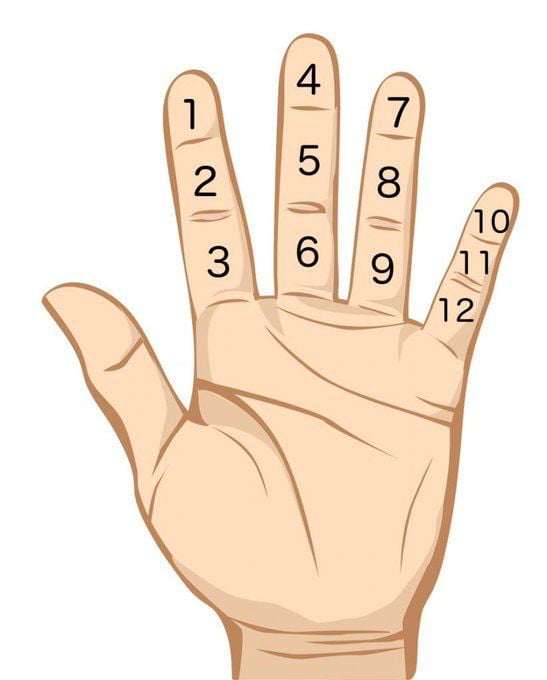
IIRC they counted the bones in their fingers using their thumb and that gives 12. The first sundial was around the equator and there is always light for half a day, so half a day becomes 12 hours.
To count large numbers often one hand was used to count using 5 fingers and the other to count the bones, so you get 5x12 for 60 minutes.
AIUI there was an aspect in the divisibility of the numbers being convenient.
12 is divisible by 2, 3, 4, and 6. 60 is divisible by 2, 3, 4, 5, 6, 10, 12, 15, 20, and 30.
10 is divisible by 2 and 5. 100 is divisible by 2, 4, 5, 10, 20, 25, and 50.
If you want to minimize dealing with fractions, 12 and 60 are far more convenient than 10 and 100.
That’s an interesting thought, but I believe it to simply be a coincidence.
The base 12 counting being based on counting the division of your fingers is historically verified, but if the division aspect was so compelling to them you’d expect it to carry forward into their writing system.
By the time you get cuneiform math though, they actually go back to base 10.
https://images.app.goo.gl/9GR6VEiT7GHYF3KaA
As you can see base 12 is not in the written system, or for written mathematics. It just was convenient for counting on their hands.
They used mixes of base 10/base 12 and base 60.
Base 10 would be used go determine the symbols for a specific “digit” in base 60.
So similar to how our 13 is 1 ten and 3 ones, their 13 was the symbol for 10 then 3 symbols for 1. 13 = 𒌋𒁹𒁹𒁹 But 73 would be written 𒁹 𒌋𒁹𒁹𒁹
Which would be interpreted as 1 sixty and 13 ones, or 60 + 13
I’ma start a revolution where we use duodecimal metric for everything, including time.
That’s how we ended up with 12 months of varying length in a year and it’s a mess.
It’s a problem no matter how you divide the year
That’s why I propose changing the orbit of the earth, too
13 months of 4 weeks + new year’s day (+leap day) actually fits perfectly.
Not if you divide by 5. It gets you 73 days each.
Ok, but now subdivide the 73 day month-analogs into week-analogs.
I can see calling the month analogs “seasons”, but 73 is a prime number so you’re boned. We need subdivisions smaller than that for practical purposes
Also why clockwise?
Earth rotates and orbits counter clockwise. It just seems more right
Because Sundials rotate clockwise ( in north hemisphere )
To be fair whichever direction they made it go would be clockwise
True, but also it’s because of sundials
Well that depends on where you look at the earth from doesn’t it. It’s like saying ‘righty righty, lefty loosey’ which only holds true as long as you’re thinking about the top edge of the screw head.
Also why clockwise?
We read from left-to-right, so the front span of numbers continues that visual pattern.
No we do not all read left to right. Countless languages are written right to left or even vertically.
And there are a rare few instances of writing systems that alternate left-to-right and right-to-left on each line
I know a language which kinda-sorta has two writing systems, one of which is left-to-right, the other one right-to-left.
Which one?
Hungarian

Granted, the right-to-left thing is not used anymore outside of enthusiast circles, and is kind of an anachronism and part of a movement to revive it as part of national heritage. That said, you can find a whole bunch of town limit marker signs in both scripts around the country.
The Hungarians settled the Carpathian Basin in 895. After the establishment of the Christian Hungarian kingdom, the old writing system was partly forced out of use during the rule of King Stephen, and the Latin alphabet was adopted. However, among some professions (e.g. shepherds who used a “rovás-stick” to officially track the number of animals) and in Transylvania, the script has remained in use by the Székely Magyars, giving its Hungarian name (székely) rovásírás. The writing could also be found in churches, such as that in the commune of Atid.
From Wikipedia
I don’t know which one HK65 is referring to, but I know a few examples:
- Punjabi, which is left-to-right in India and right-to-left in Pakistan (the Indian one being influenced by older Indian scripts and the Pakistani one by Arabic)
- Kazakh uses the RtL Arabic script in the part of China where there are a lot of Kazakhs and the LtR Cyrillic script in Kazakhstan
- At least some of the kinds of Tamazight (spoken by Amazigh people, mostly in Morocco and Algeria) use Arabic script, but there is a script specifically for Tamazight languages called Tifinagh which goes left to right and there’s also some use of the Latin alphabet for these languages
Now that I think about it: Yiddish is traditionally written in Hebrew script but also in Latin. I don’t know if the Latin is “just” a transliteration but I think both are standardized (which wouldn’t mean it’s not a transliteration)
We?
The answer is ‘sundials’
Earth rotates and orbits counter clockwise.
No it doesn’t. It depends on the human perception of “up” and “down” which are completely arbitrary. We by convention see the North Pole as the “top” of the world but it could as easily be seen as Antarctica.
deleted by creator
Before the age of exploration, orientation of maps were random. North became the norm so Europe could be placed at the top center.
At least our hours are the same length regardless of latitude now, so let’s be grateful for that.
deleted by creator
My guess is there are only so many conversations you can have over whether a Silvertip Badger is superior to a Boar brush.
deleted by creator
You’d be surprised
Relatively funny but gets worse the more you think about it.
The 6 stands for 6, not 30.
When we have AM and PM it would be dumb to have 1-24.
1 is the end of the 1st hour. 2 the end of the second. This is why it starts at 0.
0
She’s a witch!
Only if she weighs as much as a duck.
She turned me into a naught!
*newt btw.
Yes, that was the intended play on words.
Also see this: https://gist.github.com/timvisee/fcda9bbdff88d45cc9061606b4b923ca
It amazingly explains all the insanities for handling dates and times.
Days start at 0h, not 12h
It can’t start at 12 hours if there are 24 segments.
And keep your letters out of it too.
What clocks do you have that say 0, except for the 0 in 10?
Digital ones.
… what digital clock goes clockwise?
European ones
Fair enough
Well I can tell you that mine definitely doesn’t go anti-clockwise
Mine just goes south
Days start at 0h, not 12h
Show me where is the zero here?


I have a clock that has 0 at the bottom, 6 in the 9 position, 12 at the top, and 18 in the 3 position.
I present to you… the binary clock

The AM/PM bullshit:
AM: 12, 1, 2, 3, 4, 5, 6, 7, 8, 9, 10, 11
Then the same for PM. Who counts like that? Whats after 12? 1! What?
The galaxy-brained group known as “Z12 + 1”. “What if we did modular arithmetic but one-indexed.”
Edit: Actually, wait, it’s worse: zero-indexing but we represent the zero element in Zn as ‘n’. Kill it with fire.
Is not 12+12Z the exact same coset as 0+12Z? Is 12 not the identity element? Must group theory follow computer science conventions?
People who lived before the invention of zero counted like that!
I have no idea if that’s true but I believe it
The idea of zero being a number rather than the absence of a number took a very long time to settle on. There’s a whole history book on the topic!
I listened to an audiobook about the history of zero years ago (can’t remember the name, might be that one). I thought it would be dull enough to fall asleep to.
It was not.
At least we’re not mixing in letters
Zulu Time: Am I a joke to you?
“At least we’re not mixing in letters”

I see
IIIIin there and I cry a little on the inside.This has become a standard on analog clocks and watches (presumably to avoid confusion with VI), but for some reason IX and XI (for 9 and 11 respectively) is fine.
Personally I’d like to see IX and IIIIIIIIIII.
ETA: I guess IX and XI are ‘fine’ because they’re not upside down, but my point still stands.
When I become dictator of the world, this will be the new time unit: https://metric-time.com/
The year will also have 13 months: https://en.m.wikipedia.org/wiki/International_Fixed_Calendar
The year will be 12025: https://en.m.wikipedia.org/wiki/Holocene_calendar
Because these things just make more sense. You will thank me after a few generations, because habits are hard to change.
Team 13-month-calendar assemble!
I haven’t done enough digging on metric time, but if it’s implemented as a UTC/global time I can get behind that. I’m sick of timezones and DST.
Nah, instead we’ll go back to the local noon standard where the time zone is set by when the sun is directly above you. Instead of a couple dozen time zones we’ll have thousands.
I’d love to have a 13-month calendar.
Seems a bit odd to not use a base 10 number of months.
If you make the 13th month a holiday with no work, you have my support .
Redefining the definition of a second sounds very problematic.
The french:

Why the ‘IIII’ insted of ‘IV’?
i’m pretty sure that IV is a modern typographic thing
I’ve also heard that in Latin, IV is the beginning of “IVPPITER” or Jupiter. There’s a theory that religious sensitivity made people avoid using “IV” to not “disrespect” the god’s name. 🤷♀️
Also, on a 12 hour clock, 3 sets of four, e.g.:
- I, II, III, IIII
- V, VI, VII, VIII
- IX, X, XI, XII
looks clean af I guess.
May as well just go with VIIII then. Or maybe 9.
IIIIIIIII
Since the IIII usage is common in the Middle Ages and even into the Early Modern Period, when nobody believed in Jupiter, that is obviously just something somebody made up.
It could have also started from that and continued on despite people not knowing the reason, no? I do agree that it’s quite silly and unlikely, though.
Prevents confusion between the four and the six: III, IV, V, VI, when the watch is not held perfectly vertically for viewing.
Actually very common in watches with roman numbers iirc
Now I really want a .beats watch. That’s so retro cool.
If you’re ok with a screwdriver, you can mod a Casio F91-W and add a .beat watchface https://www.sensorwatch.net/docs/watchfaces/clock/#beat-time
Why does everything that comes from Switzerland always seem to be owned by Swatch? Do they not have any other brands there?
Goddamn metric time
Even the French figured out that decimalized time was stupid after a couple of years.
Which has added credence to the old saying that “The French follow no one. And no one follows the French.”
Why is it stupid beyond, “nobody else uses it”?
Well, beyond the sheer social resistance to the idea. Turns out everyone needs to agree it’s a great idea and almost no one did. Evidently humans are wired to the base12 time format far better.
The attempt at switching to base10 time quickly fell apart when people started notice that the the “time markers” were starting to drift. And at some point they finally figured out that what we call “noon” was going drift rather quickly to not happening until evening and therefore Monday was going to move to a different spot also. This is a very bad thing. Because any kind of calendaring system needs to be as consistent as possible. Noon must happen at the same point in the day every day or as close to it as it it can mathematically get. If it drifts to fast and far, then it’s a worthless marker for time. And decimal time has that problem in spades.
Now, no calendar system is perfect because the orbits of the planets in our solar system isn’t perfectly consistent. Sometimes the orbit of earth is a tiny bit faster or sometimes it’s a tiny bit slower. So we strive to get a close as we can but we still need to make adjustments. Turns out, all that math is really bloody hard.
German has a word for it: historisch gewachsen
I say we divide the day into 100 sections. No reason really I just think it’d be cool to party until 100 o’clock.
Maybe go SI with day as base unit & SI prefixes? Eg, deciday, centiday, milliday.
The day in 15 increments is close, so that would be better in some ways… But we can’t seem to all agree on the monstrosity of stupid that is daylight savings so I fear implementing logic would never happen.
You might like reading about decimal time…
Don’t listen to OP’s bullshit.
They work for big clock. They’re trying to convince you 12 hour clock is useless so they can sell you double the clock.
Look at this guy, only one clock. I keep two analog clocks in each room, the AM 12-11, and PM 12-11. The way it was meant to be.
Gift from ancient Mesopotamia. Mesopotamians love 12 & base 60. They also liked 7. Those numbers recur in their mythology.
Americans have a weird fixation with 💯. Where Americans might use percentages, I’ve seen Japanese plot values in [0, 1] (ie, pure proportions).
It’s not about mythology or Mesopotamia. Those numbers are called highly composite numbers (HCN) and superior highly composite numbers (SHCN) and are great for doing calculations (especially divisions) in your head because they have a lot of factors. That’s why they were used everywhere before calculators were a thing.
That’s probably why Mesopotamians chose them: the convention traces back to them. Measuring angles in degrees also traces back to them.
Still, those numbers/units are quite arbitrary & introduce unnecessary conversions. Radians are dimensionless & require no conversion. Converting seconds to a more natural unit like days involves reintroducing those highly composite numbers that fit better in base-60 than the base-10 system we now use.