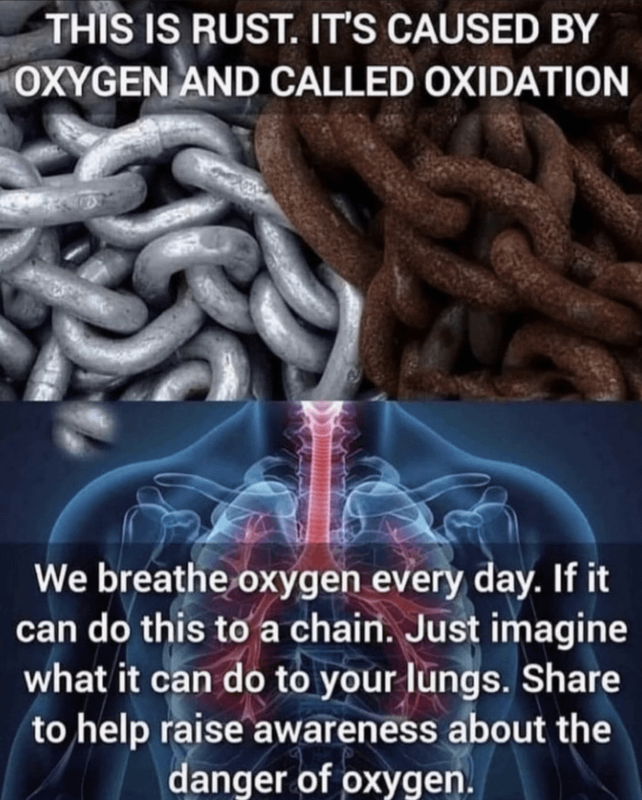

Anyone else stopped breathing here?
Ever breathe oxygen, son?
Good, don’t start. Me, I’m hooked!-Muddy Mudskipper


There are quite a few sci-fi stories and short stories built on a similar concept. One of my favorites is an alien ship lands on a random farm in the US and (leaving a lot of details out, read the book!) it comes to light that the aliens normally live at insanely hot temperatures like 900F (480C) and consider Earth an “Ice World” (that’s also the name of the book). Anyway, one of the catches in the book is that farmer figures out the alien wants to trade (again skipping a lot of details) but all he has on him that he can give up is a cigarette (the farmer doesn’t know it’s super hot inside the ship). He does the trade and we later find out that most of the galaxy is INSANELY vulnerable to being 100% completely utterly addicted to nicotine. When the alien took in the cigarette it instantly vaporized and sent the nicotine into the air and they breathed it and became instantly addicted worse than any opiod addiction IRL.
You didn’t mention the book name, so how are we to read it?
Unrelated but the bottom navbar in that screenshot makes me long for the Alien Blue days of Reddit. I also just miss that iOS design (along with the OS X Mavericks design)
On the topic, as oxidation is a pretty prevalent negative side effect of living, our body has multiple mechanisms to deal with it, no? So my question is: where do the “antioxidants” that we can eat come into the picture here? Are they like preventing oxidation from even occurring, or are they like the shields that our cells use to protect themselves from oxidative stress, or what have you?
we have enzymes to prevent oxygen radicals from forming. such as Superoxide dismutase, which is present in nearly every cell in our body, and we have 3 different version. most oxygen dependant organisms have similar enzymes.
another fun fact, our immune system can produce the same superoxide as a defense against bacterial infections, reactive oxygen species including radical oxygen. but bacteria can produce the enzyme to neutralize that too.
i think the dietary source, is somewhat alittle homeopathic/ pseudosciency, because our stomach acid would probably neutralize any beneficial effect before we can absorb it. of course there are some foods that provide nutrional benefit to certain cells(if they a chemical compound). but they dont have like anti-oxidant effect of something like superoxide dismutase. also because of this effect, people with chronic illness as a result of the dysfunction.
Cell mechanisms cause oxidative stress in the body which can lead to inflammation and faster aging. Antioxidants provide the body with an easy way to neutralise the bi-products.
I actually thought about this a few years ago, is it possible that we age because of oxidation to some degree? Is there a way to prevent that? I thought about it, how blood can rust and just had the connecting thought but I’m not smart enough to know if there’s any actual correlation.
I’m no expert but I’m fairly sure that is basically true in a way. As per zr0’s top-level comment. Forms of life that can make do with less cellular respiration, for example by using external sources to regulate temperature (cold- blooded), don’t need to invite as much oxygen into their cells, and so they get less weird damage over time. Mammals in general have not adopted this strategy.
Pretty sure oxidation plays a major role in aging, but can’t tell you the exact mechanism, I have no idea about it.
But about the blood rust idea, I don’t think that can work, cause we don’t have just iron particles that can directly interact with oxygen just floating around in our blood, we have a complex (I.e. hemoglobin) that contains significant amounts of iron, which somehow makes it really good for binding to and carrying oxygen.
Deviating a bit, carbon monoxide poisoning is really akin to suffcation iirc, cause it binds and occupies the hemoglobin, effectively reducing the amount of oxygen that can be carried by your blood.
However, do fact check me, I might be wrong about something…
Edit: BTW, it seems that “oxidation” might not be the right term to use here, so do understand that I am referring to free radicals here.
You’re pretty much right about everything. Oxygen (especially as free radicals) is damaging to pretty much all your tissues, so your body moves it around in little bodyguard proteins (hemoglobin). These each contain 4 small iron molecules as part of the much bigger structure and doesn’t rust or function like iron in any way. The iron is mostly used for electrons (and also damages your body if it’s not inside the hemoglobin and causes more aging)
Carbon dioxide has a higher affinity for hemoglobin than oxygen, so it sticks to your blood cells and makes them useless for hours. Super dangerous.
Point being “oxidative stress” is bad for you and a major cause of aging that your body tries to fight. If your body doesn’t fix this well, you age faster. If it repairs damage too well, you’re more prone to cancer. Just wear and tear of using your body.
So to the original question of can this process be stopped… Absolutely! Hold your breath - the oxygen will stop coursing through your body and you will stop aging. Just ten minutes is enough to end aging indefinitely! Then you have to worry about other problems like body decomposition, but the oxidative stress will be cured!
Carbon monoxide, not dioxide.
Oxidation is the loss of electrons, whereas reduction is the gain of electrons. The mnemonic is OIL RIG: Oxidation Is Loss, Reduction Is Gain.
Oxygen is highly electronegative (second only to fluorine), meaning that it will strongly pull electrons. So, oxygen is good at oxidizing things. It’s good at stealing their electrons.
The reason that oxygen is so important inf your body for respiration is because of its high electronegativity. It is used as the final electron acceptor in a chain of chemical reactions that are used to convert high energy molecules that you’ve eaten into different high energy molecules that your body can use.
Think of the analogy of a staircase and a ball. The ball is an electron and the stairs are energy states of different molecules along the metabolic pathway. As the ball goes down the stairs, the electron loses energy (which is usually converted to ATP or NADH). At the bottom of the stairs is oxygen, once the electron gets there, it doesn’t have anymore potential energy to lose, unless maybe you have some fluorine around.
An oxygen missing an electron (an oxygen radical) is highly reactive. It’ll just steal an electron from whatever molecule is nearby. That may be DNA or any other molecule that you’d rather keep intact. Antioxidants are helpful as electron donors, neutralizing radicals before they do damage.
This is my understanding, at least. It’s been a while since I took chemistry.
antioxidants are our internal sacrificial anodes?
Ok, I’m going to make a new nutritional supplement: “oops! all electrons!”
Oxidation is how red blood cells collect oxygen to pass to the rest of the body. In fact it is iron in hemoglobin that “rusts” to collect the oxygen. You would die if your blood didn’t “rust”.
Antioxidants have nothing to do with this.
Thanks, this is an unexpected image and a fun fact for the next party.
The process you’re thinking of is oxygenation, not oxidation. Oxygenation is the binding of oxygen to other molecules, oxidation is the loss of electrons. When the iron in hemoglobin oxidizes (from Fe2+ to Fe3+) it stops binding with oxygen, and if it oxidizes further (to Fe4+) it can start oxidizing other molecules in your body. Your body has enzymes to reduce the iron back to a reactive state, but antioxidants also play a role in reducing oxidized molecules.
It’s actually the opposite. When the oxygen binds to the iron it changes from Fe+2 to Fe+3 so the binding of oxygen to the iron in hemoglobin is an oxidation process. At that point it can’t take more oxygen until it releases it in a reduction reaction.
The term “oxidation” is originally derived from reactions where a substance combines with oxygen but has since been generalized to any reaction where an electron is given up. So “oxidation” is the broader term and “oxygenation” is the specific oxidation reaction that results in binding oxygen.
ooh, then I must have gotten the terms wrong…
What I was thinking were the free radicals that are generated during basically most oxygen related reactions in the body, I thought that was called oxidation (at least, in terms of the body).
So, you know anything about how (or if) antioxidants are used against free radicals?
That actually depends on the type of antioxidant. The body has certain innate antioxidants (e.g. enzymes like catalase) to deal with reactive oxygen species but antioxidants that you get through your diet are also very important in that system (like vitamin c and e to prevent oxidation of cell membranes for example). Also some phytochemicals (like polyphenols) can act as an antioxidant.
To sum up - because I taught this to a kid yesterday - for a period, basically all life photosynthesized and oxygen was toxic to most living things. There were large growths of photosynthetic Cyanobacteria that pumped the air full of oxygen. Living things at the time (like, bacteria and microbes, nowhere near vertebrates) couldn’t handle all the O2 and died.
Iron had been taking in most of the oxygen, but it got all rusted up. There’s beautiful geological evidence of this.

This pic sexy as fuck:

You think that’s bad, wait until you hear about dihydrogen monoxide! It’s in almost everything, even the water you drink and the air you breathe!
Took me some time
Did you know that dihydrogen monoxide kills more people than any other liquid? And yet, the government does nothing to ban it. This deadly liquid could be anywhere, even in your home!
More information about this dangerous chemical: https://dhmo.org/facts.html
if you haven’t heard of air, it’s an invisible blend of gases so addictive, we suffer fatal withdrawal symptoms within minutes of our supply being cut off
You can combat dangerous oxygen with black smoke from burning oil.
Don’t forget, water is only one atom in it’s molecular composition away from rocket fuel
Or an extremely deadly poison. Or an explosive, flammable gas.
It makes my blood run blue just thinking about it
This is why I feed blueberries to my chains
That’s why I chainsmoke constantly, I have to protect my lungs from oxidation.
you train your legs and arms and back, but when i train my lungs im told smoking isnt allowed in the restaurant 🙄
Look at what it did to the Linux kernel too.
Tap for spoiler
Ssshhh. It made it better
OOTL? 🥺👉👈
Rust programming language
Oh, but of course! Please excuse my old brain, and thank you.

Statistically speaking, for humans, breathing oxygen does eventually have a 100% fatality rate.
Did you see what oxygen did to the Hindenburg? I’m not going to let that happen to me. Say no to big oxygen!
Have you ever seen asbestos catch fire? Me neither. So it’s your choice what you’d prefer breathing in.
Delicious fluorine for me please
I’ve been thinking about neon. Imagine breathing out multicolour bright lights!
Have you heard about the dangers of dihydrogenoxide?