

“The new device is built from arrays of resistive random-access memory (RRAM) cells… The team was able to combine the speed of analog computation with the accuracy normally associated with digital processing. Crucially, the chip was manufactured using a commercial production process, meaning it could potentially be mass-produced.”
Article is based on this paper: https://www.nature.com/articles/s41928-025-01477-0
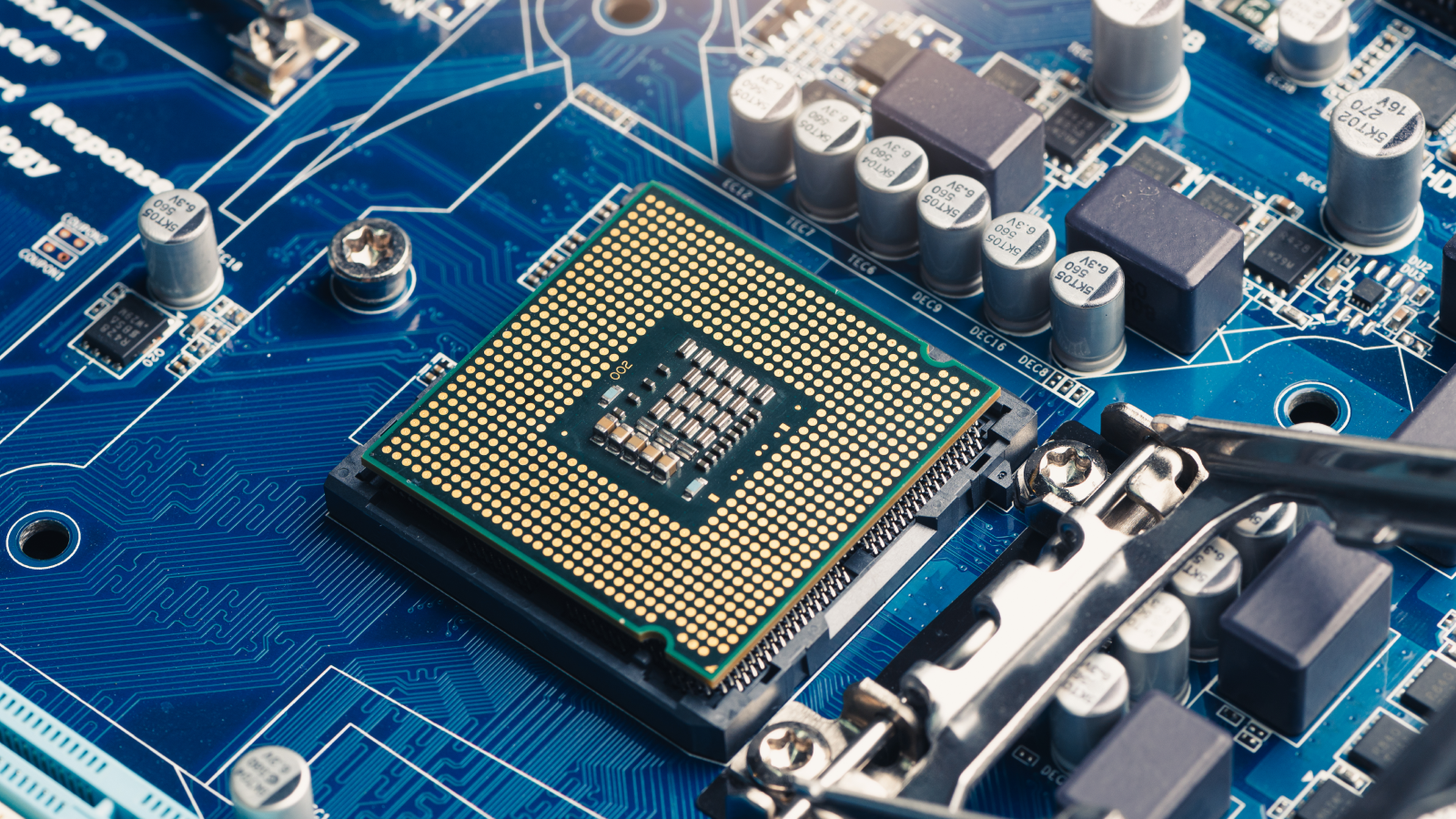
For the love of Christ this thumbnail is triggering, lol
Just push ever so slightly more when you hear the crunching sounds.
Then apply thermal paste generously
Pour a bucket of water over it for liquid cooling
Why? It’s standard socket in SMOBO design (sandwich Motherboard).
The CPU is upside down you dork.
Let me guess, you think The Onion is a real newspaper, right?
I mean, in 2025 it’s basically a preview. It’s gone from to satire to prophecy.
This already a thing, there’s a US lab doing this
Ya but they just deported all the employees, probably
sounds like bullshit.
read the paper
The paper doesn’t even claim they achieved it. They only say it could potentially reach it
The problem is with the clickbait headline (on livescience.com), not the paper itself.
This is not a new line of research in the sense that this is not the only place looking in the mixed analog/digital computers. been articles on it for at least a year I think and when digital was taking over there was a lot of discussion around it being inferior to analog so I bet its been being thrown around to combine the two likely since digital became a thing.
Ahh yeah and we should 1. Believe this exists 2. Believe that china doesnt think technology of this caliber isnt a matter of national security
(x) Doubt.
Same here. I wait to see real life calculations done by such circuits. They won’t be able to e.g. do a simple float addition without losing/mangling a bunch of digits.
But maybe the analog precision is sufficient for AI, which is an imprecise matter from the start.
You don’t need to simulate float addition. You can sum two voltages by just connecting two wires - and that’s real number addition
I know. My point was that this is horribly imprecise, even if their circuits are exceptionally good.
There is a reason why all other chips run digital…
How is it imprecise? It’s the same thing as taking two containers of water and pouring them into a third one. It will contain the sum of the precious two exactly. Or if you use gears to simulate orbits. Rounding errors are a digital thing.
Analog has its own set of issues (e.g. noise, losses, repeatability), but precision is not one of them. Arguably, the main reason digital took over is because it’s programmable and it’s good for general computing. Turing completeness means you can do anything if you throw enough memory and time at it, while analog circuits are purpose-made
Wouldn’t analog be a lot more precise?
Accurate, though, that’s a different story…
No, it wouldn’t. Because you cannot make it reproduceable on that scale.
Normal analog hardware, e.g. audio tops out at about 16 bits of precision. If you go individually tuned and high end and expensive (studio equipment) you get maybe 24 bits. That is eons from the 52 bits mantissa precision of a double float.
Analog audio hardware has no resolution or bit depth. An analog signal (voltage on a wire/trace) is something physical, so its exact value is only limited by the precision of the instrument you’re using to measure it. In a microphone-amp-speaker chain there are no bits, only waves. It’s when you sample it into a digital system that it gains those properties. You have this the wrong way around. Digital audio (sampling of any analog/“real” signal) will always be an approximation of the real thing, by nature, no matter how many bits you throw at it.
The problem is that both the generation as well as the sampling is imprecise. So there are losses at every conversion from the digital to the analog domain. On top of that are the analog losses through the on chip circuits themselves.
All in all this might be sufficient for some LLMs, but they are worthless junk producers anyway, so imprecision does not matter that much.
Not in a completely analog system, because there’s no conversion between the analog and digital domains. Sure, a big advantage of digital is that it’s much much less sensitive to signal degradation.
What you’re referring to as “analog audio hardware” seems to be just digital audio hardware, which will always have analog components because that’s what sound is. But again, amplifiers, microphones, analog mixers, speakers, etc have no bit depth or sampling rate. They have gains, resistances, SNR and power ratings that digital doesn’t have, which of course pose their own challenges
The maximum theoretical precision of an analog computer is limited by the charge of an electron, 10^-19 coulombs. A normal analog computer runs at a few milliamps, for a second max. So a max theoretical precision of 10^16, or 53 bits. This is the same as a double precision (64-bit) float. I believe 80-bit floats are standard in desktop computers.
In practice, just getting a good 24-bit ADC is expensive, and 12-bit or 16-bit ADCs are way more common. Analog computers aren’t solving anything that can’t be done faster by digitally simulating an analog computer.
What does this mean, in practice? In what application does that precision show its benefit? Crazy math?
Every operation your computer does. From displaying images on a screen to securely connecting to your bank.
It’s an interesting advancement and it will be neat if something comes of it down the line. The chances of it having a meaningful product in the next decade is close to zero.
They used to use analog computers to solve differential equations, back when every transistor was expensive (relays and tubes even more so) and clock rates were measured in kilohertz. There’s no practical purpose for them now.
In cases of number theory, and RSA cryptography, you need even more precision. They combine multiple integers together to get 4096-bit precision.
If you’re asking about the 24-bit ADC, I think that’s usually high-end audio recording.
Who is China? Why is it so smart?
West Taiwan. Because The Great Ruling Party said so.
Okay, I’m starting to think this article doesn’t really know what it’s talking about…
For most of modern computing history, however, analog technology has been written off as an impractical alternative to digital processors. This is because analog systems rely on continuous physical signals to process information — for example, a voltage or electric current. These are much more difficult to control precisely than the two stable states (1 and 0) that digital computers have to work with.
1 and 0 are in fact representative of voltages in digital computers. Typically, on a standard IBM PC, you have 3.3V, 5V and 12V, also negative voltages of these levels, and a 0 will be a representation of zero volts while a 1 will be one of those specified voltages. When you look at the actual voltage waveforms, it isn’t really digital but analogue, with a transient wave as the voltage changes from 0 to 1 and vice versa. It’s not really a solid square step, but a slope that passes a pickup or dropoff before reaching the nominal voltage level. So a digital computer is basically the same as how they’re describing an analogue computer.
I’m sure there is something different and novel about this study, but the article doesn’t seem to have a clue what that is.
This is an analog pc: https://en.wikipedia.org/wiki/Analog_computer
https://en.wikipedia.org/wiki/Vacuum-tube_computer
It does seem to be talking about this, analog doesn’t from my understanding use 1 or 0 as a representation. It is true that the cpu uses voltage as you stated, but what differentiates it from analog is that in analog the volatge isn’t represented as 0 or 1 and is used as is in calculations.
They are not programmed, they are physically made to preform the calculation from my understanding, like for example the https://en.wikipedia.org/wiki/Antikythera_mechanism
Normal one and zero transistors can hold their state for a while only needing refresh cycles at intervals.
Seems logical to me that it’s harder to hold values of greater variance, which is probably also why everything works with binary systems, and not a single vendor has chips that use bits with for instance 3 or 4 states.
What would be most obvious if this wasn’t a problem would be to make a decimal based computer. There’s a reason we don’t have that, except by using 4 bits wasting 6 values, which is very wasteful.To be clear though, the two defined states are separated by a voltage gap, so either it is on or off regardless of how on or how off. For example, if the off is 0V and the on is 5V then 4V is neither of those but will be either considered as on. So if it is above thecriticam threshold it is on and therefore represents a 1, otherwise it is a 0.
An analogue computer would be able to use all of the variable voltage range. This means that instead of having a whole bunch of gates working together to represent a number the voltage could be higher or lower. Something that takes 64 bits could be a single voltage. That would mean more processing in the same space and much less actual computation required.
The thing which makes digital chips so much better than analog chips is something both you and the article are missing: noise. A digital chip is very robust against noise, as long as the noise in one step isn’t too big so it causes a bitflip immediately the stable configuration will pull the voltage level back and no information is lost. Not so with analog logic, since the information is continuous every step which introduces noice (which is basically every step) will cause loss of information. Go a few levels of logic deep and all you’ve got left is noise.
Digital systems are built on analog systems, as you observed. A continuous voltage range is reduced to two possible states: high voltage (the upper part of that range) and low voltage (the lower part of that range). Then, we design algorithms that manipulate these high/low voltages that only consider the two possibilities of either being high or low. Since we dont consider what the actual voltages are, just if they are high or low, we are doing digital computing, we are not taking full advantage of the analog potential of the physical objects we are using underneath the sheets.
1000x!
Is this like medical articles about major cancer discoveries?
1000x yes!
yes, except the bullshit cancer discoveries are always in Israel, and the bullshit chip designs are in china.
Yes. Please remember to downvote this post and all others that are based on overblown articles from nobody science blogs.
This was bound to happen. Neural networks are inherently analog processes, simulating them digitally is massively expensive in terms of hardware and power.
Digital domain is good for exact computation, analog is better for approximate computation, as required by neural networks.
You might benefit from watching Hinton’s lecture; much of it details technical reasons why digital is much much better than analog for intelligent systems
BTW that is the opposite of what he set out to prove He says the facts forced him to change his mind
much of it details technical reasons why digital is much much better than analog for intelligent systems
For current LLMs there would be a massive gain in energy efficiency if analogue computing was used. Much of the current energy costs come from stimulating what effectively analogue processing on digital hardware. There’s a lot lost in the conversation, or “emulation” of analogue.
I wish researchers like Hinton would stick to discussing the tech. Anytime he says anything about linguistics or human intelligence he sounds like a CS major smugly raising his hand in Phil 101 to a symphony of collective groans.
I respect Hinton as a computer scientist (with an infinitesimally narrow field of expertise). But the guy is philosophically illiterate.
Thank you for the link, it was very interesting.
Even though analogue neural networks have the drawback that you can’t copy the neuron weights (currently, but tech may evolve to do it), they can still have use cases in lower powered edge devices.
I think we’ll probably end up with hybrid designs, using digital for most parts except the calculations.
For low power neural nets look up “spiking neural networks”
That’s a good point. The model weights could be voltage levels instead of digital representations. Lots of audio tech uses analog for better fidelity.I also read that there’s a startup using particle beams for lithography. Exciting times.
At least one Nobel Laureate has exactly the opposite opinion (see the Hinton lecture above)
what audio tech uses analog for better fidelity?
Vinyl records, analog tube amplifiers, a good pair of speakers 🤌
Honestly though digital compression now is so good it probably sounds the same.
speakers are analog devices by nature.
The other two are used for the distortions they introduce, so quite literally lower fidelity. Whether some people like those distortions is irrelevant.
You want high fidelity: lossless digital audio formats.
Yeah, I get very good sound out of class d amplifiers. They’re cheap; they’re energy efficient, and they usually pack in features for digital formats because it’s easy to do.
That and the way companies have been building AI they have been doing so little to optimize compute to instead try to get the research out faster because that’s what is expected in this bubble. I’m absolutely fully expecting to see future research finding plenty of ways to optimize these major models.
But also R&D has been entirely focused on digital chips I would not be at all surprised if there were performance and/or efficiency gains to be had in certain workloads by shifting to analog circuits
I asked chatgtp to explain the paper - here is what it said - so you don’t have to:
Many computing tasks (especially in things like signal processing, wireless communications, scientific computing, and AI) boil down to solving equations like A x = b (a matrix times a vector equals another vector). Nature +1
Traditionally these are solved in digital computers (with floating-point arithmetic) and for large problems this can be slow and energy-intensive. Nature +1
An alternative is analogue computing where you do operations more directly in hardware (for example using resistive memory devices) rather than converting everything to the digital domain. These can potentially be much faster and more energy-efficient. Nature +1
But analogue computing has historically had a big problem: precision (how accurate the answers are) and scalability (how large a problem you can handle). This paper addresses those issues.
What they did
They used resistive random-access memory (RRAM) chips — specifically memory devices where each cell’s conductance (i.e., how easily it lets current through) acts like a number in a matrix. Nature +1
They built an analogue system that does two key steps:
A low-precision analogue matrix inversion (LP-INV) step.
A high-precision analogue matrix-vector multiplication (HP-MVM) step, using bit-slicing (splitting the number into parts) to boost precision. Nature +1
They also developed a method called “BlockAMC” (Block Analog Matrix Computing) — this partitions a large matrix into blocks so that the analogue method can be scaled to larger sizes. Nature
They built the hardware: RRAM chips in a foundry (40-nm CMOS process) with a 1 transistor-1 resistor (1T1R) configuration, supporting 3-bit multilevel conductance (so eight states). Nature
They experimentally solved a 16×16 real‐valued matrix inversion with ~24-bit fixed-point precision (which is comparable to 32-bit floating point) using their analogue system. Nature
They also demonstrated a real‐world application: detection in a “massive MIMO” wireless-communication system (16×4 and 128×8 antenna setups) using high-order modulation (256-QAM). Their analogue solver matched the performance of a digital processor in two/three cycles. Nature
They measured the speed (the analogue inversion circuit converged in ~120 ns for 4×4) and estimated that their approach could offer ~1000× higher throughput and ~100× better energy efficiency than state-of-the-art digital processors for the same precision. Nature
Why it matters
If you can solve matrix equations much faster and with much less energy, that opens up possibilities for e.g. base stations in wireless networks (where there are many antennas), real-time signal processing, AI training, scientific simulation, etc.
Using analogue hardware like RRAM arrays helps overcome the “von Neumann bottleneck” (the slowdown/energy cost caused by moving data between memory and processor) because the memory is the compute. Nature
The fact that they reached high precision (comparable to digital float32) is important because one of the big criticisms of analogue computing has been that it’s too “noisy/low precision” for serious tasks. This shows you can do it.
The scalability (through their BlockAMC approach) means this isn’t just a toy demonstration of a 2×2; they show up to 16×16 and hint at larger.
Important caveats & challenges
Their currently demonstrated arrays for LP-INV are small (8×8) and scaling to much larger arrays still has engineering challenges (device reliability, wiring resistance, noise, etc.). Nature
The BlockAMC algorithm introduces some overhead when you scale up. The complexity isn’t strictly constant for arbitrary large matrix sizes; there is some cost. Nature
While they show big energy/throughput gains in estimates, real‐world integration (with all peripheries: DACs, ADCs, control logic) will still need refinement.
Applications: They show wireless signal detection (MIMO) which is great, but other domains (scientific computing, general AI) may have different requirements (matrix size, sparsity, conditioning).
The analogue computing world still has to deal with variability, drift, calibration, faults in memory cells, etc. The paper mentions some of these (e.g., stuck-at faults) and how to mitigate them. Nature
In everyday terms
Imagine you have a huge table of numbers (a matrix) and you need to solve for a vector x so that when the matrix multiplies x you get some result b. This is like solving a system of linear equations. Normally, a computer does this step‐by‐step in digital form and it takes time and energy (especially for large tables). What these researchers did is build a physical piece of hardware where the table of numbers is literally encoded in a memory chip (via conductances) and the solving is done via analogue electrical flows. Because electricity flows in parallel and instantly (relative to digital clocked logic), it can be much faster and more efficient. They also built in ways to ensure the answers are very accurate (not just approximate) and to scale up the method to realistic sizes. In short: they brought back some of the old “analogue computing” idea, but using modern memory chips, and showed it can match digital precision while running faster / lower-power.
It was a decent summary, I was replying when you pulled it. Analog has its strengths (the first computers were analog, but electronics was much cruder 70 years ago) and it is def. a better fit for neural nets. Bound to happen.
The article is like 5 paragraphs, not even a single sheet of paper if printed (with the unneeded images and ads excluded of course). Why does it need a summary‽
The summary was for the paper the article was based on. And it was also put it in an easier to understand language.
This comment violates rule 8 of the community. Please get your AI generated garbage out of here.
In that case I’m editing it. I’m sorry for my mistake, I thought it would be useful to a point. That’s why I said it was AI.
No one is reading that.
That’s fine. Just have a good day :)
I appreciate that you wanted to help people even if it didn’t land how you intended. :)
Nice thorough commentary. The LiveScience article did a better job of describing it for people with no background in this stuff.
The original computers were analog. They were fast, but electronics was -so crude- at the time, it had to evolve a lot … and has in the last half-century.
Look, It’s one of those articles again. The bi-monthly “China invents earth-shattering technology breakthrough that we never hear about again.”
“1000x faster?” Learn to lie better. Real technological improvements are almost always incremental, like “10-20% faster, bigger, stronger.” Not 1000 freaking times faster. You lie like a child. Or like Trump.
Here’s a Veritasium video from 3 years ago about an American company making analog chips, explaining why they are so much more efficient in certain tasks. https://youtu.be/GVsUOuSjvcg
It is not an incremental improvement because it’s a radically different approach. This is not like making a new CPU architecture or adding more IPC, it’s doing computation in a whole different way, that is closer to a physical model using springs/gravity/gears/whatever to model something like the Antikythera mechanism or those water-based financial models than any digital computer.
Also, uncritically dismissing anything coming from China as a scam is not being resistant to Chinese propaganda, it’s just falling for the US’.
Yep! It’s a modal difference. Analogous to dismissing SSDs as a replacement for HDDs. HDDs get incrementally better as they improve their density capabilities. SSDs, meanwhile, came along and provided a “1000x” gain in speed. Let me tell folks here: that was MAGICAL. The future had arrived, at tremendous initial cost mind you, but it’s now the mainstream standard.
(Funny thing about HDDs — they’re serving a new niche in modern times. Ultra high densities have unlocked tremendously cheap bulk storage. Need to store an exabyte somewhere? Or need to read some data but don’t mind waiting a couple minutes/hours? SMR drives got ya covered. That’s the backbone of the cloud in 2025 with data storage exploding year over year.)
Because until it hits market, it’s almost meaningless. These journalists do the same shit with drugs in trials or early research.
I agree that before it’s a company selling a product it’s just dreams.
However this is serious research. Skip the journo and open the nature.com link to the scientific article.
For the ones not familiar with nature, it’s a highly regarded scientific magazine. Articles are written by researchers not journalists.
The Nature paper says they’ve done a proof of concept with a few bits, and concluded that they can reproduce it with cutting edge processors. That’s akin to ‘Mice survive cancer longer’ becoming ‘We’ve cured cancer forever’.
They might be right, but I’m not holding my breath.
Oh yeah if this advances fast it may be a product in 5 to 10 years.
AI hype in a nutshell
Analog is literally computing on the fabric of the universe.
You mean like all computers
You are dumb.
You have gotten close to understanding something profound and failed to understand that the thing in your hand also represents that profundity.
Dumby.
Computation is arranging the structure of the universe to reflect itself and something not a mind but a necessary component part thereof. All computing is literally computing on the structure of the universe. A well expressed thought to which you shall reply what? “Dumby” not even a word anyone uses. It’s not merely that you are incapable of expressing an alternative position you are not even capable of calling someone stupid correctly.
Why are you so dumby???
“1000x faster?” Learn to lie better
Analogue computers are indeed capable of doing a task 1000x faster than a regular computer. The difference is they do only that task, in a very specific way, and with one specific type of output. You can 3D print at home an “analogue computer” that can solve calculus equations, it can technically be faster than a CPU, but that’s the only thing it can do, it’s complex, and the output is a drawing on paper.
If you come up with a repeatable and precise set of mechanical movements that are analogous to the problem you want to solve, you can indeed come up with headlines like that.
It can be 1000x faster because it analog. Analog things take very very little time to compute stuff. We don’t generally use them because they are very hard to get the same result twice and updating is also hard
The fun thing is, for LLM you don’t need perfectly repeatable result. It won’t speed up training but running the chips could be significantly cheaper with that kind of tech. Veritasium had a video about it a couple of years back, before the ai craze.
link thanks
" Future Computers Will Be Radically Different (Analog Computing)" - https://www.youtube.com/watch?v=GVsUOuSjvcg
> See article preview image > AI crap CPU > Leaves immediatelyHmm I see.
I did some further research because I didn’t know any CPU that looks like that and this is probably an Intel Core2Duo processor from before 2009 lol
Maybe they’re about to solder it on “dead-bug” style? lol

Which is worse - AI slop, or people decrying everything they see as AI slop, even when it isn’t?
Pdf link for the lazy 💛
This seems like promising technology, but the figures they are providing are almost certainly fiction.
This has all the hallmarks of a team of researchers looking to score an R&D budget.