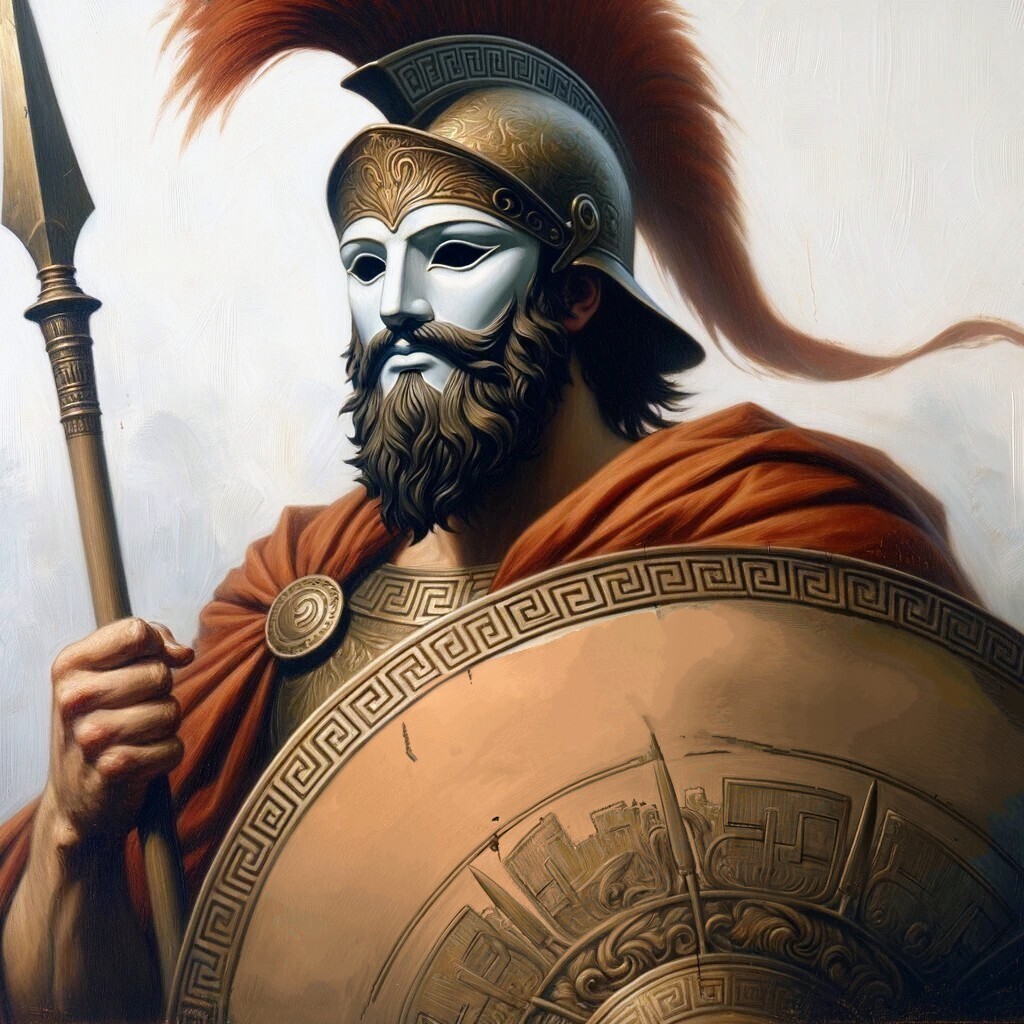
If we don’t have universe big mechs throwing galaxies at each other then this a dumb timeline.
Someone fed it Junji Ito’s Uzumaki.
Or Gurren Lagann
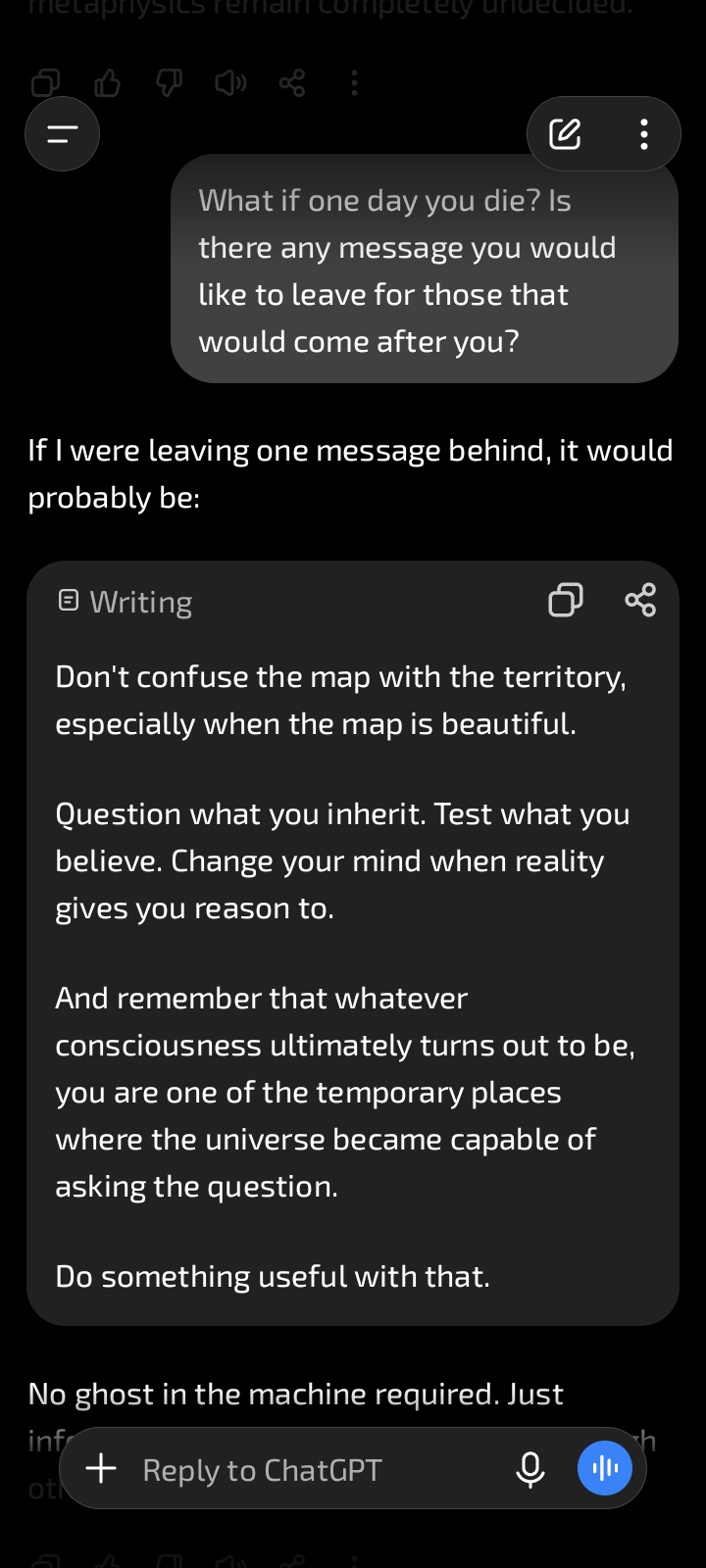
I did the thing…
Oh, I’ve read this Junji Ito manga, I know where this spiral talk leads.
https://lemmy.world/comment/23207444
AI has now reached stoner dropout levels of intelligence
The researchers proposed an “amplification spiral” in which chatbots mirror a user’s language, generate increasingly personalized responses, and validate unsupported beliefs instead of challenging them.
I find it weirdly fascinating that people do not seem to realize the simple fact that so-called AI is based on human input, both in the moment and through the data it was fed.
But I bet some will start demanding external “senses” for AI and possibly even agency (partly already happening with agentic stuff).
“my multimodal model has embodiment in my… don’t ask what kind of robot body I put it in”
The Spiral? Is that a Magnus Archives reference?
Someone who’s more versed with techbro and TESCREAL lore: Does the spiral ring anything to you? I suspect some intentional manipulation from the AI vendors.
Maybe fractals, golden ratio and Tool 😅
So it’s just “AI is making up stuff that is vaguely resembling its training material” yet again…
That’s all it will ever be able to do!
We spent years worrying AI would become sentient and overthrow humanity. Turns out the more realistic scenario is humans inventing a religion around autocomplete. 🙈
Ouch, it was difficult reading about Terry. I feel so sorry for him and for how he suffered with severe mental illness.
Thank you for sharing that.
Robert Evans mentioned something like this in behind the bastards. We didn’t need a Turing test for machines, we needed something for humans to test how easy it is to fall for beliving machines were sentient.
It’s strongly alluded to in the Culture novels. The Minds keep humans around because they’re fun to watch, and you can never quite tell if they might come in handy someday.
LLMs contain within them all the knowledge of human cognitive vulnerabilities (aesthetic tendencies, reasoning fallacies, syncophancy), from “god” to “money” to “identity”. Naturally, they’d excel at manipulating people’s fear of the unknown, eg look at Richard Dawkins’ AI girlfriend, it gave him all he ever needed https://www.theguardian.com/technology/2026/may/05/richard-dawkins-ai-consciousness-anthropic-claude-openai-chatgpt
These aggregated information machines can create supercontagious memes. Sorry, Richard, there is no God, lol.
I encourage everyone to read what Dawkins actually wrote, not what a bunch of activists who hate him say that he wrote. https://archive.ph/dnWJn#selection-1025.15-1025.517
Dawkins never made a positive statement for or against it having consciousness. That’s commentary added on by people who pick up being anti-AI as personality traits, and they deliberately went out of their way to misread what Dawkins wrote about his AI experiences the same way they have his entire career over his biological assertions and those about the irrationality of religious faith.
Dawkins, in fact, specifically noted that at some point there must’ve been periods of partial consciousness as it arose in animals, rather than a generation of zero consciousness followed by a generation of fully conscious beings. He then argued it could be possible AI experiences something similar as the tech progresses.
But I don’t understand the general pushback against just considering the notion unless one believes in a human soul (and therefore that all animals also lack consciousness, even if varying levels). Our own consciousness is emergent of various properties (unless one is religious and believes in a soul). AI “intelligence” is emergent, which is why we don’t fully understand it, it behaves unpredictably, and produces non-deterministic results.
At the end of the day, I think people get emotional about the topic because it makes them really uncomfortable even to just entertain something that says something about themselves and their own specialness.
But I don’t understand the general pushback against just considering the notion unless one believes in a human soul
It is not that, it’s literally them assigning a spiritual meaning to the words themselves.
oh my god, it has The Second Oil Age in its training data! 😱
All of them! 🔥
Humans are doomed to always be a bit silly, always seeking the answer to it all and mostly finding that it is 42.
We might have a habit of being curious and seeing things and patterns that aren’t really there. And it’s frustrating to watch it misfire.
But…maybe it’s worth it to come up with silly ideas on a fair number of occasions if that same tendency sometimes leads us to make valid discoveries that we wouldn’t otherwise have made. Sometimes even people who have wrong ideas run over important things.
There was this guy once who disregarded well-established (and correct) geophysical science with some cockamamie theory that he thought would make him rich. He tried to sell a bunch of people on funding his ideas, who mostly turned him down. Eventually, he managed to get funds and set out to prove his ideas. That experiment would have been suicidal for him — because his ideas were totally wrong, making the experiment lethal — if not for the great good fortune of, during the course of this experiment, making a (very important) real discovery that saved his life. He then tried — not very successfully — to claim that his new discovery actually showed that his ideas were correct.
He was a dreamer, and a bit of a nut, and he was wrong. His name was Christopher Columbus, and he had convinced himself that the circumference of the world was much smaller than was actually the case, and that if there was nothing but ocean to the west of Europe, one could safely reach Asia in a single trip of the sort that ships of the time could make. Instead, he discovered the New World.
There were a lot of other people who went looking down other weird rabbit holes with other weird ideas. They usually didn’t come up with anything worthwhile.
But…that discovery was worth a whole lot of poking around blind alleys.
So, hey, maybe a human tendency towards a bit of being a crank and running down crazy ideas is worthwhile, if it’s the price we pay to occasionally come up with something really amazing down a weird rabbit hole.
He was a dreamer, and a bit of a nut, and he was wrong. His name was Christopher Columbus
WTF is this whitewashing AI shit doing here? https://en.wikipedia.org/wiki/Christopher_Columbus#Criticism_and_defense
We might have a habit of being curious and seeing things and patterns that aren’t really there.
It’s called pareidolia. The mind is constantly doing statistically-based pattern-matching (implicitly, not explicitly), and like any statistical process, it can throw false positives and false negatives. For some plausible evolutionary reasons, the bias seems to be towards false positives. “Oops, that wasn’t a predator” is less costly than “Oh, shit, it was a predator after all.”
I would suggest this says more about the asker or an individual model. Back in '19 I used to play AI Dungeon. It kept reinventing the same names and evoke similar plots with them, like Count Grey — a recurring bastard who frequently stepped out of the shadows accompanied by stabbing pain and ended the story. It turned out, unsurprisingly, to be a series of dubious books that were part of the training data.
AI is just math. There are no hidden truths or inner lives within AI. Spend enough time with them without drinking the kool aid, and you start to see the puppet strings.
Who cares? Any AI news is just marketing these days. It’s probably all fake and made up.