
ETA: summary…
Author describes how agentic coding tools have disincentivized the developer training and mentorship pipeline that the software industry has implicitly relied on to produce seasoned developers, predicting that once the shortage is fully realized it could take years to reverse.
The solution proposed is for managers and senior developers to get ahead of this shortage by foregoing the immediate yet shortlived productivity maximization offered by the agent-multiplied-senior structure in favor of longterm sustainability by deliberately facilitating experience fan-out to juniors.
The methodology proposed is based on a successful nuclear engineering apprenticeship program carried out on active service naval submarines.
This is probably a bad thing, but I can live with general programming skills becoming the new COBOL programming skills.
40 + year greybeard here. I never touch AI. When I am told I must use it, I say No. When I am told my use will be measured and part of my yearly review, I say ‘record 0 usage now’
I am the only senior left with 20 snot nosed kids using AI to code, create IaaS scripts.
I can say No to AI because the company cannot have me quit…
Staying in tech today is soil crushing. Me and my fellow techs would get excited about trying stuff, experimenting with new software, ooohing and aaahing because someone got a fancy keyboard…
Now everything sucks.
Can you sabotage the access to their tools, like with an DNS block or whatever would be feasible. And then suddenly have a very serious groundshaking issue come up that needs immediate attention. Something along this line. Just to see what’s going to happen. Not to give you bad ideas, just being a little creative.
Maybe your juniors just don’t give the same amount of fucks about working for some big faceless corp who doesn’t give a shit about them (20 juniors eh? Sounds pretty big), and no promise of a better future.
When can they come for the business side?
If agents are good enough to operate as “drones” and tools for senior devs, it seems like they could automate/clean up the dysfunction I see over deciding what software should be made, and the complications on that end.
For example, instead of long meetings on the minutia of features, maybe agents could communicate amongst themselves, with structured access to company documentation, and present distilled recommendations for humans to review?
…Or maybe I’m rambling.
I’m a senior software engineer (~20 years of experience) and job-hunting right now is killing me. Most want AI prompt experience of which I have zero. I don’t use coding agents. I’m also in deep rural Japan and most jobs here are killing remote (which is why I need to find one). I have citizenship in Canada and the US and remote jobs there aren’t interested for both time zone reasons and logistical ones (such as needing to use an EOR or similar which is cost, even though I go lower on my salary requirements). I’ve also mostly been doing golang for the last 6ish years which is not the most sought-after, and haven’t touched any modern UI framework. I’ve even decided I’m OK with basically giving up on the life I built in Japan (where I planned to retire) and applied for jobs in EEA countries to no avail since no one wants to do visa support at least in my target country. Shit is awful right now.
So their “solution” is for senior developers to keep giving work to junior developers… In order to prevent senior developer salaries from skyrocketing.
…the same junior developers that management and the investor class have stopped hiring.
Most seniors I know like mentoring newer engineers and would happily have more juniors on the team, but we don’t get to make hiring decisions. I don’t like that we have a glut of unemployed/underemployed new college grads and I feel bad for them, but I do not remotely care that management may have to pay me more than they’d like in 5 years because they decided they didn’t need a junior pipeline anymore. Play stupid games, win stupid prizes.
likely they are going to rely more on you or hire a smaller amount of senior devs, so they can avoid paying for junior or even entry level for fresh employees in the future.
Newly graduated computer engineer here. I find this whole thing extremely depressing. Rant incoming.
Look at this passage from the article:
There’s a terrific writeup from the folks at FlintAI — their team is now 5 devs and 45 agents, all living in Slack. Nine agents per developer. The agents take roles — triage, deploy, review — the human steps in for the two decisions that actually matter (code review, release approval), and they report something like a 3x productivity bump.
I’m not sure what I imagined software engineers did before I graduated, but it wasn’t this. It is so soul crushing that even if I could get hired and accumulate experience to be a senior, the role I would have is to clean after LLMs. I like software development. I want to do the thing I studied to do.
It makes me wonder how these 5 senior engineers came to found a company that works like that. Do they not like writing the code? Do they have dreams of being rich? Do they believe the product they will produce is so essential that the process doesn’t matter?
Looking at their company (FlintAI), it makes a CRM with an integrated chatbot. The first result that came up when I searched FlintAI was another website named FlintK12 that makes an education oriented chatbot platform for teachers and students.
90% of software development jobs I see are for companies like these. Business gobbledygook software equivalent to the other 9999 business gobbledygook softwares. Job replacer 4000. Ai bot to do things that traditional software already do. Sell your knowledge to our ai bot. Help us steal information for our ai bot. Smart camera. Missile guidance system.
They all add 0 or negative value to the society, or that’s what it looks like to my baby brain.
Then there’s the obvious problem with the author’s proposal: Senior engineers aren’t something companies can sell. If they get rarer and more valuable, that value would be captured by the engineer. Which means the value of the experience that a Juinor earns from a job is also higher. So the value the Juinor provides to the company has decreased while the value they receive from the company increased. The only way I see this ending is Juinor wages plummeting and turning into unpaid internships or paid (the other way) ‘educational programs’.
i think they like other stems,. like biotech has done rely more on the senior level/scientists, of course they hire less of them, and not hire any, or barely any of the entry or junior level employees. so its a law of diminishing returns for a employer since they are mostly holding onto more “experience” employees.
Yeah part of why I posted it here was to avoid causing juniors unnecessary anxiety. It’s ultimately seniors who will need to have a plan in place to prevent this. And to be clear no senior worth their stripes wants this, because yes it would be soul sucking.
What would be the point? We’re already solving solved problems and reproducing known design patterns for someone else’s product. Money problems are solved pretty early in a developer’s career, so for most that motivation has diminishing returns. Meaningful work is harder to come by where the air gets thin, and developing people is where many of the best developers rediscover it. They won’t just give that up and spend every workday managing bots for nesting yacht riches.
Also new tools are just tools. Anyone who thinks they can replace human judgement needs to read more. Stakeholders will prioritize short-term profits because they’re free to be greedy shortsighted fools, but engineers who are any good at their jobs don’t have that luxury. They look ahead. They have a bench. Because that’s the job.
So i wouldn’t worry about this too much. If you want a takeaway from articles like this, something to give you an edge, maybe check out the new tools. Learn how to run them on basic local machines, how to train them, and understand what they can and (more importantly) can’t do. Even if it’s just to prove to yourself why they could never replace you.
Developer of over 20 years. Yeah job offers haven’t really changed last 5-6 years. Boom bust. They need us.
Definitely has some opus smell in several places. Then again, people who use specific model families at work seem to get infected by their lexical patterns. Not a fan.
Yeah your probably right. Its the:
X, not Y verbiage.
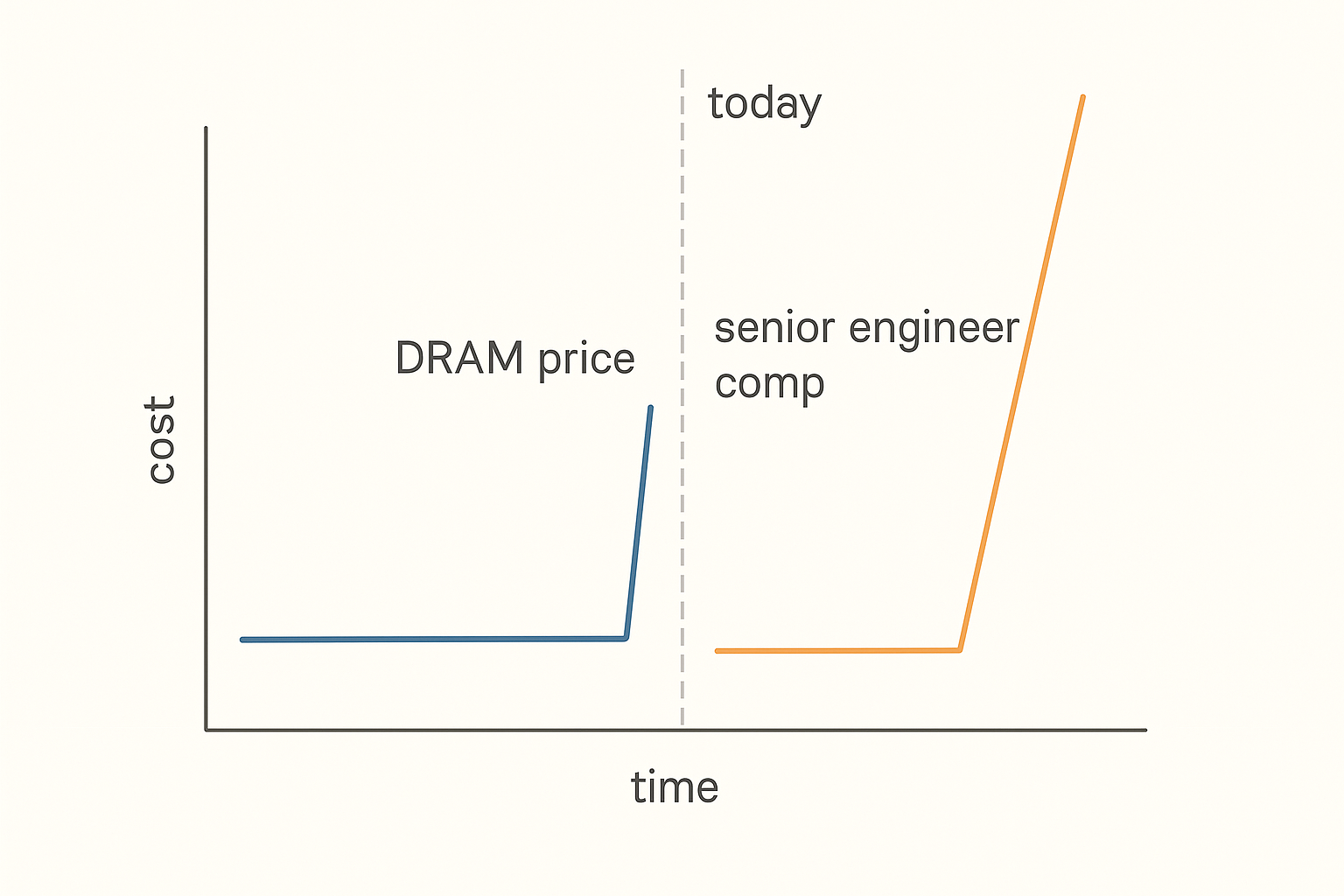
Hopefully my salary skyrockets to match the current RAM bullshit pricing…
My employer: best we can do is 3% raise.
Me: best I can do is quiet quitting. Enjoy
They don’t want to pay for engineer premium so they get basic or plus levels of efforts.
they dont want to hire more new to the field, because that would be more payroll they had to payout.
A good article, and a great point. At the place I was recently laid off from, even the “juniors” were skipping the basics to go right to running with scissors. My team asked me daily how the things they were working on actually worked with the rest of the system, but apparently they’ll be fine.
And that mistake is even more shortsighted than the systemic failure condition the author focuses on (retaining only seniors and replacing juniors with AI).
Firing your seniors instead also cripples the growth of juniors but, as a bonus, guarantees proliferation of technical debt that tends to scale exponentially with the project. And that’s all before the compounding factor of reliance on coding agents.
Sounds like your former employer insists on learning the hard way. While I’m glad you got out ahead of the shitstorm, I do feel bad for your juniors.
Articles about this looming problem aren’t new, but this one stood out to me for the author’s diligence in
- projecting the scope of the problem at scale convincingly without resorting to hyperbole,
- demonstrating the problem-solution framing engineering leads will inevitably need in order to convince clients and stakeholders (i.e., via market anticipation/contingencies/scalability rather than true yet unpersuasive appeals to the common good), and
- actually proposing a grounded methodology, with concrete reporting and workflow examples, toward rebuilding and maintaining the endangered training and mentorship pipelines in the context of agentic development instead of just pressing a hardliner easybutton before acknowledging its impossibility and declaring the illness terminal.
I’m particularly interested to hear critique of the author’s apprenticeship model, where it might fail, how it might be improved, etc.
Full disclosure, I’m not a senior developer, but a senior elsewhere in IT facing this exact same situation.
Like the author, I’ve also identified our cannibalism of our juniors with the obvious future consequences to this if continued unabated. I’ve struggled with how to combat this, and I really give the author lots of credit for producing actual actionable plans on a path forward.
The main failure mode I see for the proposal is organizational self interest. Investing in juniors made sense in the past because the junior work (grunt work) was needed completion anyway so the exercise of training produced a useful result while also freeing up cycles for seniors to engage in higher level work. The result is that the training of the junior became partially subsidized by their output. Today that isn’t really the case. A senior with an agentic workflow can likely produce the same result as the junior with only a rounding error of effort. This shifts the organizational incentive model significantly to the point were training the junior is purely a cost sink with only a negligible return to the organization.
The author points out properly that systemically across the industry cannibalizing juniors eventually means cannibalizing future seniors, but wrongly assumes that training juniors inside the organization means producing seniors long term in the organization. Unless the entire industry adopts the new system to train juniors there will be organizations that simply poach juniors that have been trained up. Money is fungible. If it takes money to train the junior an org could take those same dollars and offer relatively obscene salaries to trained juniors.
From my view, seems like it will always be more expensive to train than to hire those trained. What am I missing here? How can an org that trains up its juniors (using the author’s good suggestions on how) guarantee they keep their trained juniors (or at least retain enough to make the whole exercise worth it)?
How do you keep people? Same as always: treat them well, pay them fairly, don’t be a dick. It’s quite easy actually. Of course, if you can only think short term, that sounds like a waste of money, but long-term, it’ll pay off.
And when I say “you” I mean the generic you, not you specifically.
Basically. Making employee retention a priority pays off. Getting new people spooled up is expensive. Team productivity dips while the newbie gets their bearings. Keeping the knowledge around.
Although, another problem would be people sticking around which would block Jrs from moving up.
Same as always: treat them well, pay them fairly, don’t be a dick. It’s quite easy actually.
How about a hypothetical:
Take your current paycheck amount, now multiply it by 10. That’s the pay offer from the other probably dickish company. If you last even just 1 year at dickish employer, you can take the next nine years off and still be ahead financially. If you last 2 years, you may be financially set and done working for the rest of your life.
Would you stay at your current employer?
I’ve kind of done this hypothetical in real life. My quality of life is better than my friends who took this offer.
Perhaps the specifics of your example are different. Your quality of life still going to work everyday is better than your friends who retired comfortably 20 years early? If not these specifics, what were the ones you and your friends had in front of you?