You must log in or # to comment.
“Violence is not the answer” says country that won its place in the world through violence.
The USA would still be a colony of Britain if it wasn’t for a violent revolution.
The USA would still be a native american land if millions of people had not been wiped out by Europeans
The Native Americans would have been much better off if they had simply strangled Columbus and all his crew the moment they made landfall…
I get the humor in what you say, but it’s worth noting that the Native American civilizations were collapsing due to disease brought by earlier European visitors by the time Columbus set sail.
Granted, history probably would’ve been largely the same if Columbus’ expeditions were unsuccessful, given the English, French, Dutch and Spanish appetites for empire building
There’s a saga that is about “what if Columbus arrived to America but never got back to Europe?”. It’s “the tale of the feathered serpent”.
That sounds super neat. When I google it I find these books amongst other more confused seeming results. Is that the right ones or is it something else?
Yeah, I found the same books, and they don’t seem like the right one.
You can say that about almost everywhere white explores showed up
And it’s true!
No it wouldn’t
The historical record says that if violence isn’t working, you’re just not using enough of it.
The people saying “Violence isn’t the answer” are the people who don’t want to see anything change
Allow me an argument by Doctor Who: https://www.youtube.com/watch?v=BJP9o4BEziI
You can use violence, but when does it end, and what makes you think you are going to end up better off?
The doctor was against violence as a principle but he famously uses tons of violence (I guess in the form of trickery) but as a last resort.
House: “fear me, I’ve killed hundreds of time lords”
The Doctor: “fear me, I’ve killed all of them”
You can use words, but when does it end, and what makes you think you are going to end up better off?
Violence ends when non-violent reforms are able to succeed. The real value of violence is that it makes the non-violent option palatable to the political center.
The problem here is that the war already started but just one side is really fighting it.
I would be in favour of not starting it too, but it’s too late now.
Pacifism is only good for aggressors and cowards
Non-violence != Pacifism
A person can be an advocate for non-violence and not be a pacifist. No need to conflate the two, particularly when people have so much hate and vitriol for any perceived pacifism.
Arguably, accepting the necessity of occasional violent protest is more reasonable than giving up pacifism.
A notable uptick in web queries for “guillotine for sale” is not a DDoS.
just a good ol fashioned foreshadowin’
Peaceful protests were meant to be a compromise to warn that something worse was coming. Black Panthers. Weather Underground. IRA and Sinn Fein.
Effective peaceful movements had potentially violent components. The more radical elements disappeared and peaceful protests became useless.
Unions were a compromise. Before unions, you’d drag the factory owner into his front lawn and exact justice.
I think this guy hit the nail in the head.
Peaceful protest only works if politicians and financial elite has fear and/or respect towards the commond man/woman. Too much elitisms strips away the respect, too many years of peaceful protests takes away the fear. Sometimes ivory towers need to come down, but violence has a tendency to spread and spiral out of control. It’s a balance trick.
Nelson Mandela was released on the terms that he would preach peaceful protest, as the movement he had formerly been leading was a serious threat to the South African Government.
Reverend Martin Luther King Jr was a proponent of peaceful protest, though it could be argued he was losing faith in it near the end when he was assassinated. right after his death, the Holy Week Uprisings occurred, which saw immediate action from the federal government to pass the Civil Rights Act.
At the same time, acts of violence lie on a spectrum, and I think there is a fair amount of conversation to be had about what degree of violence and what type of violence are most effective.
Martin Luther King Jr was able to succeed with his peaceful protests because the threat of Malcolm X was looming directly over his shoulder. One requires the other. Either of them alone would not have made nearly the progress they did.
Ghandi was partly successful because of the British governments violence towards thier peaceful protests.
MLK was only successful because Malcom X was the alternative, and the powers that be knew it.
Yea only under the threat of violence has power ever changed hands. You need both peaceful and violent components to any movement to make any change last though.
Also: we’ve got where we are under threat of violence. Charlottesville and Jan 6 in the USA, the recent gammon riots in the UK, everything Putin does, etc, etc. The Authoritarians have weaponised both peace and violence against us.
Violence is the question? Right?
There’s a lot of evidence that says that non-violent resistance is more often effective, and when it is effective it’s more effective, than violent-based resistance.
Can’t grab the source info link at the moment, but this video talks about it.
Edit:
https://cup.columbia.edu/book/why-civil-resistance-works/9780231156820
https://www.nonviolent-conflict.org/about/civil-resistance/
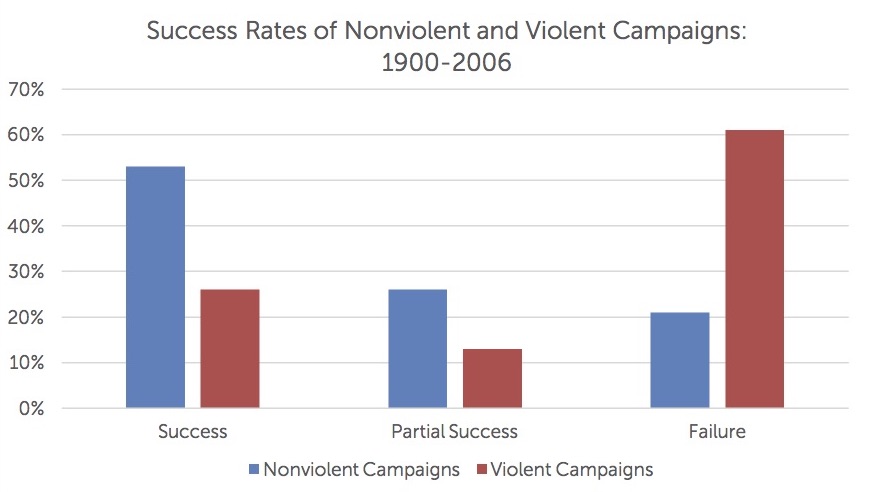
non-violent resistance is more often effective
It’s only ever effective when a credible violent alternative is present.
No oppressed person in history has ever gotten their rights by appealing to the better nature of their oppressor.
Civil rights weren’t won when black people asked politely and just moving everyone’s hearts at how unjustly they were being treated, when MLK died, he had a 75% disapproval rating. Civil rights were won through repeated demonstrations of power and showing what would happen if their demands weren’t met.
You’re jumping the gun and assuming a lot.
Please read more about what I am talking about before assuming what I am saying.
https://www.nonviolent-conflict.org/about/civil-resistance/
Wait, are you using multiple accounts to support your argument? The OP comment is under a different username but you just responded to that person as if you made that initial content presenting the data.
And reminder that Lemmy shows edit history.
Are you talking about enkers’s comment? I saw their response, which was clearly meant for me and responded. Then they deleted that comment and moved it to where they intended to put it, so I did the same.
No, the op comment presenting the data. The username just changed right now to match yours.
I’m very confused about what you’re claiming. Are you saying I somehow edited a comment’s user?
Regardless, I’m not using multiple accounts to… argue with myself?
If a comment author changed username, I would be dubious of the platform you’re using to view this thread. Could be an issue with an app you’re using.
Yeah, sorry 'bout that; that was my bad. I didn’t mention it since you figured out my intent. Looks like me moving my comment might have led to some confused lemmings, though.
I couldn’t get past the 4th example of “non-violence” without laughing at how wildly revisionist they are. While each of these had non-violent components, none of them would have succeeded without violence. The housing rights act wasn’t passed until literally every city was on fire.
The British gave up their occupation of India after a decades-long nonviolent struggle by the Indian population led by Mohandas Gandhi.
The Danes, Norwegians and other peoples in Europe used civil resistance against Nazi invasion during World War II, raising the costs to Germany of its occupation of these nations, helping to strengthen the spirit and cohesion of their people, and saving the lives of thousands of Jews in Berlin to Copenhagen to Paris and elsewhere.
Labor movements around the world have consistently used tactics of civil resistance to win concessions for workers throughout the twentieth and twenty-first centuries.
African Americans used civil resistance in their struggle to dissolve segregation in the United States in the 1950s and 1960s.
Civil resistance against Nazi invasion
I’m sure the 2.7 million tonnes of bombs being dropped on them didn’t exactly tip that scale much…
I couldn’t get past the 4th example of “non-violence” without laughing at how wildly revisionist they are. While each of these had non-violent components, none of them would have succeeded without violence.
I believe the violent aspects of these resistances are considered and included in the overall analysis in the book I linked.
I think you may be jumping to conclusions when you see something that doesn’t immediately fall into your own views. Those examples are clearly a simplified and truncated set to quickly get the point across for the purpose of an “About Us” page while there is lots of in-depth information available throughout the site.
If you have qualms with their findings or data, you’d be better off taking it up with them instead of me. I don’t purport to be an expert on this subject. I am only relaying that there is plenty of credible research, data, and analysis that shows that non-violent resistance is effective.
Edit
Here you can see how and why the book defines these. The book and its author is a major resource for the website.
https://www.ericachenoweth.com/wp-content/uploads/2019/07/WCRW-Appendix.pdf
1900-2006? This past century has literally been humanity’s most transformative ever, and this chart is just glomming all the data together. We’d need to see trends of how these have changed over time to get a realistic picture.
Well, when you only look at that one image alone and not any of the rest of the information and studies that accompany it, I can see why you’d make that hasty judgement.
Maybe go read more of the vast amounts of information available on it: https://www.nonviolent-conflict.org/about/civil-resistance/
That’s the exact same link I already read. Did you mean to send me something else? There was a link titled “award-winning research” to a $27 book. I wasn’t able to find any further data sources beyond the provided anecdotes. Did I miss something?
(Minor edit for clarity.)
“anecdotes”? Yes, you have clearly missed a lot. There’s lots available and easy to find. I don’t think you need me to hold your hand.
Here’s a full dataset if you want: https://dataverse.harvard.edu/dataset.xhtml?persistentId=doi%3A10.7910%2FDVN%2FMHOXDV
I mean, you literally said:
the rest of the information and studies that accompany it,
(Emphasis mine.)
I only saw only one study referenced, which seems to be a book, not an academic paper.
In any case, I appreciate the data sources. I’ll take a look.
The book itself is based on multiple studies. Here is the first part of the second paragraph for the book’s description:
Combining statistical analysis with case studies of specific countries and territories […]
The website has some other studies referenced and such. It kinda seems that you barely opened either of the links.
Ok, well I don’t have the book, or links to the studies it’s based on, so that’s not particularly helpful.
I throughly scanned the page for data sources and scholarly papers, and also read some of the major concepts and provided examples. I did not see any further studies or data linked in either of the pages you linked to yourself, but if I did miss something, please feel free to point it out.
Once again, thank you for providing the source data you already did. It’s a fairly complicated dataset, so it’ll take some effort to grok.
A few questions for the study:
-
What’s the data source? If they’re just doing news reports and traditional history that can hide a lot of failed non-violent protests. A non violent protest, especially one against the medias interests, is way less likely to show up in the historical record then a violent insurrection. Only the successful movements like the civil rights movement will get mentioned on the non-violent side whereas every insurrection or riot, successful or not, is captured in the historical record.
-
What’s the breakdown by method? It seems they’re including strikes in this which has a very high success rate and high occurrence, so much so it could drown out all the failed protests.
The book’s methodologies: https://www.ericachenoweth.com/wp-content/uploads/2019/07/WCRW-Appendix.pdf
The data set:
https://dataverse.harvard.edu/dataset.xhtml?persistentId=doi%3A10.7910%2FDVN%2FMHOXDV
-
Random, generalizing comment:
The people saying “Violence isn’t the answer” are the people who don’t want to see anything change
50 upvotes. Comment actually based on real data that happens to show that the original premise is actually wrong: 0 upvotes. Why is Lemmy exactly like Reddit? I thought people coming here were a bit more aware of ideologies etc.
The real data you like is arguing the Nazis were more effectively defeated through non violence.
Lemmy is just slower Reddit. Plenty of ideologues here.
Everyone’s an idealogue. Don’t kid yourself, ObjectivityIncarnate.
There is a massive difference between someone who actively fights against their biases and doesn’t let them dictate the conclusions they reach, and is always open to changing those conclusions and their way of thinking as new information comes to their attention, and someone who clings to those biases, and happily ignores anything that may challenge them.
I only define the latter category as “ideologues”. Sure, technically everyone who is sapient has an ideology, but as the definition says:
an adherent of an ideology, especially one who is uncompromising and dogmatic.
I have a feeling you know very well that’s the kind of person I was talking about. And no, not everyone is like that. On Reddit I was once called a “commie” and a “Nazi” on the same day by different people in different subs, lol, both in reaction to being told a fact that contradicted a bias of theirs. Those are the kind of people I’m talking about.
This whole UHC/Luigi thing has really outlined how dangerously toxic Lemmy is. I mean “dangerous” very literally, too. It should not incite the amount of vitriol I have received because I dared to say “I don’t like killing”.
You got flak - rightfully - because you critiziced the claims adjustment while having no sympathy for the victims of legalized mass murder by denial of claims. So don’t play the victim here.
Never did such a thing. Lying should not be necessary to try to make a point.
My Abeka Book history book says God destined America to succeed, so I think you guys might be overreacting.
If brute force doesn’t work, you’re not doing it enough
To quote the onion, violence is never the answer, if you ignore all of human history.
It really isn’t though. It’s always two steps forward three steps back. Anything good that arises out of the destruction, always comes at an immense cost, and usually corrupts the revolutionary leaders who made it happen.
Is there any violent revolution in history for which genuine peace followed in the immediate aftermath?
I think violence is often necessary. But I wouldn’t say it’s ever the right answer.
Maybe look into how we ended up with 8-hour workdays and weekends… Hint: it was not through peaceful, polite negotiations with the ruling class…
Is there any violent revolution in history for which genuine peace followed in the immediate aftermath?
Most of them, depending on your definition of immediate.
A few weeks to months following the rebellion. Maybe a year at most.
It’s different if the rebellion does not itself topple the structures of government. I’m talking about violent coups specifically I suppose, not a bit of violent protesting that motivates an existing government to act.
-
Whenever violence is involved, either both sides are violent, or violence wins.
-
When neither side is violent, violence is not the answer.
-
Now both sides look at #1 and ponder if the other side is ready to be violent.
I think killing people through apathetic business practices that are specifically designed to maximize profit over human life is not just murder, it’s genocide.
I also believe that a justice system that is curtailing law for the wealthy based on some sense of increased personal worth compared to that of a “lowly commoner” goes against the fabric of our nation and is a personal attack against the culture of our country. I also believe that anyone lending support to these traitors are themselves traitorous filth that deserves to be imprisoned in a public gallows to send a message that that behavior will no longer be tolerated.
short answer though, yes violence begets violence.
As many people say, the horror of the Nazis wasn’t just that they killed so many people, but that they industrialized it, turned it into an inhuman factory process like they were mass-producing shoes.
In a similar way we have modern corporations that have brought neo liberal styles to the idea of murder. Instead of the industrial style of the Nazis, this style serves to alienate the murder from the murderer, putting a price tag on deaths and profiting from the lives they’re destroying all veiled by the size of these companies and the corporate double-speak that places all the lives they have control over into their sterile profit-centered game they play.
It’s murder for profit, don’t dilute the term genocide. The last thing we need is people calling everything genocide and making the literal genocide in Gaza seem more normal.
idk, murdering people based on their genetic predisposition to healthy living standards seems more of a literal definition of it.
I do understand (and agree with) your point though.
https://en.wikipedia.org/wiki/Strategy_of_tension
a political policy wherein violent struggle is encouraged rather than suppressed. The purpose is to create a general feeling of insecurity in the population and make people seek security in a strong government.
🤔
-
Predictably, people are arguing if violence can be an answer. But the best rule of thumb is “speak softly, but carry a big stick”. If peaceful demonstration and diplomacy ran its course, then violence is the only path forward. I mean, the abolition of slavery in the United States could never be done by peaceful means (unlike what UK had done) so war was the only way.
There are entire Game Theory textbooks dedicated to grappling with the question of when and how one engages in violence. Because broadly speaking, violence is bad. The destructive social forces inhibit socio-economic development, degrade global quality of life, propagate disease, and cause catastrophic shortfalls of critical goods and services.
Whether you’re working at the micro-scale of domestic abuse or the macro-scale of the bombing of Hiroshima, you’re talking about a gross net negative for everyone involved.
But if a detente is one-sided, or a violent actor is free to act uninhibited, there are huge immediate rewards for looting and pillaging your neighbors, pressing ganging people into forced labor, and seizing neighboring property at gunpoint. It works great for perpetrators who engage in violence unchecked. Its only a problem when the perpetrator runs into a countervailing force.
But then over the long term, the violence takes an increasing toll. People don’t build in neighborhoods that they think will be bombed. They don’t invest in communities that are fracturing and falling apart. They don’t befriend people they feel they can’t trust or work alongside people they’re terrified of.
Go look at Yugoslavia before and after the wars of the 1990s. Huge unified economy capable of operating on par with France or Italy, only to be splintered by violence and reduced to a near-pre-industrial state for over a decade. Who won the Yugoslav Wars? Who benefited from Bosnians and Serbians and Albanians and Croats pounding their plowshares into swords and slaughtering one another?
People talk about a “Peace Dividend” and you can see it in any country that’s avoided a protracted military conflict for a generation or more. You can’t be a successful country if you’re always trying to hold one another at gunpoint.
I really like your comment. Gave me lots to think about. I don’t have much to say in return, other than that, and that your comment is really well written. I don’t find many comments on here that are a pleasure to read; most long ones are incoherent rambling, or canned talking points.
Thanks for providing something for my brain to chew on and making it palatable.
The US is a successful country and has almost always been at war.
Britain at its peak was holding 10s of countries at gunpoint.
Violence works best if you are much much stronger than the other party.
The US is a successful country and has almost always been at war.
The areas of the US that are most successful are those most insulated from social conflict. Areas that are subjected to state violence through overpolicing or are left to flounder in the face of industrial abuse, mafia violence, or unchecked domestic violence do much worse. Comparing Ferguson, MO to neighboring St. Louis illustrates this dynamic. One neighborhood is alternately brutalized by the city police and left exposed to domestic crime, dragging its socio-economic state into the gutter. The other is judiciously policed and socially supported by state and private largess, resulting in a far healthier and happier population.
Britain at its peak was holding 10s of countries at gunpoint.
And those countries suffered immensely. Meanwhile, Britain itself endured pockets of chronic crime and substance abuse specifically in areas that hosted military bases and other enclaves. The country saw an explosion in wealth inequality during its economic peak with the new wealth almost entirely accruing to the aristocracy. Victorian England was a hellhole for the Dickensian proletariat.
Areas that are subjected to state violence through overpolicing
Chicken, egg
Both of those are just chicken, egg
Chicken, egg
The police trace their roots to military officers, cattle rustlers, and plantation overseers.
The conception of police-as-civil-servant intent on discouraging violence rather than initiating it is a relatively new one.
Very wise, you should reincarnate as a 2nd century Chinese warlord
China’s a great example of the Peace Dividend in action. You get a generation or two of peace and the country explodes with riches - both physical infrastructure and flowering culture.
Then warlords start poaching the wealth of the nation and the country plunges down into poverty, famine, and epidemic, immolating decades of social process.
After the burn out, you get a peaceful renaissance, and the country flowers again like a forest after a wildfire.